

Blog Archive:
Beneath Our Feet
Global Worming
Dr. Rüdiger M. Schmelz
71 new species of earthworms and enchytraeids in a Zootax Special Issue in honor of András Zicsi (1928-2015)
Seventy-one new species of earthworms and enchytraeids – small whitish relatives of earthworms – have been uncovered in a Special Issue of the journal Zootaxa (Nº 4496). More than 100 authors have contributed in 40 articles to the 575 pages volume. The species were found in 15 different countries of South America, Africa, and Eurasia. This volume was published to commemorate András Zicsi (1928-2015), the eminent German-Hungarian earthworm taxonomist. It provides a good overview on the current state-of-the-art of earthworm taxonomy, with respect to methods, styles and standards of description, geographical and thematic focus. DNA-sequencess are increasingly used to corroborate or even to establish new species, even though detailed morphological descriptions remain the backbone of earthworm taxonomy.

A highlight of the Zootaxa Special Issue on earthworms: a second marine littoral earthworm species, Pontodrilus longissimus. Up to now only one truly marine littoral species of earthworms had been known, the peregrine Pontodrilus litoralis. The second species was discovered by the specialist and "earthworm species hunter" Samuel James with a short look at the material ("this is a new species"), but it's a long way from discovery to valid description. This work was carried out in the group of Somsak Panha at the Chulalongkorn University of Bangkok. The paper includes a revision of the sister species P. litoralis and a comparison of both species at DNA-level. Left: Three specimens right after fixation. Right: Drawings of taxonomic structures, morphology and anatomy. Bottom: Molecular comparison of the new species with its sister species. From Seesamut et al., Zootaxa 4496, pp. 218-237, with permission of the authors.
Earthworm taxonomy is not an ivory tower discipline. Many species are discovered in areas where people live, work, and sustain their livelihood. Because of their body size they are often known by the locals before science gets hold of them. Farmers are interested in the species that live on their lands. Sustainable agriculture is unthinkable without earthworms. The amount of endemic species with a narrow distribution range—and therefore with risk of extinction due to soil degradation or land use change—is tremendous. So earthworm taxonomy really matters. This volume increases the number of known species by 1%, a small but notable proportion!
The editorial can be downloaded here.
Global diversity of earthworms and enchytraeids (Clitellata): papers in honor of András Zicsi (1928–2015) (ed. Rüdiger M. Schmelz). Zootaxa 4496, 575 pp.; 30 cm. Magnolia Press, Auckland, New Zealand. ISBN 978-1-77670-496-5 (paperback).
ISBN 978-1-77670-497-2 (Online edition). Orders via magnolia@mapress.com.
Dr. Rüdiger M. Schmelz is taxonomist of enchytraeids and Zootaxa subject editor for Oligochaeta.

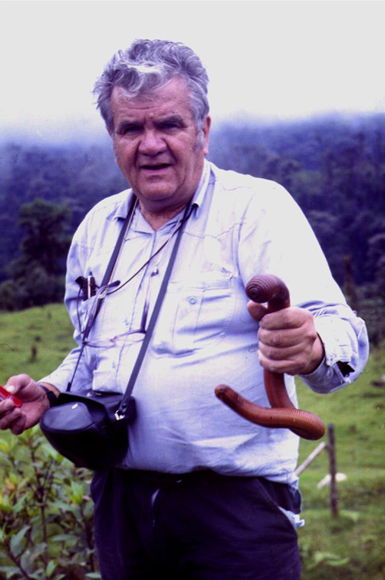
András Zicsi and Martiodrilus ischuros Zicsi, 1990 in Santa Rosa, Prov. Pichincha, Ecuador, April 1990. This deep-burrowing giant earthworm was well-known to the local people; they knew when and where it would crawl up to the surface. András Zicsi (1928-2015) was Hungarian but his mother-tongue was German. He was a researcher in the Soil Zoology Group at the Hungarian Academy of Sciences and gave courses at the Eötvös Loránd University in Budapest. In 137 papers he described 237 new species of earthworms, mostly from Europe and South America; he erected and revised numerous genera, wrote identificatin keys ... His earthworm collection – among the largest worldwide – consists of roughly 100.000 specimens and more than 800 species. His legacy is now continued by one of his students, Csaba Csuzdi, the leading European earthworm taxonomist.
Photo by: Csaba Csuzdi.

What lies beneath: South Africa’s megadiversity of soil biota Part III
By Dr. Charlene Janion-Scheepers & SERG members
This is the final in a three-part blog series highlighting the rich soil biodiversity found in South Africa.

In our previous blog we discussed some key findings of our review on the rich soil biodiversity of South Africa. In this last blog we want to highlight some key conservation priorities, threats to soil biota and some future directions we think are necessary for the advancement of soil biota research in South Africa.
Threats to soil biota in South Africa
Global drivers, such as land degradation, exploitation, pollution, climate change and
biological invasions, are serious threats to South African biodiversity. For many understudied groups even the identification of invasive species are problematic, while the impact of these invasives on the indigenous species are also unknown. Climate change will probably directly and indirectly favour invasive species in all South African ecosystems, thus the identification and assessment of distributions of invasive species should become a research priority for all soil biota groups.
Other threats to soil biota include intensified land-use. The livelihoods of people in South Africa depend in many ways on the continued functioning of the soil ecosystem, thus there is an urgent need for basic biodiversity knowledge in order to facilitate the soil ecosystem research required to assess sustainability.

Conservation
Soil dwelling species are usually classified as Data Deficient in the IUCN red list criteria. This appears to be related to the limited number of soil biota researchers, difficulties in identification, and inherent logistic difficulties in surveying and sampling. Even the most basic IUCN Red List criteria require a reasonable understanding of the taxonomy and distribution of individual species. The results from our review agree with previous findings, that many taxonomic groups of soil biota could not be assessed for conservation status due to a lack of baseline data. However, exceptions do exist, and the recent First Atlas of the Spiders of South Africa provides an excellent model of what is possible. In addition, the inclusion of endemic soil biota in conservation planning should be the next step to ensure soil habitat conservation.
Future research directions
The major issues that need to be addressed were clear: funding needs to be put in place to:
Train taxonomists
Consolidate and curate existing collections for improvement of data storage and management
Capture existing data
Fill gaps identified in this paper, especially focusing on the functional roles of soil biota
Use our existing and growing expertise as a base to tackle a continental deficiency in our understanding of soil ecosystems
Use current taxonomic expertise to facilitate the development of DNA barcode libraries
Sampling areas that have been poorly studied should be a priority for future work, which includes the Nama-Karoo, Northern Cape and Eastern Cape

Fig. 1: A schematic example of an integrative sampling approach.
In South Africa, funding and expertise is required in a coordinated research framework. Successful examples of this approach have been demonstrated for Europe, such as BISQ and EcoFINDERS. The development of an integrative sampling approach to sampling soil communities (Fig. 1) should be initiated in South Africa to place taxonomic knowledge in an ecological context and develop monitoring tools to provide valuable advice for soil health management. Such an overall strategy for South African soil biota research is needed, which recognises that although different research priorities exist for each group, sharing and contrasting experiences will help advance our knowledge across the board. We see the formation of SERG as the first of many steps towards the goal of an integrative approach to soil ecosystem research in South Africa.

What lies beneath: South Africa’s megadiversity of soil biota Part I
By Dr. Charlene Janion-Scheepers, Postdoctoral Research Fellow, Monash University, Australia
This is the first in a three-part blog series highlighting the rich soil biodiversity found in South Africa.

Soils are integral to agricultural productivity, biodiversity and the maintenance of ecosystem services. However, soil ecosystem research depends on foundational biological knowledge that is often missing. In a recent review published in Pedobiologia, we review the current knowledge on the soil biota of South Africa. The paper outlines the literature and sampling methods used to assess soil biota, the available taxonomic expertise and depository of main collections within South Africa, the availability of identification guides and online resources, and the status and distribution of described species.
This review was the result of two workshops held by the Soil Ecosystem Research Group in South Africa (SERG). We are a soil biodiversity research group that provides a platform for linking and promoting research on soil organisms. One of the first priorities identified by SERG was the need to collate and mobilise data and collections such that we can consolidate and compare the state of knowledge of each group. We also identified that foundational work on soil organisms is needed to facilitate research on soil health, as was outlined in our paper The unknown world: Understanding soil health in South Africa.

The first Soil Health Workshop held at the XVII Entomological Society of Southern Africa Congress in Bloemfontein, 6 July 2011.
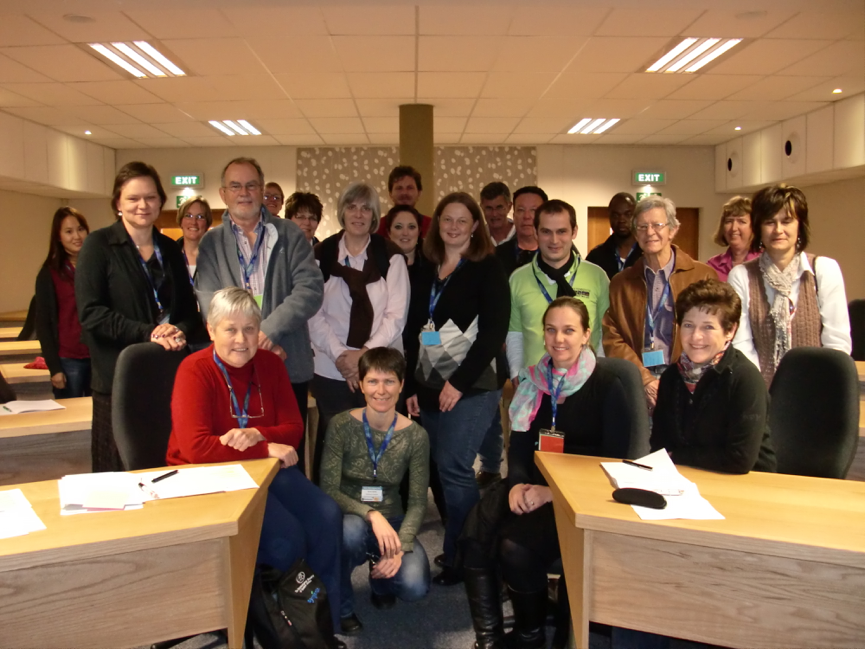
Second workshop of the Soil Ecosystem Research Group held at the XVIII Entomological Society of Southern Africa Congress, 2 July 2013, North West University, Potchefstroom.
In our next blog What lies beneath: South Africa’s megadiversity of soil biota (part II) we will discuss the rich soil biodiversity found in South Africa.