

Blog Archive:
Beneath Our Feet

Biodiversity in a warmer world: lessons from soil nematodes
By Madhav Thakur, postdoctoral researcher, German Centre for Integrative Biodiversity Research (iDIV)

Predatory female nematode Clarkus sp. Image by M. Ciobanu
John Haldane, the famous evolutionary biologist, popularized the immense diversity of beetles by writing: “The creator, if he exists, has an inordinate fondness for beetles”. I wonder if Haldane was aware of nematodes. Nematodes are incredibly diverse and abundant tiny worms living almost everywhere on planet Earth. Some estimates point that we may have a million of nematode species on Earth. I remember Tom Bongers, a world-known nematode taxonomist, in his lectures saying every time one samples a forest soil, s/he is likely to find a new species of nematodes.
At the beginning of my PhD in 2013, I got interested in how on-going climate warming affects biodiversity. At this point, I already was familiar with the free-living nematodes in the soil, and in particular, impressed by their omnipresence in any environment. After the consultations with my PhD supervisor, Prof. Nico Eisenhauer, I decided to investigate whether warmer soil harbours less or more diversity of nematodes. Fortunately, I was offered to investigate nematode diversity in a long-term climate warming experiment in the meadows of Cedar Creek in Minnesota, USA. This climate warming experiment was unique for two reasons: 1) Climate warming was experimentally crossed with plant diversity and, 2) Plant diversity treatments in this experiment were the part of the BigBio experiment, which is one of the oldest biodiversity experiments in the world. Further, I was very excited to work with Prof. David Tilman, who is the principal investigator of this experiment, and well-known for his contributions for our understanding of the causes and consequences of biodiversity.

Aerial view of Biodiversity & Climate experiment. Image by J. Miller
Once I was able to collect nematodes and identify them with the help of colleagues (Dr. Marcel Ciobanu in particular), I started getting back at the warming and biodiversity question. Since we understand biodiversity in many different ways, I calculated many different metrics of biodiversity and see whether I could find any consistent pattern. The most striking and consistent pattern was that warming both increased and decreased nematode diversity. The key was whether the nematodes were from plant monoculture soils or from the soil of diverse plant communities. Warmer plant monocultures were lower in nematode diversity, whereas warmer diverse plant communities were higher in nematode diversity. Although these results were exciting, I did want to explore further. With the help of Dr. Oliver Purschke, I investigated whether warming also structures nematode communities in a given way. Indeed, the results revealed that nematodes were taxonomically more similar than expected in warmer soils independent of plant diversity. So even if warming increased nematode diversity in diverse plant communities, nematode communities become increasingly similar. We published these results recently in Science Advances.
The climate warming and biodiversity question will stay with ecologists for a longer time. Our results do provide some clues by using one of the most diverse and abundant organisms. At this stage, I am even more curious by the question how general are our results. Whether Haldane’s beetles, or our nematodes, biodiversity in a warmer world is very likely to be different than the past and present biodiversity.
Reference
M. P. Thakur, D. Tilman, O. Purschke, M. Ciobanu, J. Cowles, F. Isbell, P. D. Wragg, N. Eisenhauer (2017), Climate warming promotes species diversity, but with greater taxonomic redundancy, in complex environments. Science Advances 3, e1700866. Doi: 10.1126/sciadv.1700866.

Weathering the storms
One of the consequences of current climate warming is that the amount and intensity of extreme weather events is increasing. A rapidly growing number of studies show that these extreme events may have complex and often indirect ecological consequences, however, little is known about the role of soil biodiversity in these processes.
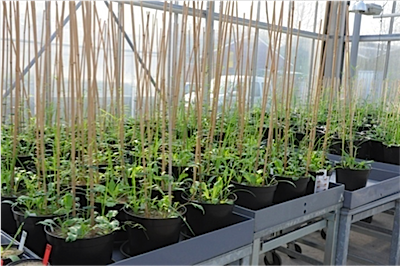
Photo by Annelein Meisner
In a recent paper in PNAS (2013; 110:9835-9838) Annelein Meisner and colleagues show that extreme weather events may tip the balance between native and exotic plant species in vegetation. The researchers dried and wetted soils before planting a mixed vegetation of native and genetically related exotic plant species. Although all soils were re-set to standard moisture conditions before planting, the differences in plant biomass distribution between natives and exotics were striking. In soils that had been dried, exotic plant species became dominant, whereas in control soils, exotics and natives were more in balance. The role of different nutrient availabilities leading to the shifts in plant dominance could be largely ruled out.
In a second experiment, soil samples were inoculated into sterilized soils and planted again with the same plant mixtures as before. Interestingly, most effects could be recalled, suggesting that soil microbes were responsible for the plant responses to the extreme weather events. This study revealed that soil biodiversity might memorize effects of extreme weather events, which may influence plant community composition that was established after the abiotic stress had been taken away.
The study by Meisner and colleagues shows that effects of extreme weather events - due to climate warming - may work out on ecosystems in quite unpredicted ways.
The study also gives rise to some questions.
First, what is the mechanism leading to dominance of the exotic plant species? It is increasingly recognized that feedback interactions between plants and soil properties influence plant community composition. The question now is how these feedback effects are organized. In most studies, plant-soil feedback effects are measured as net effects of all decomposers, pathogens, and symbiotic mutualists. Each of these major groups of soil biota can include hundreds to even thousands of species. The challenge will be to tease apart the contribution of the various groups, as well as the species within these groups in explaining how plant-soil feedback effects may depend on extreme weather events and other environmental conditions. This is a major issue for soil ecologists to study in the near future.
Second, it needs to be analyzed how the effects reported by Meisner and colleagues might work out in the field, where many other influences can affect plant performance, such as aboveground and belowground invertebrates, aboveground vertebrates, resource limitation, as well as other abiotic environmental conditions. Although these issues need more work, a fact is that extreme weather events have been reported to enhance plant invasions. A memorizing effect of the abiotic stress conditions in the soil biodiversity might provide a new explanation for plant invasiveness.
This study on effects of abiotic stress that can be memorized in the soil community is a demonstration of the complex involvement of soil biodiversity in plant community composition and ecosystem functioning.
Still, Pandora´s box does not seem to be fully opened yet. Plant-soil interactions are net effects of myriad interactions of plant roots with the diverse soil community. Some of these interactions can be positive, whereas others are negative. Studies during the past years have elucidated that soil biota can be much more specific in their interactions with plants than has been assumed for long. It is a major challenge in order to further explore soil biodiversity, its specificity, and effects on plant community dynamics.

From Archaeology News Network, credit to Marcel van Oijen