

Blog Archive:
Beneath Our Feet

Marvelous soil present, another adventure in Brussels
By Gerlinde De Deyn
Wageningen University, Dept. Soil Quality

September 2015. Regular readers of this blog will not be surprised that I was in Brussels for the European Union Researchers’ night, this year was very special: the 10th anniversary of researchers’ the night! Not only in Brussels of course, lots to see and do across Europe at this major science outreach event which runs simultaneously in all main cities of the EU http://ec.europa.eu/research/researchersnight/index_en.htm.
For this occasion I was not asked to bring a living soil micro-zoo, just myself and my reflections on what makes science so wonderful for me. The setting: a predominantly French interview by the public from Brussels, with Christophe Deborsu as moderator and Stefaan Vaes (University of Leuven, Dept. of Mathemathics) and me (Flemish soil ecologist who hardly spoke French since leaving Belgium fifteen years ago) as the researchers.
How and at which age did we get inspired to become a scientist? What do we earn and how many hours a week do we work? Why did you move to another country? What impact does your science have on society? What is the current status of biodiversity? How come there are so few female professors? These were just a few of the questions that came a long during the interview. Not always easy to answer, but luckily not due to language - thanks to an eager public and multi-lingual moderator.
Was there any soil ecology involved? Sure there was in this International Year of Soils! We gave a copy of the European Soil Biodiversity Atlas (French or English version) to each person posing a question. Perhaps some of them will get the spark of wonder and turn into soil ecologists… Given the enthusiasm I also promised that a Global Atlas of Soil Biodiversity will come out later this year, something we are all looking forward to of course J.
PS: As with previous events also now great meet scientists you would otherwise never meet, a tip from Stefaan Vaes if you like math and visualizations of it check out this site: http://imaginary.org/
Identifying with soil fauna

This small tube contains all the springtails extracted from one kilogram of soil, in a grassland springtails and mites are the most abundant animals and can be found to be as numerous as 40,000 per m2. The soil as an ecosystem is absolutely bursting with life, in one hectare of productive soil there is the equivalent weight of one cow of bacteria, two sheep of protozoa and four rabbits of soil fauna!
When I started my PhD a few years ago now, I remember my supervisor advising me to spend time at the microscope to get an idea of the soil fauna I would be investigating as part of my experiments, and to start to grasp the diversity and beauty I would be seeing. The microscope had a camera attachment, which meant I could easily photograph unusual or interesting specimens, without too much difficulty or time wasted (although invariably much time was spent trying to obtain the perfect photograph of that individual I’d never seen before!).
Today much of my time is spent promoting “healthy soils” as part of the PROSOIL project (http://www.aber.ac.uk/prosoil/). One of the main aims is to promote soil biodiversity to farmers and the public, most of whom have never considered soil fauna as anything more than “creepy crawlies” that are more likely to be causing problems than increasing plant yields.
All farmers have heard of are wireworms (Agriotes sp.), leatherjackets (Tipulid sp.) or cutworms (Agrotis sp.), however few know about springtails or mites, or just how small and numerous they are. Each year soil organisms can process an amount of organic matter equivalent in weight to 25 tonnes per hectare. Reductions in earthworm abundance for example have been found to diminish water infiltration rates by over 90%!
Seeing is believing they say? When studying organisms that live in an environment often referred to as “a black box”, or opaque, it is difficult to comprehend the effects of predation or optimal foraging theory.
Ideas on feeding preferences become based on proxy measures like enzymes, stable isotopes or gut content analyses. All are useful measures to try and elucidate the soil food web, but none cover all scenarios.
Only 0.25% of the actual soil is alive, however it is one of the most diverse and biologically active ecosystems on the planet, with the biodiversity of soil fauna exceeding the above-ground diversity by several orders of magnitude in many habitats.


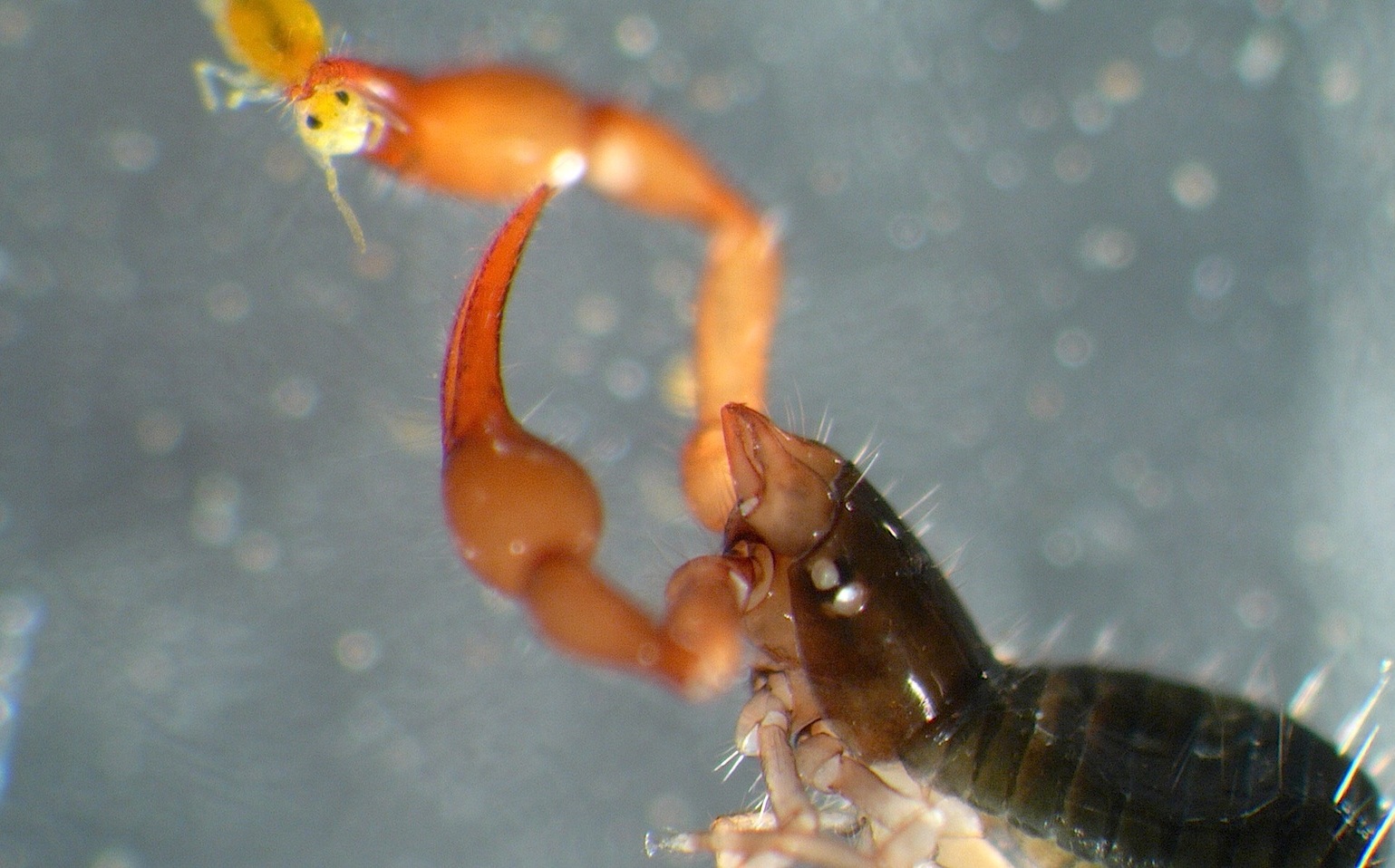

Clockwise from top left:
1) This scanning electron microscope (SEM) image, shows the hypopi (non-feeding / dispersal) stage of an astigmatid mite. Clearly visible on its notogaster (back) are fungal spores, adhering to it. As this is the dispersal stage of the astigmatid mites’ development, the fungal spores are likely to be dispersed with it, to a greater distance than if they had adhered to a different mite.
2) At times photographs can be used to illustrate unusual situations, for example from a pitfall trap, a sminthurid collembolan was found caught in the pincers of a pseudoscorpion, although we know that springtails are prey for these top predators, it is rarely seen.
3) A photograph can be a very good teaching tool, particularly if similar looking specimens are actually different suborders. On the left is an astigmatid mite, whilst on the right is an oribatid mite. The hairiness of the Astig is clearly visible as are the apodemes, in comparison to the Oribatid which has noticeable genital and anal shields, as well as aggenital and adanal shields visible.
4) A photograph illustrating just a tiny portion of the diversity from a soil fauna sample, won first prize in the Agriculture, Food, Diet and Health category in the Biotechnology and Biological Sciences Research Council (BBSRC) science photo competition (February 2010); Featured in Science 327, (2010) p1183 – Random Samples: A World in a Grain.
Unfortunately, due to this immense diversity and opacity, expertise in taxonomy has suffered. There are labs of nematologists, acarologists or microbiologists, but few that try to identify the diversity of taxa to the same level. Teaching soil ecology to students is hampered by these limitations that have already been set.
The ability of visualising interactions at the microscale has increased our understanding of the interactions occurring between the soil fauna. It is thought that soil fauna have a large influence of the microflora community. Ingestion of spores can increase the likelihood of sporulation; faecal pellets can form a large nutrient pulse that can be colonised by bacteria – providing a food source for later; the soil fauna can also be used as a dispersal mechanism, transferring spores to new habitats.
The soil food web has the greatest diversity of species and the greatest number of interactions between species of any food web studied. This is why continuing to investigate these interactions and visualising them is of vital importance to the study of this ecosystem.
Felicity Crotty is also on the editorial board for Beneath Our Feet. Check out her bio on our site here.