

Blog Archive:
Beneath Our Feet

The Mysterious Case of the Microbe in the Soil
By Emm Fulk, graduate student, Rice University, Houston, TX, USA

Microbial biosensors sense and environmental signal and,
in response, produce a measurable reporter such as a gas.
Image by E. Fulk
Flagella? Check. Cell wall? Check. Cheesy music? Yes, that's right. What's a microbial detective without a melodramatic theme song?
Studies of soil microbiology have traditionally - and necessarily - been conducted from the outside in. Net fluxes of nutrients and gases from the soil environment can be chemically measured. High-throughput sequencing techniques can give metagenomic data, which provides a snapshot of the general composition of a soil microbiome. This is, essentially, a stakeout - we can get a general sense of a soil community by observing the surrounding environment and may be able to infer some activities by measuring who and what comes in and out. These strategies give us an overall picture of soil communities and their net interactions within the ecosystem but lack the spatial, temporal and chemical sensitivity to fully understand the internal dynamics of soil microbiomes.
We need a microbe on the inside.
The idea of using living microbes as biosensors is not especially new. To survive and adapt to new environmental stresses, such as nutrient or water deprivation, microbes have evolved networks to sense these changes and adapt their metabolism accordingly. Tying these naturally-evolved systems to a measurable reporter (for example, a fluorescent protein) is a logical step for understanding how microbes interact with their environment. Think of a light bulb and a light switch. The light switch senses whether it is on or off. The light bulb reports on the ON/OFF state of the light switch. Even if you can't see the switch, you can infer whether it is on or off by looking at the light bulb. Likewise, we can detect when a particular environmental condition elicits a microbial response by monitoring
the production of the reporter.
I know just the microbe for the job… he's sensitive, discreet and reports only to me.
For microbial biosensors to be useful in soil, their sensors and reporters must both be suitable for monitoring interesting
environmental conditions - for example, drought conditions, concentrations of nitrogen or carbon species, or cell-cell
communication signals. Sensors for -osmotic stress, nitrate, quorum sensing molecules and various heavy metals have been or are being
developed. These systems must also be sensitive to an environmentally relevant level of the signal. If too sensitive or not sensitive
enough, reporter production is not triggered at the right times to give useful information. Ideally, reporters need to be measurable in
situ. Traditional fluorescent or pigmented reports can't be used because, well, you can't see them in soil. Expanding our toolbox of
reporters would allow us to monitor cell growth as well as environmental response and to measure multiple signals.
The name's coli. Escherichia coli.

In standard biosensors without memory, microbes produce a reporter directly
in proportion to the level of signal. In biosensors with memory, the reporter is induced by the first instance of the environmental cue and remains on thereafter. The top cartoon shows how these two scenarios compare at the level of individual microbes. The bottom graph illustrates how reporter production differs at the whole-sample level. Image by E. Fulk
Even after engineering a useful biosensor, it remains to find suitable host microbe. Most synthetic biology is initially done in E. coli, because it is relatively well understood and easy to engineer. E. coli can also a good first organism to test biosensor function. Expanding our ability to engineer other microorganisms is a key challenge both for biosensors in soil ecology and for synthetic biology as a whole. Numerous other organisms - for example, several soil-dwelling Pseudomonas species - have successfully been engineered as biosensors. However expanding our repertoire of bacterial hosts will enable biosensors to be used in more microbial communities.
Where were the suspects on the night of the…high nitrate concentration?
Recent developments in synthetic biology have greatly expanded our ability to manipulate microbes and perform increasingly difficult computations. For example, microbes can now be programmed to produce a reporter only if both signal 1 AND signal 2 are present. Other logic functions (1 OR 2, 1 AND NOT 2, etc.) could allow for studying specific combinations of environmental conditions, such as in hot spots or during hot moments.

The Many Roles of Protists in the Soil
By Dr. Enrique Lara, University of Neuchâtel, Switzerland
This is part two in four part soil protist series! Part 1 can be read here.

Figure 1: This unidentified amoeba is one of the members of the extremely diverse protist community inhabiting the soil of a common indoor flower pot; new species can be found even in the least exotic environments! This species feeds on yeasts and bacteria.
Protists are extremely diverse in soils, often reaching thousands of species of protists and fungi per gram. If we bring these numbers to our scale of perception, this means that a little piece of soil the size of a fingernail hosts a number of species comparable to the diversity of insects in a hectare of tropical rainforest! Like in the jungle, the different organisms play various roles in the soil ecosystem. Globally, these roles can be divided in three great categories: osmotrophs, phototrophs and phagotrophs.
Osmotrophs absorb their food from the environment; they are unable to engulf preys. They play a fundamental role in the decomposition of dead organic matter produced by plants. Mostly fungi take this role, but they are not alone! Another very common group of soil osmotrophs is the oomycetes, which closely resemble fungi but are now classified within the stramenopiles- a group very distant to fungi together with many algae such as the marine kelps! Some organisms evolved from photosynthetic ancestors to live in the absence of light and became secondarily osmotrophs, like the green alga Polytomella. Osmotrophic organisms often tend to become parasites during evolution; they start the evolutionary process as mostly free-living organisms that infect occasionally any potentially weakened host. Then, they become gradually more and more specialized and virulent. Many species of fungi and oomycetes are well known plant parasites, and are responsible for huge economic losses every year. Others infect animals (including humans) and even other fungi! Other groups are entirely parasitic such as the Phytomyxea (plant parasites) and the Apicomplexans (animal parasites, including amongst others the agent of malaria Plasmodium falciparum), which can be extremely abundant and diverse in soils. However, osmotrophs can also become Mr. Niceguy and collaborate with plants: mycorrhiza are the most widespread and famous example.
Being a phototroph, obtaining energy from the sun like a plant, in soils may seem contradictory; however, phototrophic organisms are numerous and diverse as well. Logically, they are limited to the upper part of the soil that is reached by light; they are responsible (together with mosses and cyanobacteria) for the formation of so-called cryptogamic crusts, which are common in deserts and high altitude soils. Some of these groups are well known in lakes and rivers (like diatoms, green algae, xanthophytes), but most often species are specific to soils as they went through specific adaptations to be able to colonize these environments.
Many protists in soils are phagotrophic, which means that they prey on other organisms through phagocytosis (just like the macrophages of our immune system). Bacteria are a common food source for them, and it has been shown that predation by protists is the main source of mortality for soil bacteria. By eating these preys, nutrients are released and taken up by plants; it has been shown that this phenomenon, coined the soil microbial loop, is key in driving plant productivity. However, all bacteria are not equally preyed upon by protists, and food preferences vary drastically even between closely related protist species. On the other hand, bacteria are by no means defenceless and produce secondary metabolites that can kill protist predators. This make trophic interactions between protists and bacteria extremely complex. But bacteria are by no means the only prey of protists. Fungi are also consumed, and some species of ciliates possess a cytostome (=cell mouth) that prevents them from eating anything else; they are simply unable to consume bacteria! Others are top predators and will feed only on other protists. Some, like the tiny shelled amoeba Cryptodifflugia, are able to kill even nematodes, and practice a kind of pack hunting to slay their victims which weigh about hundred times more than them!

Figure 2: A testate amoeba, Centropyxis aerophila, hunting for small protists and fungi in its favourite environments, forest litter. It uses its pseudopod to move forward and capture preys by immobilizing them before engulfing.
The situation is complicated even more as some organisms may belong to two functional categories at the same time. Many soil flagellates and amoebae are capable of both actively hunting for preys and absorbing nutrients from the environment, thus combining phagotrophy and osmotrophy. Phototrophy and phagotrophy are also often combined, especially in wet soils like in peatlands (where it is largely practised by golden alga like Ochromonas, Synura and Mallomonas). Altogether, functional diversity of eukaryotes in soils is immense. Our knowledge on their diversity is now at a turning point where it starts to be evaluated, but still remains an open field for new, exciting discoveries.

Soil Microbes in Ecological Restoration
This post originally appeared on the Restoration Blog from the Midwest-Great Lakes Chapter of the Society for Ecological Restoration
By: Elizabeth Bach, Global Soil Biodiversity Initiative (formerly Illinois Natural History Survey), Jonathan Bauer, Indiana University, Liz Koziol, Indiana University, USA
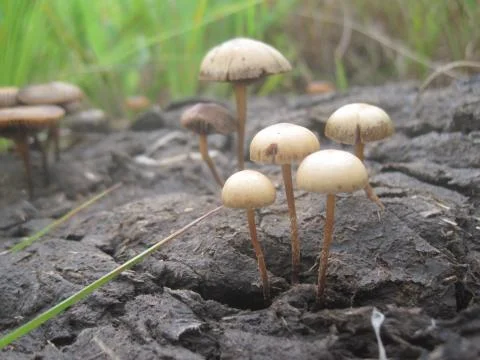
Increasingly, ecological restoration goals include belowground ecosystem services including reducing soil erosion, retaining soil nutrients, restoring plant-soil feedbacks, and potentially storing carbon to reduce CO2 concentrations in the atmosphere. Soil organisms are involved in providing all these services, as such, interest in soil communities is booming in the restoration community.
Within the tallgrass prairies of the Midwest and Great Lakes region, there has been exciting progress made in this area of research, with scientists advancing our foundational knowledge of soil ecology, gaining insights into how soil microbial communities respond to ecological management, and developing techniques for the reintroduction of soil microbial communities to restoration sites. At the 2016 meeting of the SER-MWGL, we organized a symposium featuring early and mid-career scientists actively contributing to this rapidly developing field. The symposium featured Dr. Kathryn Docherty (Western Michigan University), Dr. Sara Baer (Southern Illinois University Carbondale), Dr. Elizabeth Bach (Illinois Natural History Survey), Dr. Jonathan Bauer (Indiana University), and Liz Koziol (Indiana University).
Kathryn Docherty kicked-off the symposium sharing her research focused on the function of soil microbial communities and their recovery in restored tallgrass prairie.
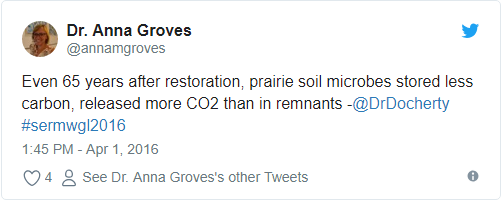
This is an important finding for two reasons. First, it emphasizes the importance of protecting the limited native prairie left in order to keep soil carbon out of the atmosphere. Second, microbial recovery may take much longer than aboveground recovery. However, it might be possible to restore soil communities and their effects on the soil. Docherty found that inoculation with microbes from remnant prairies and planting of diverse plant communities can stabilize microbe-driven carbon cycling.
Sara Baer built on these conclusions with a cross-continental dataset. Her work from restored grasslands in Nebraska, Illinois, Kansas, and the Free State, South Africa show that abiotic soil factors, like soil texture, play an important role in recovery of microbially-mediated soil functions like carbon and nitrogen storage. Even when aboveground plant community recovery was similar, belowground communities did not recover on similar trajectories. This provides another key insight, that soil type may be an important consideration when prioritizing sitesfor ecological restoration to meet goals focused on belowground ecosystem services.

Elizabeth Bach focused on soil fungal community recovery in restored and remnant prairies across Illinois. Supporting the conclusions of Docherty and Baer, Bach found distinct fungal communities in restorations compared with remnants, and this pattern was consistent on different soil types at multiple locations. In addition, microbial activity varied within the growing season, and these seasonal patterns were also similar across soil types and in remnants and restorations, although overall activity was greater on silty loam soils. These data are very important to restoration practices because they suggest some microbial recovery patterns are consistent across sites.
Jonathan Bauer dove deeper into soil fungal community relationships, sharing his work using fungi to facilitate the establishment of “late-successional” prairie plants:

Bauer’s work shows that fungi, particularly arbuscular mycorrhizal fungi that form mutualistic associations with plants, are important to the establishment and success of many desired plant species with high floristic quality in prairie restoration. Bauer showed that early successional species, many of which have low floristic quality, are most likely to establish in a restoration and are less mycorrhizal, such as Ambrosia artemesiifolia and Rudbeckia hirta. In contrast, plants that are late successional plants and of high floristic quality tend to be both very responsive to soil fungi and are less likely to establish from seed in a restoration, such as Amorpha canescens and Veronicastrum virginicum.
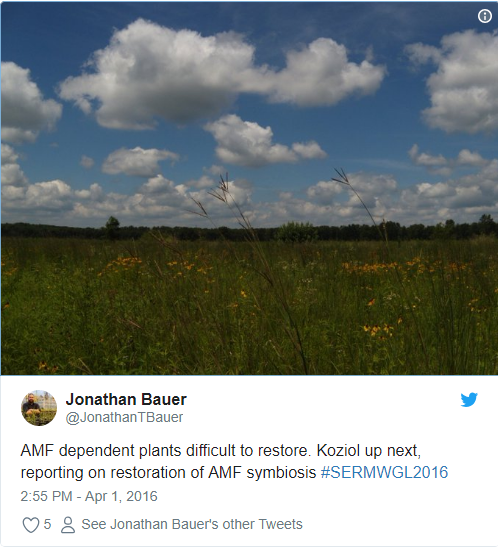
Liz Koziol rounded out the symposium sharing her exciting work using inoculations of soil microbial communities to improve late successional establishment in tallgrass prairie restoration.
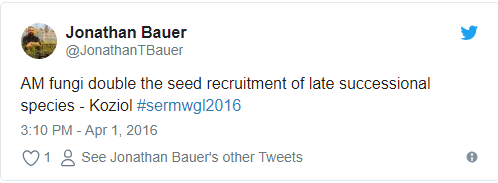

Koziol demonstrated that adding prairie microbial inocula, specifically arbuscular mycorrhizal fungi acquired from remnant prairie soils, can be effective at improving the establishment of high quality prairie plant communities from seed plantings. Liz found that the particular composition of arbuscular fungal species at a restoration site can have dramatic effects on the plant species that establish there, as some fungi promote weeds while other promote desirable species. Liz cautioned against many commercially propagated inocula sources, where origin and quality of the fungi is unknown. Instead, Koziol suggested that adding a diverse AM fungal inocula from an undisturbed reference site more quickly facilitates late successional prairie establishment.
The symposium ended with open questions for all speakers from the audience. The engaging discussion included questions about how restoration practitioners can incorporate new belowground knowledge and measure success of belowground recovery. Here’s what the panelists suggested:
Baer: easiest, quickest single measure of belowground recovery is soil bulk density, essentially the density of a known volume of soil. Soil density covaries with microbial communities and functioning
Docherty: get roots in the ground, establishing plants is key to microbial recovery, although belowground recovery will be much slower
Bach: feed the microbes to feed the full ecosystem, more roots and inputs to microbes will increase belowground functioning and feed the aboveground community
Koziol: consider inoculations, but source is very important. Consider fungal/microbial nurseries that produce native and locally adapted microbial inocula, just like plant nurseries
Bauer: target to site goals, different goals may require different actions, if goal is establishing a late-successional plant community, invest lots in AMF mutualisms
Relevant additional reading on the topic of soil microbes in restored environments: