

Blog Archive:
Beneath Our Feet
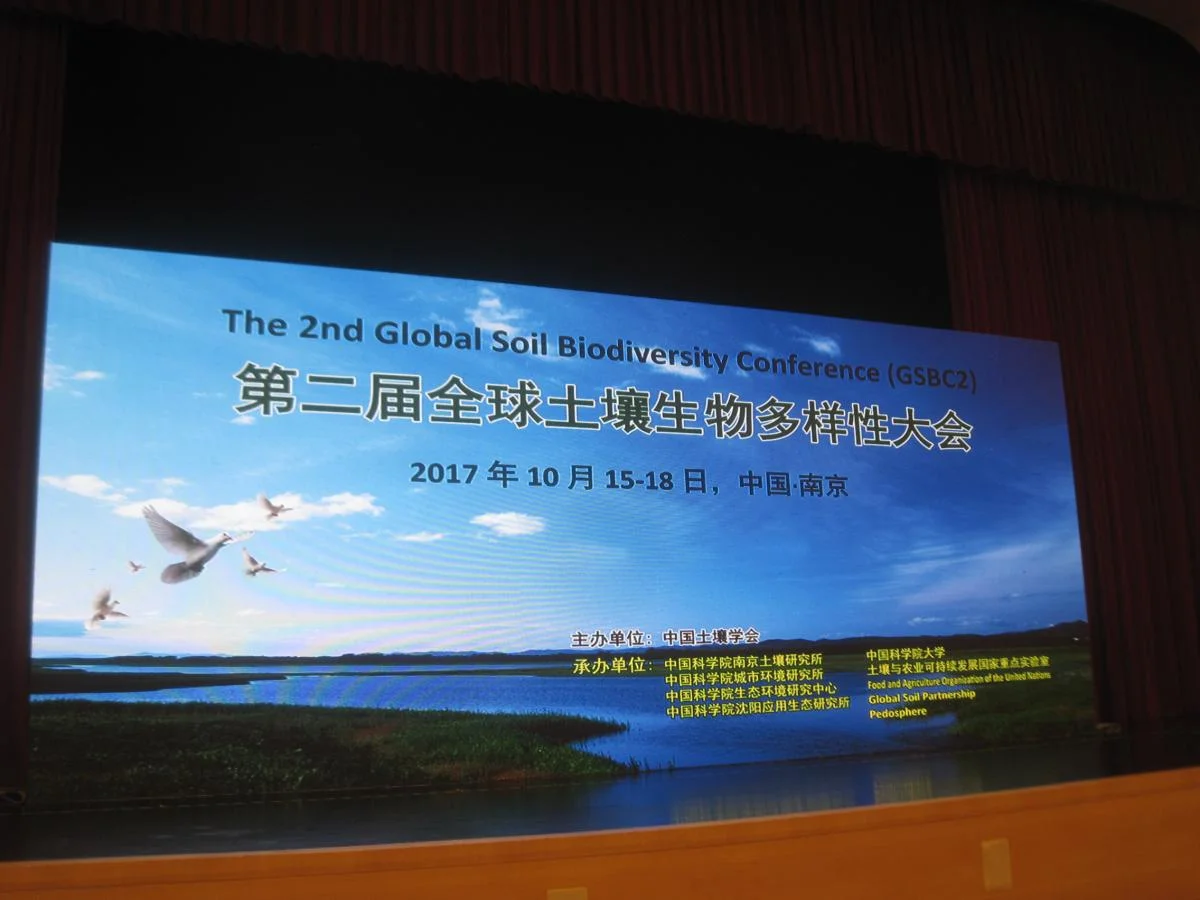
2nd Global Soil Biodiversity
By Elizabeth Bach, Executive Director, Global Soil Biodiversity Initiative, Colorado State University
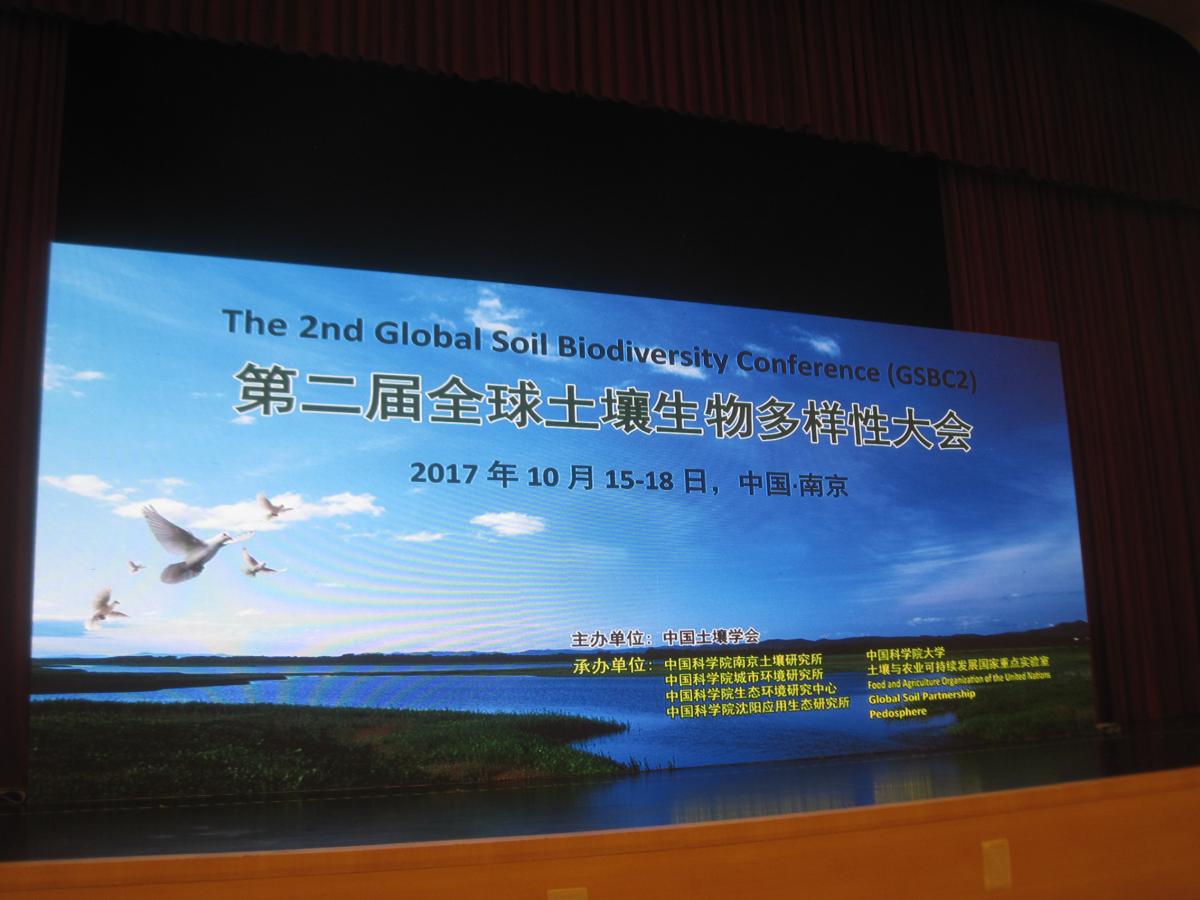
The 2nd Global Soil Biodiversity Conference (GSBC2) was held 15-18 October, 2017 in Nanjing, China. More than 1000 scientists from 47 countries gathered at the Nanjing International Youth Culture Centre to hear about the latest soil biodiversity science, network with colleagues new and old, and share new ideas.
Applying soil biodiversity science to global policy, Dr. Ronald Vargas, the Soils and Land Management Officer at the UN Food and Agricultural Organization and Secretary of the Global Soil Partnership, and Dr. Luca Montanarella, European Commission Joint Research Centre and chair of the Intergovernmental Technical Panel on Soils, called for a formal international assessment on soil biodiversity. There was much excitement around this call and it will be exciting to see it develop.
Conference co-chairs Prof. Ren-fang Shen (Institute of Soil Science, Chinese Academy of Science) and Prof. Yong-guan Zhu (Institute of Urban Environment, Chinese Academy of Science) shared recent developments in soil biodiversity research in China. Soil biology research has accelerated tremendously in the past 5 years in China and support for future work is strong. The China Soil Microbiome Initiative is a more than USD$35 Million project to systematically survey and sequence soil microbial diversity across China and link this biodiversity with key ecosystem services including nutrient cycling, crop production, and carbon storage. Leaders in the Soil Science Institute of the Chinese Academy of Science are seeking additional funding to extend support to include soil animals as well. In addition, the hundreds of Chinses graduate students, postdocs, lectures, and professors in attendance demonstrated deep knowledge, enthusiasm, and curiosity driving soil biodiversity research in China on topics ranging from agricultural production, ecosystem functioning, and restoration. In addition, the 19th National Congress of the Communist Party of China happened in Beijing the same week as GSBC2, and President Xi Jinping specifically included soil and ecological concerns as priorities for the Chinese agenda.
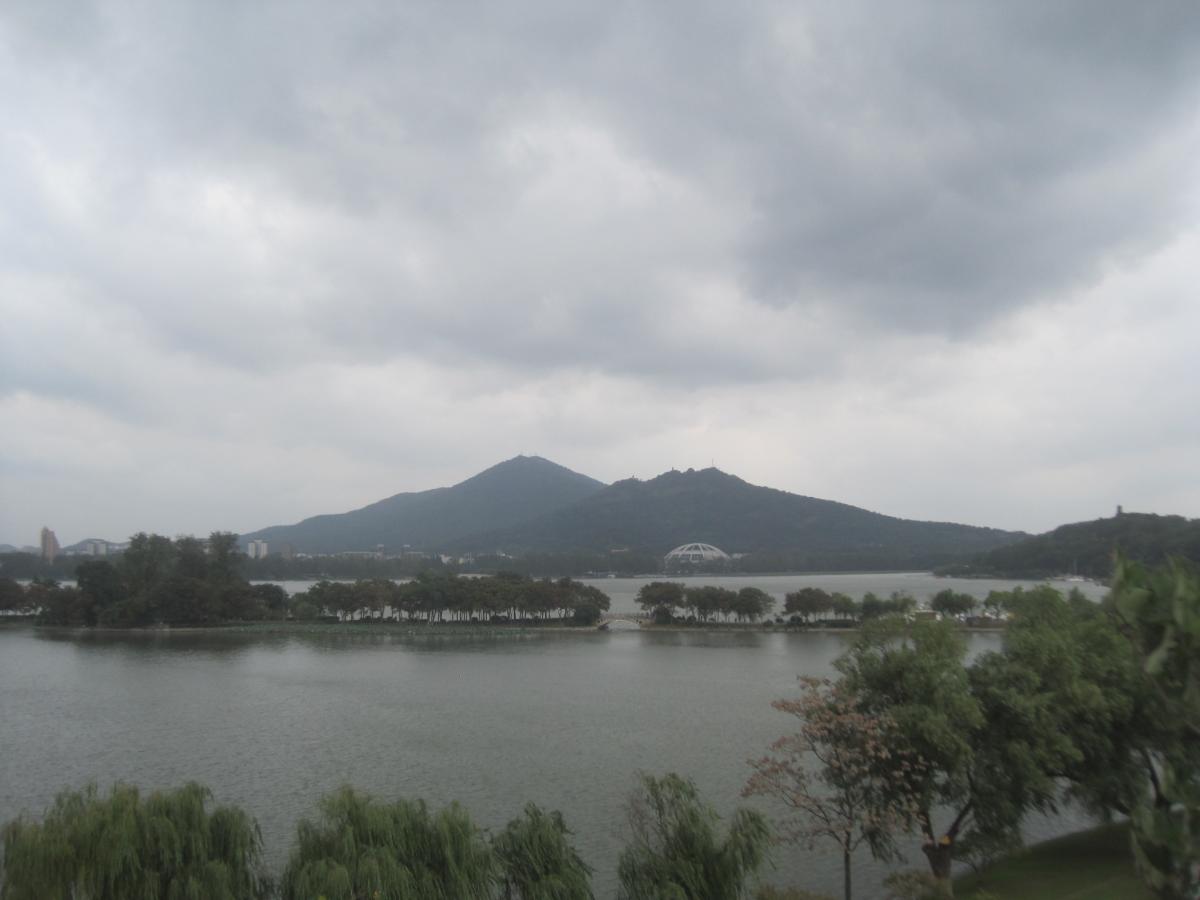
Zhongshan Mountain (Purple Mountain) is east of Nanjing, China.
Photo credit E.Bach
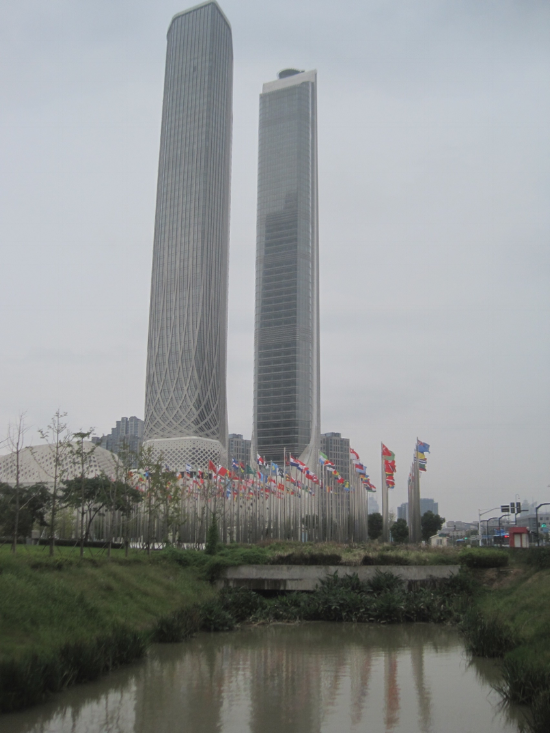
Nanjing International Youth Culture Centre
hosted GSBC2.
Photo credit E.Bach
Dr. Diana Wall, Scientific Chair for the Global Soil Biodiversity Initiative (Colorado State University), highlighted key Global Soil Biodiversity Initiative (GSBI) accomplishments since the 1st GSBC including publication of the Global Soil Biodiversity Atlas (including a new website), publication of many prominent papers, establishment and funding of working groups like sWORM, and incorporation of soil biodiversity into international policy documents including the Global Land Outlook (UNCCD), Global Assessment on Land Degradation and Restoration (Intergovernental Platform on Biodiversity & Ecosystem Services, IPBES, expected spring 2018), and Global Assessment on Soil Biodiversity (IPBES, expected spring 2018).
The GSBC2 featured research from around the world, including Europe, North America, South America (Brazil), Australia, and Africa. The European Joint Research Centre is gearing up for the 2018 Land Use/Land Cover Frame Survey (LUCAS) which will include DNA sequencing analysis for the first time. Dr. Brajesh Singh shared the first published results from the Biomes of Australian Soil Environments survey, showing distribution of bacteria and fungi across the nation. Brazilian scientists shared emerging work focused on soil microbes and fauna in the Amazonia region, investigating impacts of deforestation, agricultural management, and ecological restoration. Several Canadian and American scientists highlighted how soil biodiversity interfaces with global challenges including climate change, providing ecosystem services, ecological restoration success, and plant evolution.
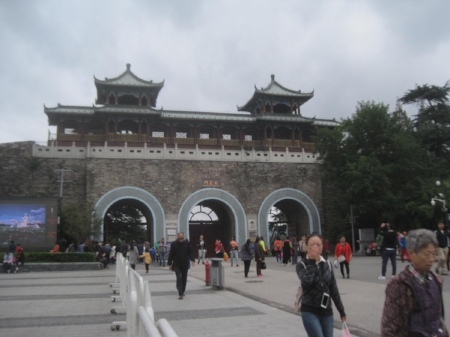
Xuanwu gate to the old Nanjing City Wall
Photo credit E.Bach
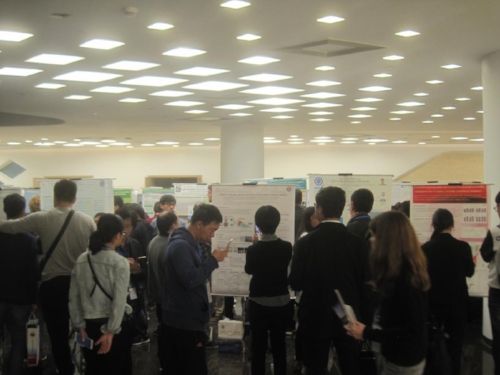
Participants enjoy a poster session at GSBC2.
Photo credit E.Bach
In addition to talks and posters, the conference featured several workshops and roundtables to share knowledge between established and early career scientists. Writing workshops were led by Dr. Wim van der Putten (Netherlands Institute for Ecology, NIOO-KNAW), Dr. Karl Ritz (University of Nottingham), and Dr. Josh Schimel (University of California Santa Barbara). In addition, there was an open evening social with the editors of Soil Biology & Biochemistry. Dr. Stefan Geisen (NIOO-KNAW) organized a roundtable featuring experts sharing best practices and emerging methods for studying soil organisms including bacteria, viruses, protists, nematodes, mites, molecular approaches for mesofauna, and working across disciplines and beyond the scientific world. Ting-wen Chen (University of Göttingen, Germany), Dr. Meixiang Gao (Harbin Normal University, China), Dr. Stefan Scheu (University of Göttingen, Germany), and Dr. Tancredi Caruso (Queen’s University of Belfast, Northern Ireland, UK) organized a roundtable focused on ecological theory and soil biota, which spurred exciting discussion late into the evening. Dr. Nadia Soudzilovskaia (Leiden University, Netherlands) and Dr. Gerlinde de Deyn (Wageningen University, Netherlands) organized a roundtable linking soil biodiversity to ecosystem functioning and provisioning of ecosystem services. These provided important opportunities for attendees to interact in focused small-groups and develop important career skills.
Look at the full program, including keynote abstracts here: http://ddl.escience.cn/f/PsCF
The 3rd Global Soil Biodiversity Conference will likely happen in 2020, stay tuned for more information!

Soil Microbes in Ecological Restoration
This post originally appeared on the Restoration Blog from the Midwest-Great Lakes Chapter of the Society for Ecological Restoration
By: Elizabeth Bach, Global Soil Biodiversity Initiative (formerly Illinois Natural History Survey), Jonathan Bauer, Indiana University, Liz Koziol, Indiana University, USA
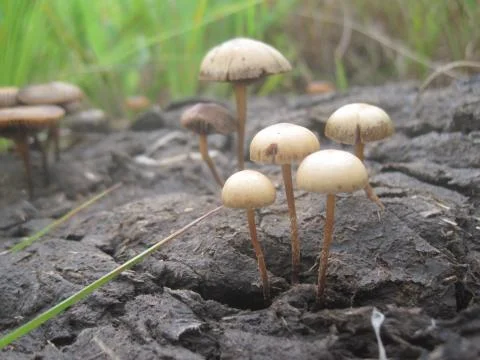
Increasingly, ecological restoration goals include belowground ecosystem services including reducing soil erosion, retaining soil nutrients, restoring plant-soil feedbacks, and potentially storing carbon to reduce CO2 concentrations in the atmosphere. Soil organisms are involved in providing all these services, as such, interest in soil communities is booming in the restoration community.
Within the tallgrass prairies of the Midwest and Great Lakes region, there has been exciting progress made in this area of research, with scientists advancing our foundational knowledge of soil ecology, gaining insights into how soil microbial communities respond to ecological management, and developing techniques for the reintroduction of soil microbial communities to restoration sites. At the 2016 meeting of the SER-MWGL, we organized a symposium featuring early and mid-career scientists actively contributing to this rapidly developing field. The symposium featured Dr. Kathryn Docherty (Western Michigan University), Dr. Sara Baer (Southern Illinois University Carbondale), Dr. Elizabeth Bach (Illinois Natural History Survey), Dr. Jonathan Bauer (Indiana University), and Liz Koziol (Indiana University).
Kathryn Docherty kicked-off the symposium sharing her research focused on the function of soil microbial communities and their recovery in restored tallgrass prairie.
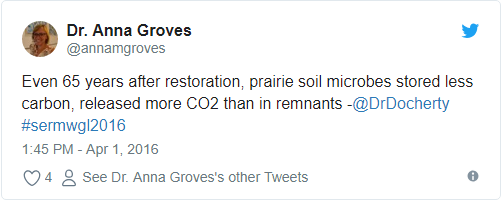
This is an important finding for two reasons. First, it emphasizes the importance of protecting the limited native prairie left in order to keep soil carbon out of the atmosphere. Second, microbial recovery may take much longer than aboveground recovery. However, it might be possible to restore soil communities and their effects on the soil. Docherty found that inoculation with microbes from remnant prairies and planting of diverse plant communities can stabilize microbe-driven carbon cycling.
Sara Baer built on these conclusions with a cross-continental dataset. Her work from restored grasslands in Nebraska, Illinois, Kansas, and the Free State, South Africa show that abiotic soil factors, like soil texture, play an important role in recovery of microbially-mediated soil functions like carbon and nitrogen storage. Even when aboveground plant community recovery was similar, belowground communities did not recover on similar trajectories. This provides another key insight, that soil type may be an important consideration when prioritizing sitesfor ecological restoration to meet goals focused on belowground ecosystem services.

Elizabeth Bach focused on soil fungal community recovery in restored and remnant prairies across Illinois. Supporting the conclusions of Docherty and Baer, Bach found distinct fungal communities in restorations compared with remnants, and this pattern was consistent on different soil types at multiple locations. In addition, microbial activity varied within the growing season, and these seasonal patterns were also similar across soil types and in remnants and restorations, although overall activity was greater on silty loam soils. These data are very important to restoration practices because they suggest some microbial recovery patterns are consistent across sites.
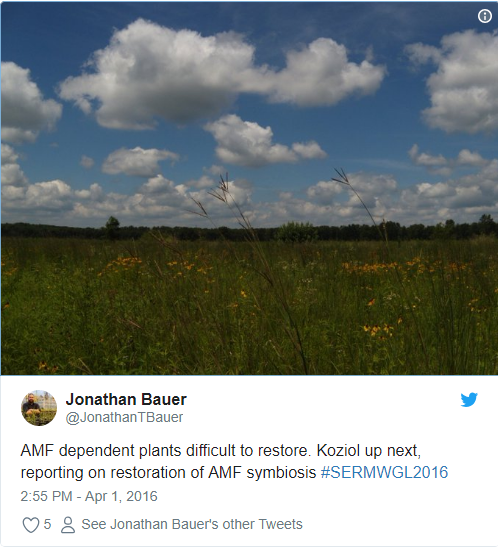
Jonathan Bauer dove deeper into soil fungal community relationships, sharing his work using fungi to facilitate the establishment of “late-successional” prairie plants:

Bauer’s work shows that fungi, particularly arbuscular mycorrhizal fungi that form mutualistic associations with plants, are important to the establishment and success of many desired plant species with high floristic quality in prairie restoration. Bauer showed that early successional species, many of which have low floristic quality, are most likely to establish in a restoration and are less mycorrhizal, such as Ambrosia artemesiifolia and Rudbeckia hirta. In contrast, plants that are late successional plants and of high floristic quality tend to be both very responsive to soil fungi and are less likely to establish from seed in a restoration, such as Amorpha canescens and Veronicastrum virginicum.
Liz Koziol rounded out the symposium sharing her exciting work using inoculations of soil microbial communities to improve late successional establishment in tallgrass prairie restoration.
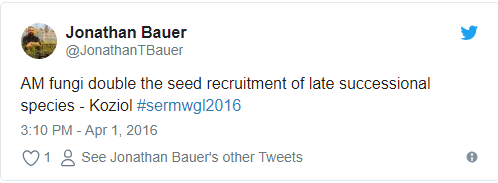

Koziol demonstrated that adding prairie microbial inocula, specifically arbuscular mycorrhizal fungi acquired from remnant prairie soils, can be effective at improving the establishment of high quality prairie plant communities from seed plantings. Liz found that the particular composition of arbuscular fungal species at a restoration site can have dramatic effects on the plant species that establish there, as some fungi promote weeds while other promote desirable species. Liz cautioned against many commercially propagated inocula sources, where origin and quality of the fungi is unknown. Instead, Koziol suggested that adding a diverse AM fungal inocula from an undisturbed reference site more quickly facilitates late successional prairie establishment.
The symposium ended with open questions for all speakers from the audience. The engaging discussion included questions about how restoration practitioners can incorporate new belowground knowledge and measure success of belowground recovery. Here’s what the panelists suggested:
Baer: easiest, quickest single measure of belowground recovery is soil bulk density, essentially the density of a known volume of soil. Soil density covaries with microbial communities and functioning
Docherty: get roots in the ground, establishing plants is key to microbial recovery, although belowground recovery will be much slower
Bach: feed the microbes to feed the full ecosystem, more roots and inputs to microbes will increase belowground functioning and feed the aboveground community
Koziol: consider inoculations, but source is very important. Consider fungal/microbial nurseries that produce native and locally adapted microbial inocula, just like plant nurseries
Bauer: target to site goals, different goals may require different actions, if goal is establishing a late-successional plant community, invest lots in AMF mutualisms
Relevant additional reading on the topic of soil microbes in restored environments: