

Blog Archive:
Beneath Our Feet

Decomposers and the City
By Alessandro Ossola PhD, The University of Melbourne, Australia and US National Academy of Science, Engineering and Medicine NRC Associate c/o NRMRL-USEPA, Cincinnati, OH.
Cities are generally associated with grey jungles of concrete, glass and steel. Where the urban land is still profitable for new development, little chance is left for the soil to persist unsealed. When this happens, soil is generally heavily compacted, polluted, its biota depleted and ecological functioning greatly reduced. Urban soil faces a complex and uncertain future of irrigation, fertilization, transportation, remediation and molestation which is rarely observed in natural and agricultural soils. Urban soil is ultimately associated with a mere substrate where to build new above- and below-ground structures and infrastructures to connect our modern cities. Despite their intrinsic complexities, cities and the soils underneath represent useful pre-constructed laboratories to extend our knowledge about soil functioning, its biodiversity and resilience towards a variety of stressors and habitat management practices.
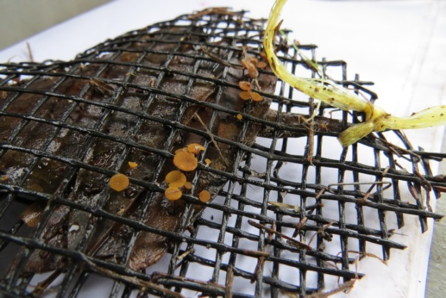
Figure 1.

Figure 2.
Figure 1, Figure 2. Fungi colonizing Eucalyptus globulus litter in litter bags exposed in an urban park characterized by complex vegetation and high litter mass in Melbourne, Australia.
In a paper published this week in Ecosystems, we asked whether relatively small changes in the complexity of vegetation, litter and soil characteristics driven by urban green spaces management were translated into differences in superficial organic matter microbial decomposition and detritivore comminution. Since the 90’s, microbial decomposition processes have been measured in cities and towns mostly in forest remnants along urban-rural gradients. Surprisingly, to date no studies measured superficial decomposition or comminution processes in areas, such as urban parks, which make up most of the green space in cities worldwide. This is likely due to the intrinsic difficulties and risks (e.g. people, mowers, animals, etc) in undertaking litter bags experiments in these habitats. In our study, we found that the simplification of urban habitats in Melbourne, Australia, and particularly of the understory vegetation, significantly decreased decomposition and comminution rates of two substrates in litter bags (i.e. Eucalyptus globulus leaves and pea straw). This is likely determined by drier conditions under simple urban vegetation, where water availability might represent a stronger limiting factor for the activity of both microbes and detritivores compared to temperature. The soil function in structurally complex urban parks was comparable to that of woodland remnants, and the age since land use change from agricultural land to urban park (40-100 years) did not affect decomposition and comminution processes. This suggests that urban soils can recover their function towards that of remnant ecosystems if enough time has transpired and proper management measures are taken. The volume of the understory vegetation was positively related to the species richness of macrofauna detritivores, which in turn significantly enhanced comminution rates. More than 70% of detritivores sampled were European exotic species. The relation between species richness of numerous soil organisms and soil processes have been largely investigated through mesocosm experiments in the last century, but rarely observed or tested in the field.

Figure 3.
Figure 3. Relationship between urban understory volume, species richness of macrofauna detritivores and Eucalyptus globulus litter mass remaining after 1 year litter bag experiment.
While the ecological exploration of cities started decades ago, we have just begun to investigate the functional role of urban organisms and particularly the soil biota. Worldwide, cities can represent useful laboratories to test new hypotheses and questions about the role of biophysical factors, human management, environmental legacies, soil biodiversity and their complex interactions upon soil functioning. Time is ripe to dig into!

An unexplored urban jungle

Tomorrow morning a group of soil ecologists will meet on the steps of the American Museum of Natural History to begin a day-long effort to sample the soils of Central Park, New York City. Within soil lives an astounding amount of biological diversity, scaling from microbes to insects and worms that is mostly invisible to the naked eye. One question researchers are interested in is how this biodiversity compares to soils in natural systems- Yellowstone National Park, for example. Do the same controls, such as temperature, rain events, plants and soil nutrients, that determine the composition of organism in a soil community in forests or grasslands hold up in a city park in the middle of Manhattan?
Soil provides a number of ecosystem services that are necessary for human well-being (see this interesting NYTimes article for more on ecosystem services). Urban soils can provide the same ecosystem services as natural soils- food production, water cycling and purification, and carbon cycling (especially important in the context of climate change). Additionally, urban soils provide a habitat for a vast amount of soil biodiversity, though it is still unclear just which organisms thrive under urban conditions and how the services they provide may be affected by urban stresses.
The glamorous job of soil sampling involves metal soil corers, sharpies, collection bags and a love of dirt. For this project we will collect soils, about a handful sized amount for each sample, from over 600 sampling locations throughout Central Park.
(The park is ½ mile wide and we will be sampling from approximately 15 points across the width of the park, for 50 blocks, minus area covered by water = greater than 600 soil samples!)
Just for fun, we have only scheduled one sampling day, so this is going to be a crazy sampling effort!! (And it may be a bit warm.)
For this project we will use molecular sequencing techniques to see where and what types of life (both new and cosmopolitan) lie beneath the surface of Central Park. Then, we will build maps of the microbial and micro-/meso- faunal diversity across the park and compare the biodiversity with the plant cover, nutrient levels and other soil characteristics. Additionally, we will get a pretty good idea of the shear amount of soil biodiversity that lives in Central Park.
This is a collaborative research project organized by the GSBI and researchers from CSU, CU-Boulder, Yale and the AMNH (see this post for more details).
Stay tuned for the post sampling post, glamorous field shots and more information on the project.