

Blog Archive:
Beneath Our Feet
Happy Birthday GSBI!

GSBI Founders Johan Six, Luca Montanarella, Diana Wall, Richard Bardgett, Wim van der Putten. Click here to view our leadership.
Wish us a happy birthday, because this September marks the two-year anniversary of the Global Soil Biodiversity Initiative (GSBI). In that time, we have established a small but solid base of supporters and contributors. We now have over 350 members representing 69 countries.
The GSBI is a bottom-up collaboration of international scientists dedicated to enhancing the use of soil biodiversity science and ecosystem services into sustainable policies and management of global terrestrial ecosystems. It’s structured through a scientific leadership and global participant network, with the secretariat hosted at Colorado State University.
The GSBI was initiated in 2011 with the main focus of establishing global participation by a representative scientific community (systematists to biogeochemists, and ecosystems from Antarctica to urban soils). To be truly representative of the scientific community the GSBI encourages all interested parties to support and contribute by simply signing up to become a participant.
Over the last two years the GSBI has made great strides in connecting with the scientific community and beyond.
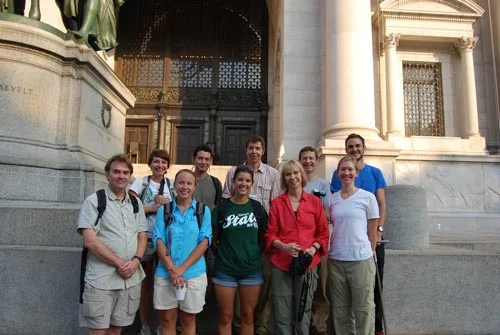
The Central Park team
Timeline of Events:
March 2012 - The first Open Meeting for the GSBI group was held in London.
June 2012 - Diana Wall, Scientific Chair, and Kelly Ramirez, Executive Director, attended the Rio+20 UN conference on global sustainability.
July 2012 - The GSBI, in collaboration with the CSU, CU Boulder, Yale, and the American Museum of Natural History, set out to explore the biodiversity of Central Park in New York City (group picture to the left).
November 2012 - The GSBI co-hosted a session called "Ecosystems services for soils: competitions and synergies" at the first Global Soil Week.
**This year, we are co-hosting a session: Get it, use it, improve it: Global soil information.
November 2012 - Diana Wall and Kelly Ramirez attended the annual EcoFinders meeting as outside contributors. Find out more about the project, in its final year, here.
December 2012 - January 2013 - Diana Wall and a team went to Antarctica to sample soils in the McMurdo Dry Valleys. An important role of the GSBI is to keep up with current research efforts.
February 2013 - The GSBI hosted an international workshop, held in Fort Collins, Colorado, to plan the GSB-Assessment. The first step towards this assessment will be a GSB-Atlas, which is modeled off of the European Atlases. The release date is set for December 2014 during the first conference of the GSBI.
June 2013 - The GSBI was lucky enough to attend the Soil Ecology Society meeting at Rutgers University in Camden, New Jersey. This allowed for good networking and connections between scientists.
August 2013 - The GSBI held a session on integrating soil biodiversity at the Ecological Society of America (ESA) meeting in Minneapolis, Minnesota.
August 2013 - The GSBI attended Intecol 2013 in London. GSBI leadership, Diana Wall, Wim van der Putten, and Richard Bardgett all participated in organized symposia.
Here are a few pictures from the last two years.

Rio+20 focused on achieving a green economy and creating a framework for sustainable development.

(from left to right) Diana Wall, Kelly Ramirez, and Heitor Coutinho representing GSBI at the Rio+20 event.

GSBI members at the first open meeting in London.

(clockwise from left) Zach Sylvain, Diana Wall, Ed Ayres, Breana Simmons, Kelly Ramirez, and Josh Schimel at SES (Soil Ecology Society) event.

The GSBI co-facilitated a session on "Ecosystem Services of Soils: Competition and Synergies" at Global Soil Week in 2012 Right: Ecological Society of America (ESA) meeting

Noah Fierer presenting at the GSBI Symposium "Predicting soil microbial diversity and function in a rapidly changing world."

Diana Wall and her Wall Soil Ecology Lab has been studying the soils of the McMurdo Dry Valleys in Antarctica since 1989.

Diana Wall and company sample soils in the McMurdo Dry Valleys

David Wardle and Richard Bardgett at the EcoFINDERS meetings in November 2012 in Wageningen, Netherlands
We have come a long way from just a year ago, when we had 65 members from 21 countries. We could not have made this progress without the help of our many contributors and members.
Thank you, and we look forward to another year of progress!

Professor Håkan Wallander presenting at the Summer of Soil
This month the Summer of Soil presents the Living Soil Forum, a 5-day program designed to activate and empower people to secure a better future for our soils. From July 22-26 participants can attend presentations from international experts on issues of soil sustainability, film, discussion groups, and experience field work opportunities, all to better connect people and ideas around solutions that work to secure and restore healthy, living soils.
Professor Håkan Wallander, of Lund University, and representing the GSBI, will be presenting July 25th, A closer look at soil: Re-examining soil and its importance for biodiversity, food security, climate stability and healthy living systems. Dr. Wallander is a professor in soil biology and environmental sciences, working with ectomycorrhizal fungi that form symbiotic relationships with trees. They produce several hundreds of kilograms of mycelia per hectare every year in most forest ecosystems. This is important for nutrient uptake of the trees, but also for carbon sequestration and N retention in the soil. His main research interest is to understand how this flux of belowground carbon is regulated, and how important the composition of the ectomycorrhizal community is for carbon sequestration and nutrient uptake. Find out more about Dr. Wallander’s research at his university website: http://www4.lu.se/o.o.i.s/28390

Dr. Wallander has recently released a book “Soil: Reflections on the foundation of our existence.” http://www.atlantisbok.se/layout/detail.php?id=7710
For more information and the full program visit: http://www.summerofsoil.se/forum/

Important EcoFINDERS survey

Dear All,
A survey is being conducted to allow us to carry out a scientific assessment of the range of biological methods available for monitoring of soil biodiversity and associated ecosystem function. The EcoFINDERS project is a collaborative FP7 funded project with researchers from 23 institutes across 10 countries working to increase our knowledge of soil biodiversity and its role in ecosystem services across different soils, climate types and land uses. This is being done as a result of knowledge and data gaps highlighted by the European Commission in development of the recently proposed Soil Framework Directive.
The aim of this questionnaire is to provide a semi-quantitative approach to indicator selection for monitoring of soil biodiversity. A thorough assessment has already been undertaken from literature within the EcoFINDERS project, but this does not allow for the user information, which is vital when trying to assess the applicability of biological methods for monitoring purposes. The questionnaire is split into four sections that allow us to assess the importance of each section on the overall score. There are 15 questions in total and it should take no longer than 45 minutes to complete.
http://www.ecofinders.org/global-biodiversity-questionaire.html
Sections include:
1. Measurement 5 questions address the skills and equipment necessary for measurement of the biological indicator
2. Cost 6 questions assess the start-up, field and laboratory costs associated with measurement of the biological indicator
3. Sensitivity 3 questions review the sensitivity of the indicator
4. Appropriate to Measure 1 question only
The questionnaire is quite detailed to allow a robust scoring using the logical sieve approach designed by Ritz et al. (2009). You will be given a list of potential indicators, but we ask you only to score on those indicators you feel you have a reasonable knowledge on. If you feel that you do not have a reasonable knowledge on a specific indicator please select ³No Knowledge².
Many thanks in advance for completing this survey, I appreciate that everyone has very busy schedules and it is often difficult to find time to undertake such a questionnaire but this information will be extremely useful in informing science and policy in the future for soil biodiversity issues.
Best wishes
Rachel
------
Dr Rachel Creamer
Soil Quality Research Officer
Teagasc
Johnstown Castle
Wexford
Tel: 053 9171266
Tags:

Why should we care about soil biodiversity?
By Barbra Fricks

Last week a key group of soil biodiversity scientists arrived in Fort Collins with a bang despite a massive snowstorm. Delayed flights and cold temperatures couldn’t keep this group down; they were on a mission to develop a Global Soil Biodiversity Assessment/Atlas on the state of global soil biodiversity. Soil scientists are some of the most passionate people I’ve ever met and soil biodiversity researchers kick it up a notch. Soil biodiversity rarely appears in biodiversity assessments, which I believe fuels the desire to put in the extra hours and get educational resources, such as an Atlas, out to the public.

Every participant showed up ready to go for the opening session Tuesday morning, February 26 2013. Colorado State University (CSU) Vice-President and Provost Rick Miranda opened the session with a warm-hearted welcome. He offered full support for the collaborative effort and appeared to take pride in the fact that CSU is a central role in the efforts. James Cooney, the Vice Provost of International Programs, followed Rick. Impressively Dr. Cooney stayed for the entire morning sessions despite a busy schedule to learn more about soil biodiversity prior to moderating the lunch panel. The morning schedule followed with a series of talks--see agenda for full list. Notably during the coffee break many of the scientists mingled with persons attending the session not participating in the Workshop. The lunch panel discussion, “Global Science Policy and the Soils Challenge” was a huge success and ended with some questions remaining unasked; clearly there was a demand by the public for more information on soil biodiversity.
Once behind closed doors the scientists jumped right into the task at hand. A lively discussion on whether there should be an Atlas, Assessment, or both dominated the afternoon session. The debate featured a range of scientific perspectives with Dr. Luca Montanarella of the European Commission routinely reminding the group what they found the most effective aspects of the European Global Soil Biodiversity Atlas from a policy perspective– cool pictures. Ultimately the group agreed to produce an Atlas in three years, identified core topic areas, and discussed how to get the much-needed pictures.
Day two proved just as productive as day one. The scientists broke out into small groups to discuss the topic areas and potential outline. The consistent pattern of small breakout groups, entire group discussion, and breaks provided the needed rest after a super productive group sessions, re-energizing the scientists to come back to the table ready to work.
By Thursday, day three, we were so ahead we took a slightly longer morning break enjoying some videos on soil biodiversity. The scientists also submitted their top eight reasons why soil biodiversity is important, which we made into a word cloud that impressed everyone present. Surprisingly few scientists included biodiversity in their reasons but money ended up ranking high –heads up neglecting soil biodiversity may affect your pocket books!
I have attended several workshops over my career and can take a page from the effectiveness of these scientists. At first I had doubts on the three-year time frame outlined for the Atlas, but while tight, the timeline seems completely feasible in light of the GSBA Workshop. Participants stayed energetic and on task for the entire three days despite the jet lag and grueling schedule. While there were disagreements, for example on the role of maps in the atlas, ultimately everybody came to a common consensus regarding the final product. It will take a massive effort and dedication by all the scientists involved, but after what I saw, I think they are up for the task!
Stay tuned for progress updates and ways to get involved.
For more pictures of the event visit: http://www.globalsoilbiodiversity.org/GSBAW_Pictures
For a full participant list visit: http://www.globalsoilbiodiversity.org/GSBAW_Participants
Barbara Fricks is the Project Director for the Global Soil Biodiversity Initiative. She worked as a science communication intern in Washington DC with the Soil Science Society of America, and is currently pursuing her PhD at Colorado State in Soil Microbial Ecology

Assessing the state of soils

There are millions and millions of organisms in the soil under your feet that play a critical role in maintaining a multitude of global services. Often overlooked, these organisms control critical processes ranging from nutrient availability for plant growth to carbon sequestration for greenhouse gas mitigation. With recent advances in molecular techniques, global surveys and communication between researchers, scientists can now link this unseen diversity with key ecosystem services.
The next step, however, will be assembling these studies into a single resource that could be used by policy makers for more educated decisions, especially regarding land use, management and global changes. The GSBI and European Commission-Joint Research Centre (EC-JRC) have joined forces to organize a global effort to synthesize the current state of soil biodiversity into a Global Soil Biodiversity Assessment (GSBA). The assessment will specifically summarize current knowledge on soil biodiversity and ecosystem services with topics critical to sustainable development (desertification, food security, biodiversity and climate change).
To kick off the assessment, the GSBI and EC-JRC, with support from Colorado State University, will host a planning workshop at the CSU Fort Collins campus February 26-28, 2013. Twenty renowned soil biodiversity scientists from around the world will attend the workshop. The three day workshop will open with a series of seminars open to the public (see the full schedule) on February 26, 2013. In the public Opening Session: Soil Security: Is Biodiversity The Missing Link? we will hear talks on research challenges and management options. Attendees will then get down to business in a series of closed-door sessions.
Ultimately the attendees will define the core topic areas of the GSBA, outline content, develop a timeline, identify products (maps, website, including a Global Soil Biodiversity Atlas), create working groups, and determine the process to complete the Assessment. There has never been a global attempt to synthesize the breadth of this data before. As past efforts by the EC-JRC in publishing the European Soil Atlas demonstrate, the passionate scientists who study soil biodiversity are up to the task.
To help achieve these goals, the workshop participants will need all the support they can get. To help support the efforts please take the time to submit any global and regional references you have. The GSBI will collect your submissions and present them to the GSBA committee.
Scratching the surface of soil microbial diversity
By Kelly Ramirez:

I recently wrote a post for my blogging group Early Career Ecologists. Briefly, I discuss a recent paper out by Dr. Noah Fierer and colleagues in PNAS, where they used metagenomic techniques to explore soil microbial communities of 16 soils from across five biome types. I chose to write about this publication because it exemplifies the amazing progress made in sequencing techniques and microbial ecology in such a short period of time. Our understanding of soil communities has grown rapidly, and as researchers work to put the massive amounts of data into context we are learning that soil communities operate in a very similar way as above ground communities (soil pH, temperature, precipitation and nutrients are, not surprisingly, large drivers of community composition and diversity). We have also clearly established that everything is not everywhere, though we can find organisms with similar life history traits in similar biomes. And we are now starting to discover that community patterns are mirrored in gene patterns, and those patterns are controlled by a complex mix of environmental conditions and community interactions (something else we are just beggining to scratch the surface of).
Read my full post on Soil Equality and be sure to read the paper in PNAS, Cross-biome metagenomic analyses of soil microbial communities and their functional attributes.

What is the GSBI? A brief synopsis of the GSBI's past, present and future.

The GSBI was formed in 2011 and announced at the 2011 Wageningen Soil Conference, The Netherlands, by founders Drs. Richard Bardgett, Luca Montanarella, Johan Six, Wim van der Putten and Diana Wall, with the goal of uniting scientists across disciplines (soil ecology, soil science, biogeochemistry, agroecology, policy) to convey soil biodiversity research to policy and land managers for global sustainability of ecosystem services. The GSBI looks to link science and policy through the application of rapidly expanding knowledge of soil biodiversity.
As the first step, the GSBI hosted an open meeting in London, March 2012, following the Planet Under Pressure Conference. Attendees, from 13 countries (across 5 continents) agreed on the urgency to disseminate current knowledge of soil biodiversity to both policy and land management sectors. From this meeting the GSBI White Paper was produced, where we describe more thoroughly the group’s aims including: remaining scientific challenges, harmonization of methods, managing soil biodiversity for ecosystem services and the role policy.
The GSBI (Dr. Kelly Ramirez, GSBI Executive Director, Dr. Diana Wall, Science Chair) then attended Rio+20 and hosted a side event, “Towards a Truly Global Soil Biodiversity Initiative” with the help of Dr. George Brown, Embrapa, Brazil. At this side event the GSBI presented alongside the CBD, FAO, EU-JRC and Embrapa and laid the groundwork for future synergistic partnerships. Additionally, GSBI leadership Dr. Diana Wall and Dr. Luca Montanarella, presented on the role of soil biodiversity in supporting ecosystem services in sessions with the UNCCD and FAO. Together the attendance of the GSBI in RIO served to propel the initiative into a new arena, one step closer to applying soil biodiversity science to sustainable land management.
Now, as the GSBI approaches one year since initiation we continue to move forward. This august we launched an official membership, where researchers can sign up to participate in GSBI scientific events. Already we have 65 members, spanning 21 countries. The GSBI membership will be used to form working groups on the topics deemed most important to global sustainability and land management, including: Soil Fertility and Nutrient Cycling, Soil Structure & Erosion Prevention, Regulation of carbon flux and climate, Decontamination and bioremediation, Control of Pests and Invasive Species, Health, Aesthetics and Cultural Services across all ecosystems (managed and natural) - forest, deserts, grasslands, alpine, polar, arable, urban and wetlands. From these working groups we will synthesize the current literature, identify remaining scientific knowledge gaps and propel soil biodiversity into sustainability discussions.
Another goal of the GSBI is a global assessment (the GSBA) in collaboration with the EU-JRC. Again we will draw from our membership to help inform and advise this undertaking.
The goal of the GSBI is to involve as many countries, continents and research groups as possible. Soil biodiversity is not an issue of just a few, but of all countries. With this post, we make a call, please get involved. We want your soil biodiversity expertise and knowledge. JOIN NOW and share this call with your colleagues across the world.

Taming the wilds of Central Park

Last week we successfully collected 595 samples from across Central Park in New York City. I described this huge undertaking in my previous post, so you can find out a bit more here about collaborators and sampling scheme.
Briefly, we collected soil samples, from 15 points across each of the 51 blocks running west to east in Central Park. For those of you not familiar with CP, the park is ½ mile wide and 3 miles long (51 blocks)! The park is not continuous however. There is quite a bit of rugged terrain- rock outcroppings, sports fields with 7 foot tall fences, the Met, ponds, children, fountains, dogs, cars, bikes, yoga stroller classes, Shakespeare in the park, bridges, waterfalls, music stages, merry-go-rounds… you get the idea. Check out our photos here for shots of us sampling in the wild.
We had 10 participants split between four groups, each sampling a roughly equivalent section of the park. Beginning on the steps of the Museum, we split up into groups of two and three, double checked the GPS units, measured out 5cm on our corers with sharpies and tape, and gathered cell phone numbers mostly to facilitate friendly competition throughout the day.
The first hour was slow, as each group found a sampling routine and adjusted to the rugged terrain. Then the pace started to pick up and sampling was flurried in the next 4-5 hours. By 1 p.m. the groups across the park were slowing. High humidity accompanied by 90° temperature, will do that. My group was motivated by a stop at an ice cream stand, others were not as lucky to find refreshments and were tempted instead by fountains. Still, we finished the last of the sampling by 6:30 p.m. and had all the samples safely stored in the museum by 7 p.m.! 12 hours of sweating, a few minor scrapes and bruises, a bit of heat exhaustion, but success! Really this is a huge accomplishment for one day- 600 samples... I still am in awe that we actually finished!
Wednesday after the sampling, we met again at the Museum. This time to sieve all the samples! Sieving is a monotonous process at best- take soil out of bag, sieve, separate, repeat. During the craziness of sieving we entered GPS points and a few volunteers collected water samples from all the major bodies of water in the park. Check out this sweet google map. All the samples are now ready to be processed! We will soon begin analyzing soil characteristics- pH, nutrients, moisture and microbial biomass and this fall we will sequence all soils and water samples.
This was really a fantastic sampling effort, and without the cooperation and determination of everyone involved we could not have pulled it off. Thanks again to Susan Perkins, our linchpin at the museum and Liz Johnson.
Stay tuned for more on this project and if you have questions on this project please contact me at Kelly.Ramirez@colostate.edu.

An unexplored urban jungle

Tomorrow morning a group of soil ecologists will meet on the steps of the American Museum of Natural History to begin a day-long effort to sample the soils of Central Park, New York City. Within soil lives an astounding amount of biological diversity, scaling from microbes to insects and worms that is mostly invisible to the naked eye. One question researchers are interested in is how this biodiversity compares to soils in natural systems- Yellowstone National Park, for example. Do the same controls, such as temperature, rain events, plants and soil nutrients, that determine the composition of organism in a soil community in forests or grasslands hold up in a city park in the middle of Manhattan?
Soil provides a number of ecosystem services that are necessary for human well-being (see this interesting NYTimes article for more on ecosystem services). Urban soils can provide the same ecosystem services as natural soils- food production, water cycling and purification, and carbon cycling (especially important in the context of climate change). Additionally, urban soils provide a habitat for a vast amount of soil biodiversity, though it is still unclear just which organisms thrive under urban conditions and how the services they provide may be affected by urban stresses.
The glamorous job of soil sampling involves metal soil corers, sharpies, collection bags and a love of dirt. For this project we will collect soils, about a handful sized amount for each sample, from over 600 sampling locations throughout Central Park.
(The park is ½ mile wide and we will be sampling from approximately 15 points across the width of the park, for 50 blocks, minus area covered by water = greater than 600 soil samples!)
Just for fun, we have only scheduled one sampling day, so this is going to be a crazy sampling effort!! (And it may be a bit warm.)
For this project we will use molecular sequencing techniques to see where and what types of life (both new and cosmopolitan) lie beneath the surface of Central Park. Then, we will build maps of the microbial and micro-/meso- faunal diversity across the park and compare the biodiversity with the plant cover, nutrient levels and other soil characteristics. Additionally, we will get a pretty good idea of the shear amount of soil biodiversity that lives in Central Park.
This is a collaborative research project organized by the GSBI and researchers from CSU, CU-Boulder, Yale and the AMNH (see this post for more details).
Stay tuned for the post sampling post, glamorous field shots and more information on the project.
Successful trip for the GSBI at Rio+20

This last week Diana Wall, Science Chair and Kelly Ramirez, Executive Director of the Global Soil Biodiversity Initiative (GSBI) Secretariat attended the UN Conference on Global Sustainability, RIO+20. The GSBI was fortunate to have Drs. George Brown and Heitor Coutino of Embrapa in Brazil organize a very successful side event- “Towards a Truly Global Soil Biodiversity Initiative”. (More details to follow on our website.)
Diana, along with Dr. Luca Montanarella, of the EU Joint Research Commission, and one of our GSBI leaders, also participated in the “World Day to Combat Desertification Global Observance Event”, a day long panel on land degradation. Diana and Luca were on panels discussing the relationship of the GSBI with the Global Soil Partnership (GSP) and Economics of Land Degradation, respectively.
There were numerous other Side Events on soils, indicating the high priority that is now being placed on soil security from those involved in the UN Convention to Combat Desertification (UNCCD), the Framework Convention on Climate Change (UNFCC), the Convention on Biological Diversity (CBD) and the Food and Agriculture Organization of the UN (FAO). Further, the GSBI received positive feedback from some at the CDB and FAO - indicating that our independent scientific effort on biodiversity, function and ecosystem services is already being well received. Overall, this trip reaffirmed that a collaborative, coordinated global network of scientists can be very effective at translating knowledge and identifying where knowledge can be applied.
GSBI at Rio+20: The future we want

Tomorrow GSBI Leadership Dr. Diana Wall and Dr. Kelly Ramirez will be heading down to the Rio +20 United Nations Conference on Sustainable Development. They will be meeting up with Dr. Luca Montanarella to participate in the GSBI organized side event- ‘Towards a Truly Global Soil Biodiversity Initiative’. This side event was organized by Dr. Heitor Coutinho and Dr. George Brown of Embrapa. The goals of GSBI at Rio+20 is to promote GSBI scientific activities, including a Global Soil Biodiversity Assessment, and help establish the role of GSBI alongside the Convention on Biological Diversity and other global environmental agreements.
What is Rio+20: The Rio+20 conference is a gathering of world leaders and participants- totalling up to 65,000 people - working to identify the path forward for Earth’s Sustainable Development through reducing poverty, increasing equality and promoting environmental protection. Rio+20 represents the 20 years that have passed since the 1992 Earth Summit in Rio. At this meeting 20 years ago a goal was set to restructure how governments think about economic growth and improve the quality of life for all, with specific attention being paid to social equality and environmental protection. While progress has been made, more can be done. To reach these goals, the conference has 2 main themes: 1. How to build a green economy to achieve sustainable development and lift people out of poverty? and 2. How to improve international coordination for sustainable development? These themes will be supported by 7 priority areas: decent jobs, energy, sustainable cities, food security and sustainable agriculture, water, oceans and disaster readiness.
While the actual negotiations and conference partnerships will occur June 20-22, there are a huge number of side events occurring prior to this main event. Over 500 side events will work to present focused commitments, summarizing how each specific side event will contribute to sustainable development.
Why should the GSBI be present: The GSBI has organized a side event at Rio+20 in order to bring greater awareness to the importance of soil biodiversity to ecosystem services, including: food, fiber, fuel, energy, primary productivity, disease mitigation and soil security. The Earth’s soils are living, dynamic interfaces that are supported by millions of microbial and animal species. Yet, despite the numerous benefits soil biodiversity delivers, it is often left out of policy decision. Attending Rio+20 is just one of many actions the GSBI is taking to ensure soil biodiversity is incorporated into environmental policy agendas.
Additional info: The GSBI will have presenters in the 'World Day to Combat Desertification Global Observance Event: Securing Healthy Soils and Stopping Land Degradation' session, a full schedule can be found on our website.
If you are following the Rio+20 events from home, please also check our website for regular updates on these side events and others, and follow our twitter updates @theGSBI.
GSBI at Planet Under Pressure (PUP) 2012

Planet Under Pressure (PUP) 2012
Day 1 - Sunday:
The entire GSBI team will be arriving in London throughout the week in preparation for our inaugural workshop, Friday March 30th| 9am-3pm. Today we sat down to discuss the week's schedule- what talks we need to see, who we need to meet and the goals we want to accomplish. There are some big hitters at PuP 2012 and our goal is to bring awareness to GSBI.
Tonight at the PUP reception, the keynote speaker, Sir Bob Watson, spoke of our ‘imperative to act’, discussing the steps needed to make the world a sustainable place. Already we have surpassed a turning point- the world will be warming through 2030 and numerous species have gone extinct. Our goal now is to prevent further warming and environmental destruction in the following decades. Sir Watson spoke of education, research and development, and training as means to prevent further loss of biodiversity. Other actions needed include: education of children and elderly, empowering of women, improved healthcare for children and elderly and contraception for all. Surrounding all these actions we need improved economics, using GDP as a measure of economics health is not sufficient. Implementation of Sustainable Economics, going beyond GDP, is the next step. Sir Watson, finished, saying ‘the age of innocence is over’... ‘the time to act was 20 years ago’... ‘now governments must be held accountable’.
Ominous words to begin out week.
Shunichi Samihima of the Asahi Glass Foundation followed the speaker, taking a moment to talk about Rio+20, then inviting us to the reception.
Reception run-ins: Bonding with Peter Raven over ‘dirt bugs and worms’ (colloquialisms for microbes and nematodes). Tom Lovejoy, Gina Adams, Kathy Galvin, Steve Running, Hal Mooney all seemed excited about the GSBI prospects.
Dinner- Win for Kentucky!