

Blog Archive:
Beneath Our Feet

Mapping biodiversity with environmental niche modeling (PG9)

Left: Figure 1. Schematic of the environmental niche modeling methodology. Environmental niche modeling uses a statistical model to combine community samples with maps of environmental variables to generate predicted diversity maps or range maps. In this example, most of the samples are from North America, so although a global prediction is shown, a prediction to just North America may be better warranted.)
Maps of biodiversity at global and continental scales plays a pivotal role in ecology, evolutionary biology, and conservation biology. Diversity maps give insight into the action of ecological and evolutionary processes at large scales, and they can guide management decisions. The diversity patterns of many macro-organisms are known; for instance, the global ranges of almost all known mammals, birds, and amphibians are available at a resolution of approximately 100 km. However, until recently, the ranges of many micro-organisms — including soil bacteria — have remained almost entirely unknown. In this post, I will describe an increasingly useful approach to inferring the diversity patterns and ranges of soil bacteria and other micro-organisms.
The reasons that the ranges of soil bacteria have remained elusive are at least two-fold.
First, sampling of soil bacterial communities has historically been sparse: Range maps of many macro-organisms are often based on many thousands of observations and museum records. By contrast, until recently the number of soil bacterial communities that have been sampled has been orders of magnitude smaller. However, the availability of cheaper and faster sequencing is rapidly changing this picture, and today numerous soil bacterial communities have been sequenced with additional surveys underway.
The second obstacle to mapping the ranges of soil bacteria is incomplete censusing of bacterial communities. Unlike macro-organism communities, many of which can effectively be censused given sufficient effort, fully assessing the diversity of bacteria at a location has been impossible. Although completely censusing most soil bacterial communities continues to remain impractical, improvements to sequencing technology have made it possible to get an increasingly complete picture of the bacterial communities.
Against this backdrop, we recently sought to ask not just whether we could map the ranges and diversity patterns of soil bacteria, but whether we could map the ranges and diversity patterns of soil bacteria across a largely extirpated ecosystem, the North American tallgrass prairie (Fierer et al, 2013, Reconstructing the Microbial Diversity and Function of Pre-Agricultural Tallgrass Prairie Soils in the United States. Science, 342:621-624). Historically, this ecosystem covered over 65 million ha of the United States. Today, as much as 99% of the tallgrass prairie has been lost to agriculture and other land use modification. These modifications have profoundly altered the soil communities. However, the bacterial communities that presumably inhabited the tallgrass prairie can still be sampled from the few tallgrass prairie relics that remain undisturbed, for instance in nature preserves and old cemeteries. We used samples to form these communities to infer the likely distributions of soil bacteria across the original extent of the tallgrass prairie.
To infer the distributions across the original tallgrass prairie extent, we used environmental niche modeling, a powerful methodology developed for studying the distribution of macro-organisms. To generate range maps, niche modeling combines (i) a limited number of community samples with (ii) maps of climate conditions and other environmental variables.
The idea behind niche modeling is straightforward: using the community samples, one infers the niches of taxa — e.g., bacterial OTUs or phylotypes – for the variables for which maps are available. For instance, if we had maps of precipitation and soil pH, we would check how the occurrence of an OTU of Acidobacteria depends on these variables. If it depends on these variables, for example the OTU is found only in samples with high precipitation and high pH, then we can draw its range by referencing the maps of precipitation and soil pH, shading in only regions that meet the OTU's precipitation and pH requirements.
Although the general idea behind environmental niche modeling is straightforward, the details are complicated. The challenges include: Out of the many possible environmental variables that might predict a distribution of an OTU, how do we choose the important ones? How do we model non-linear relationships between the occurrence of OTUs and environmental variables? How do we prevent overfitting? Can we reasonably assume niche conservatism through space? Do dispersal limitation and interspecific interactions substantially affect range boundaries? What regions of the inferred maps require excessive extrapolation in environmental space, and how can we control the amount of extrapolation? Can we map diversity patterns in addition to ranges?
A large body of ecological and statistical research has been devoted to addressing these and other questions, and sophisticated niche modeling methods have been developed. In many circumstances, these methods can allow the construction accurate range maps.
We applied these niche modeling methods to map the distributions of the tallgrass prairie bacteria. To make these maps across the original extent of the tallgrass prairie, we noted that climate conditions have changed little across this ecosystem in the last 150 years. Thus, if we found that a particular set of climate variables predicted the distribution of a taxon across the existing prairie relics, this would suggest that we could predict the original distribution across the prairie from the spatial distribution of this climate variable across the original extent of the tallgrass prairie. We found that climate variables were indeed excellent predictors for some taxa, and that we could additionally predict the spatial distributions of diversity across these region using climate variables. The results indicated that the diversity patterns of bacteria are sufficiently associated with climate variables that range maps can be constructed, and that their diversity patterns were driven largely by the distribution of Verrucomicrobia, a relatively little-studied phylum of bacteria.
Environmental niche modeling promises to be an important addition to soil microbial ecologists' computational toolbox. The application of environmental niche modeling to mapping tallgrass soil bacterial communities is but one example of the utility of this methodology. For instance, it may be useful for identifying microbial interactions, predicting the effects of climate change on microbial communities, and identifying unsampled regions that are likely to harbor beneficial or harmful bacterial taxa. Recent advances in sequencing technology, ongoing sampling of additional bacterial communities, and the development of the appropriate statistical tools are combining to make environmental niche modeling an increasingly practical and useful methodology for mapping the distributions of soil microbial communities.
Ethanol production, environmental sustainability and soil biodiversity in Brazil

Preparing the mololith to extract soil macrofauna according TSBF methods in a sugarcane crop in Goiás state.
Brazil has become a reference in the production and marketing of renewable energy through the strengthening of the ethanol productive chain from sugarcane, recognized as the most efficient in the agroenergy industry.
A number of advantages qualify Brazil to take the lead of energy agriculture and the bioenergy market on a global scale. The possibility to allocate new lands for sugarcane cultivation, without reducing the area used for food agriculture or causing deforestation of native forests are some of the advantages. An additional 5,720,000 ha in planted area with sugarcane would be required to achieve the objectives of ethanol production for 2020, and approximately 88% of this expansion will come from areas previously used as pasture, specially degraded pastures.
However, what about the environmental sustainability of this expected expansion of sugarcane cropped area in Brazil? How will these changes in land use affect the biogeochemical cycles of carbon, nitrogen and phosphorus, greenhouse gases (GHG) emissions, and above and belowground biodiversity? Still what are the effective indicators for environmental sustainability? These are some of the issues that impose non-tariff trade barriers to Brazilian ethanol from sugarcane.

The main land use change for sugarcane production in the center-south part of Brazil.)
To answer these questions, we are developing a research project to evaluate the main land-use sequence for ethanol production in Brazil, i.e., the conversion of native vegetation to pasture and them to sugarcane production without straw burning. This conversion model will be analyzed in three different locations in the Cerrado biome. The following sustainability indicators were selected by the research team: i) GHG emissions in the life cycle; ii) soil quality, especially the changes in soil C/N/P stocks due the land use change; and iii) above and belowground biodiversity. The challenge is to propose a way of integrating the different indicators of environmental sustainability, usually treated individually.
The importance of soil biodiversity for the terrestrial ecosystem through its ecosystem services such as regulation of carbon sequestration in the soil, reducing GHG emissions, maintenance of the physical structure and water-holding capacity of the soil, providing nutrients for plants and control of phytopathogens, makes the evaluation of soil biodiversity a key indicator of the long-term environmental sustainability.
The land use changes greatly affect the soil fauna since the structure and abundance of soil organisms are very sensitive to changes in vegetation cover. In our study we are applying different sampling methods suited to the biology and ecology of the organisms from soil micro, meso, and macrofauna. The identification of biological communities whose presence/absence, abundance, and conditions under which individuals are present show correlation with the anthropic factor will allow the grouping of bioindicators of the degree of change and environmental balance in the sugarcane agroecosystem. To bind the soil organisms to its ecosystem services, the biota will be ordered by key functional groups, i.e., sets of species that have similar effects on ecosystem biogeochemical or biophysical processes in a specific level.

An integrated view of the environmental sustainability indicators
The evaluation of cost-effectiveness will identify the indicators of high-performance to represent the environmental changes due to land use sequence evaluated in this research and the indicators that are also economically and logistically feasible for application in such studies. Our proposal will still classify the indicators hierarchically in order to suggest a protocol with minimal analysis to evaluate the environmental sustainability of sugarcane production.
The information obtained from this project may be used by decision makers of federal government programs such as the Agriculture Program of Low Carbon, Forest Investment Plan, Action Plan for Prevention and Control of Deforestation and Fires in Cerrado and Program to Stimulate Sustainable Agricultural Program.
Bottom, clockwise from top left: Sampling in a pature in Goiás state, Preparing the mololith to extract soil macrofauna according TSBF methods in a pasture in Goiás state, After a working morning, Manual sorting of macrofauna in the Lab


Interactions in soil and otherwise

“What the heck are microarthropods?”
In the fall of 2002, I was sitting in a common area at my undergraduate alma mater, William Jewell College. I was entering my second year of college and all was well but I was contemplating reenlisting in the US Army. I had joined after high school and served for 5 years. While I really enjoyed college, I was ultimately unsure what my career would be. As I was sitting there determining my next move in life, I was presented with a crossroads in the form of my spectacled undergraduate advisor who asked, “Do you want to go to Puerto Rico this summer and study litter microarthropods?” Admittedly, I only heard the first half of that sentence.
Later I thought, “What the heck are microarthropods?”
But it was this simple interaction and the summer research trip that followed which changed the course of my life and brought the amazing world of soil to light. It was made all the more remarkable by the fact that I was collecting live soil microarthropods, spending hours in front of a scope, or on my hands and knees with my nose inches from the soil surface (see video below).
It was during these episodes that I came to realize the tenacity of pseudoscorpians, the nervousness of collembola, and the slow methodical movements of orabatid box mites. The culmination of efforts spent meticulously picking small microarthropods was to manipulate community structure, altering species interactions, and observe its effect on litter decomposition rates. I collected some data and the results were interesting but the combination of a tropical storm and graduate school preparation distracted me from ever wrapping up this project.
All was not lost though; in grad school I was exposed to a whole new level of diversity in soil: microbial diversity. While not as exciting with regards to direct observation, the diversity of function between communities was astounding.
I was able to demonstrate how microbial function differed between communities and the role that resource legacies play in those differences. Yet, I was still fascinated by how interactions might shape these communities and their function, as I had expected it to shape microarthropod community function in Puerto Rico. In my mind I was envisioning competitive antibiotic battles and coordinated release of extracellular enzymes driven by quorum sensing (see image to the right).
In fact, my lab recently explored the role of quorum sensing in litter decomposition. We found that inhibiting quorum sensing led to decreased decomposition but only when the litter was chemically complex. When the litter was chemically simple, the role of quorum sensing was negligible. This may mean that this facilitative interaction is more important when resources are limited, or at least require more costly enzymes to degrade. When resources are abundant then, does this mean that competitive interactions dominate? Ecological theory predicts this possibility but definitive proof is circumstantial.

Now, I’ve returned to my earlier interest in soil microarthropods while continuing my exploration of soil microbial communities. My lab is now beginning to understand the interactions between these often separately studied groups. We’re just in the initial stages but have found that some combinations of microarthropods suppress microbial decomposition (see image bottom left). We’ve also found that, not surprisingly, microarthropods inoculate their habitat with microbes. This raises interesting possibilities concerning whether or not there are facilitative interactions between microarthropods and the microbes they disperse and whether or not co-occurrence between these two groups is generally negative or positive (a sort of microbe-microarthropod feedback). Next we hope to introduce microarthropod predators into the mix and examine their effect on ecosystem processes.
Yet, why stop there? Why not also begin to examine how changes in species interactions aboveground influence those belowground and vice versa?
I’ve been involved in work recently that illustrates one side of this interaction. That is how changes in the trophic structure of aboveground communities can have a marked influence on the function of belowground communities.

What about the other side? There are indications that it happens. For example, the presence of predators alters the distribution of earthworms in the soil profile leading to changes in plant nutrient availability. This has obvious implications for aboveground communities. Yet, we often study aboveground and belowground communities in isolation and speculate on how they might affect each other. We need to mechanistically understand the interactions between the worlds above and beneath our feet.
So to sum it all up, interactions are important from simple meetings that change the outcome of careers to trophic cascades and interspecific competition that can change the outcome of litter decomposition. This isn’t a radical thought and many are exploring the role of interactions in soil (see Felicity Crotty’s blog from October 21st). But, I think that it’s the interactions in these communities and across communities, particularly above- and belowground, that bring their diversity to life and are likely to shed light on the role of these organisms with regards to ecosystem processes.
Root herbivores: More than meets the eye
Root herbivores have a bad reputation. They are destructive, often monstrous looking pests (think alien-like scarab larvae; Figure 1) and sworn enemies of many gardeners. Although such a negative view of the activity of these soil-dwelling invertebrates might be deserved in many cases, there is more to them than meets the eye.

Figure1
Root herbivores are key components of below-ground biodiversity for reasons other than their economic importance. They can drive the community dynamics of microorganisms and plants, even those found above-ground which superficially seem to have no connection to what’s going on in the below-ground ecosystem. Their role in terms of ecosystem functioning is increasingly being recognised, as research in this area continues to uncover their indirect competitive and facilitating effects on other organisms.
As for other groups of soil biodiversity, it is difficult to study the biology and ecology of root-feeders in situ because of the inability to see what is happening in real-time. The impracticality of working with such organisms in their natural environment has undoubtedly had an impact on the type of studies that can be carried out and therefore hypotheses that can be tested. However, the application of new and emerging technologies, including those used to study above-ground insect herbivores, means that it is becoming progressively easier to focus on root herbivores in the context of functional diversity and ecosystem processes.
One area that has great potential to improve our understanding of root herbivore activity and behaviour is molecular genetics, recently reviewed (Benefer and Blackshaw, 2013) in the new volume of Advances in Insect Physiology on the Behaviour and Physiology of Root Herbivores (edited by Scott Johnson, Ivan Hiltpold and Ted Turlings; Figure 1).
It highlights the numerous DNA (and protein) based techniques that are available and have been used to study species interactions (predator-prey, plant-herbivore, endosymbiont-host), genetic diversity (population dynamics and structure, gene flow), phylogenetics (species identity and distributions) and quantification of populations of insect root herbivores; relevant pre-requisite information required to determine their beneficial (and damaging) impacts in the wider ecosystem. Despite this, only 10 of the 249 articles published in Molecular Ecology and Molecular Ecology Resources on insect herbivores are specifically on root-feeding taxa, reminiscent of a general research bias towards above-ground insect herbivores.
So far, these and other studies which have used molecular genetics techniques have, unsurprisingly, been of an applied nature, concentrating on significant worldwide pests such as wireworms (mainly Agriotes spp.), corn rootworm (Diabrotica spp.) and white grubs (Scarabidae larvae, also known as cane grubs and chafers). This trend is likely to continue in the future, but with increasing access to next generation sequencing (NGS) technologies and decreasing costs associated with their use more genome- or community-wide analyses can take place.
For other groups of the soil biota, such as microorganisms and nematodes (also including some root herbivores), the use of sequence-based methods is already relatively commonplace. However, further opportunities remain to carry out large scale studies on, for example, root herbivore interactions in whole soil food webs (as extensions of current feeding ecology studies employing PCR-based methods), the composition and diversity of soil communities (metagenetics) in relation to land-use, management and climate change, and gene expression profiling to allow assessment of root herbivore responses to biotic and abiotic components in the soil environment.
The other reviews in this volume of Advances in Insect Physiology are testament to the good progress that has been made in understanding the behaviour and physiology of root herbivores. This is only likely to continue as awareness and development of new methods to study them expands.
Reference:
Benefer, C.M. and Blackshaw, R.P. (2013) Chapter Five - Molecular Approaches for Studying Root Herbivores, in: Johnson, S.N., Hiltpold, I., Turlings, T.C.J. (Eds.), Advances in Insect Physiology. Academic Press, vol. 45, pp. 219-255.
Soil education through students
As we try to put the finishing touches to an edited volume on soil and plant growth, we are finding that a lot of discussion revolves around the diversity of soil organisms and their importance in driving soil processes. However, what is striking is exactly how little we still know about the interactions between these organisms and how they are involved in the ecosystem services that soil provides.
I wonder if this has something to do with the way biology, in many departments, is moving away from traditional biology, as I was taught, towards a more molecular and biochemical approach to the subject. In my day we were expected to know something about taxonomy of most groups of organisms and, although I have never been a great taxonomist, I do know how to distinguish between major groups of organisms and be able to get further in some selected groups.

Benjamin Franklin Bridge. Linking Philadelphia and Camden, NJ. The 2013 Soil Ecology Society Conference was held in Camden this past summer.
To my current class in ‘Advanced Soil Ecology’ (which is not truly advanced as most of these graduate students have not had the opportunity to be exposed to a general soil ecology course), the fact that there is such a diversity of organisms in soil is an eye-opener.
Two students from this class come to mind. Like many of our graduate students, they have full time jobs, and have realized that, perhaps, these organisms might be important.
One student works for a company that sells products to farmers to improve physical properties to soils, but had no awareness that soil organisms exist and may do something important that might relate to the products they sell.
I recently spent a morning with the main personnel of the company, at the invitation of the graduate student, talking with them about the diversity of organisms in soil and what they do. I got the impression that this was an exciting revelation to them and something they needed to explore further as it might impinge on how they could use their products to better effect, or how biotic factors may adversely affect their product’s success.
The second student works as an environmental consultant and deals with restoration of sites. Her current project has been involved with oil pipelines, where she has been trying to get contractors to pay more attention to the order in which they back fill with the soil horizons they have excavated. As she has been telling them more about what she is learning in class about the importance of soil biodiversity and its role in soil processes, the contractors have been more careful about what they are doing and can see that a healthy and diverse biota may help with the restoration of the site. Perhaps one-by-one we can chip away at education and get our messages across.
I have been lamenting the loss of traditional organismal based biology as I see this happening in one of my home departments. With the recent establishment of a Computational and Integrative Biology Program it has been decreed that all new members of our department must have a strong link to this program.
The interpretation of the program is that it should concentrate on genomics and metagenomics and associated modeling with an emphasis on the medical applications. I have no objections to this diverting part of the faculty into these areas, but the trend has been for every new hire to posses the skill sets and interest in these areas, leaving organismal biology sadly wanting.
It is heartening to see, however, that we still maintain a small hard core of students that have an interest in ecology (some completed their MS degrees by only taking the entire course offerings of the two faculty who teach ecological subjects).
The up and coming metagenomic, transcriptomic and proteomic methods offer great advances in our understanding of soil processes, especially those mediated by the microflora, and I see a greater need for ecologists and molecular biologists to work together to progress this area of science.
Despite my reservations about the direction in which my own department is going, I am heartened to see how successful the Soil Ecology Society has been in stimulating the interest of graduate students in soil ecology. Our recent meeting consisted of about 50% students participants, all of whom were doing excellent research. Their enthusiasm was evident and I look forward to seeing many of them taking over leadership roles in the society, pushing forward with educating others about the vital importance of soil and soil biodiversity in a world that seems to be very slow in altering positions on environmental problems that may have global implications. The Global Soil Biodiversity Initiative is an important step forward in this education initiative from which I hope future soil ecologists will benefit.
A whole week of soils

No, I am not joking, there is a whole week dedicated to soil: the “Global Soil Week - Losing Ground?”. In a clear and warm Berlin (Germany), the 2nd Global Soil Week (GSW) took place from the 27th to 31st of October. The GSW is an initiative of the Global Soil Forum, which was established by the Institute for Advanced Sustainability Studies (IASS) in 2011. GSW is also supported within the framework of the Global Soil Partnership (GSP), launched in 2011 by the Food and Agriculture Organization (FAO) and a group of partners with the aim of improving global governance of the world’s soil resources to guarantee healthy, productive soils for a food-secure world.
Global Soil Week was again a major success this year. More than 500 participants from over 70 different countries discussed soil related matters at a Global scale for four days. It was nice to see people from all over the world attending the plenaries all together, dividing into more than 20 different sessions throughout the four days and chatting about soil during coffee breaks.
GSW is not only meetings and discussions, you can also get dirty! There were many stands showing new and unusual uses of soil: from paint colors created from soils to the canvas of sand from deserts and “seedballs” of soil allowing seeds to be spread throughout our cities.
The “nexus” was chosen as a key word of the event and “Losing ground?” was the driving force of the entire week. Many discussions focused their attention on different aspects, not only the physical loss of soil (soil sealing), but also the necessity to not lose more “ground” and begin moving towards a more sustainable management of soil. Of course, losing soil also means losing organisms living in it, i.e. its biodiversity.

Global Soil Week attendees get down and dirty, putting a plant on a city sidewalk. Photo from Global Soil Week website's photo gallery.
A delegation of the Global Soil Biodiversity Initiative (GSBI) attended GSW and had the great opportunity to co-host the session titled “Get it, Use it, Improve it: Global Soil Information”. Even if this sounds a bit enigmatic, the mission of the session was clear: debating the necessity (and urgency) to reach uniformity in handling soil data. We are all studying soil, yet we often use different parameters and tools, leading to difficulties in comparing results and drawing reliable conclusions. Also the surveys on soil biodiversity require standard procedures in order to obtain more valuable outcomes.
The session was well chaired by Ronald Vargas (FAO) and divided into two parts. The first part was dedicated to discussing the importance of having a global and standard system to collect and analyze soil data (a full list of speakers and presentations is available at the above link to the session’s program). The second part was organized by the GSBI. Dr. Fatima Moreira (Federal University of Lavras, Brazil), Dr. Philippe Lemanceau (INRA Dijon, France), Dr. Luca Montanarella (EC JRC, Italy) and Dr. Alberto Orgiazzi (EC JRC, Italy) had the honor of representing the Initiative.

GSBI's Luca Montanarella signs his name on the event banner in soil paint. Photo from Global Soil Week website's photo gallery.
Fatima introduced the GSBI and the GSB-Assessment, Philippe stressed the importance of studying soil biodiversity at a large scale by showing the good example of the European project ECOFINDERs, Alberto presented (for the first time at an official event) the GSB-Atlas and Luca moderated the final discussion. Participants responded positively to our inputs; particularly concerning the Atlas. Specifically highlighted was the importance of distributing it as widely as possible (e.g., translation into as many languages as possible and use of new e-tools) in order to make it one of the main means of raising awareness of soil biodiversity across the general public.
"Sure, there is still a lot of work to do, but we have the strong feeling that the path we took is the right one."
Despite the fact that the delegation of “soil biodiversity people” was quite small, we saw a great and ever-increasing interest in this important issue. We think that the presence of GSBI was important and confirmed that it is high time for soil biodiversity to be included in all future discussions in order to achieve sustainable implementation of soil management strategies. Sure, there is still a lot of work to do, but we have the strong feeling that the path we took is the right one.
Finally, a couple of personal wishes for the next GSW (by the way, we wrote these comments in the final evaluation sheet and hope they will listen to us):
To have a more significant attendance of soil scientists. I think that decisions need to be taken with the contribution and support of research.
To make the event open to the general public. People need to be involved in order to understand the beauty and fascination of soil and its (bio)diversity.
Last thing left to say? See you at the 3rd Global Soil Week in 2014!!
Soil biology’s bright future

In Uganda, University of New Hampshire undergraduate student Michael Casazza crosses a river with local help to access a forest on the edge of Kibale National Park. Soils from the forest and nearby agricultural fields are being compared in a study of the socioeconomic factors driving agricultural sustainability in a region with one of the planet’s highest rates of population growth.
It’s an exciting time to be a soil biologist; as we develop new tools, connect increasingly to other disciplines, and expand our funding opportunities, we are showing that soil biological processes strongly affect the environmental quality and productivity of ecosystems both regionally and globally. With these discoveries we are making ourselves increasingly relevant in a world where natural resources are limited, and it’s not hard to see the signs of our field’s success. Consider, for example, the rising impact factors of journals such as Biogeochemistry and Soil Biology & Biochemistry and the diversity of academic institutions that now employ soil biologists. A quick look at the current Soil Science Society of America jobs page shows four academic jobs with soils in soil biology, but only one in soil physics, and none in soil chemistry.
Our field is finally hot but, as one of my colleagues who’s a soil physicist reminds me, these things ebb and flow. The top spot in soil science was once occupied by soil physicists helping restore soil ecosystems suffering from massive soil losses via erosion; by soil pedologists describing soil characteristics and their potential uses for an expanding human population; and by soil chemists pushing crop yields to new heights. While impactful, highly relevant research is ongoing in these areas of soil science, the momentum seems to be with soil biology. Here I explore two thoughts about how we can maintain this momentum. The first relates to expanding research efforts in agricultural systems, and the second to how important it is for soil biologists to embrace the different sub disciplines within soil science.

Cover crops like the ryegrass shown here are grown in the offseason between cash crops. They diversify simple rotations and provide a number of aboveground benefits such as reducing insect and disease pressure. However, plant diversification effects on belowground processes in both agricultural and unmanaged plant communities remain poorly understood.
Soil biologists have been making important contributions to understanding nutrient cycles at global scales and to understanding ecosystem responses to pollution, climate and other stressors at local and regional scales. In answer to the question ‘where next’, there are as many answers as there are soil biologists but my vote goes with the need to better understand soil biological processes in agricultural systems. There is no ecosystem type that our society depends upon more or, arguably, that harms its surrounding environment more, and yet they remain underappreciated and poorly understood. For example, agricultural systems are the principal source of global nitrous oxide emissions and pollute our waterways, but how can we sustain and increase crop productivity in soils that lose little N to the environment remains unanswered. Soil biology has an important role to play in answering these questions.
Because of their highly simplified plant communities, intense soil disturbance, and high rates of nutrient inputs, agricultural systems provide a testing ground for some of ecology’s most pressing questions, including relationships between plant communities and belowground ecosystem functions. In my lab, we have been comparing rotations that produce more than one crop over time to monocultures to test questions about soil responses to diversifying plant communities (e.g. McDaniel et al. 2013; Figure 1). Different rotation crop types can also be compared in order to separate the effects of diversity, per se, from the effects of including specific crop functional groups, such as legumes. Recent studies have also taken advantage of the inherent differences in decomposer communities between agriculture and grassland soils to provide new insights into decomposition dynamics (e.g. Wickings et al. 2012), while my own and other’s labs have contributed to our understanding of how nitrogen influences soil organic matter (Gillespie et al. 2013; Grandy et al. 2013). Our understanding of soil ecosystems is improved by these studies, which will also help guide management practices on the 40% of the planet’s land currently used for agricultural production.
My second point relates to the dependence of soil biology on the other branches of soil science, so when disciplines such as pedology are deprioritized we lose important context for our work. The loss of pedologists at land grant universities has many causes but is dismaying, especially when considered in light of its impact on soil biology and other soils research. Among other things, pedologists often bring a perspective that spans broad spatial and temporal scales that many soil biologists don’t routinely consider (Schimel and Chadwick, 2013). Even within the broad area of soil biology, important areas such as faunal ecology and taxonomy are being overwhelmed by current interests in microbes. Microbes may be the engines in the soil, but both microbes and the processes they mediate are strongly controlled by factors outside the realm of traditional soil microbiology. While soil biogeochemistry captures some of the interdisciplinary connection inherent in soil biology, it’s not a substitute for maintaining strengths in all areas of soil science.
Student training in soil biology is also negatively impacted by the slow drain of faculty from sub-disciplines that aren’t trendy, something I’ve come to appreciate recently. When I was a mid-career PhD student about 10 years ago I was attending the biannual meeting of the Soil Ecology Society where several accomplished elder statesmen were lamenting the poor training many soil microbiology graduate students were receiving. They argued that graduate students were crossing over into soil microbiology from other backgrounds (e.g. zoology) without ever developing a comprehensive background in soil science. At the time my opinion was that these students were bringing a fresh perspective unencumbered by outdated classes. While I still see this student crossover into soils as a positive, I also now see the value in some formal background in the foundations of soil science. Since my student days, I have been continuously amazed by how complex the soil matrix can be. I’ve observed that many of our most important discoveries in soil biology are related to the interactions between this complex matrix and the organisms inhabiting it, and thus come to appreciate the importance of taking at least a few classes in different areas of soil science. Recently, I’ve sent new PhD students without backgrounds in soil science to the Summer Soil Institute at Colorado State University (http://soilinstitute.nrel.colostate.edu/), where they explore hands-on the physical, biological, and chemical components of soil. This short course is not a substitute for full-length classes in soil science but it helps students from different backgrounds begin to transition into becoming soil scientists.
This and the next generation of soil biologists appear well positioned to play an important role in solving our planet’s environmental crisis (Figure 2), which is inextricably linked to population growth and our ever-increasing demand for agricultural products. To make the most of our opportunity requires engagement with the entire breadth of soil science sub disciplines to critical answer questions in agricultural and other key ecosystems.
Identifying with soil fauna

This small tube contains all the springtails extracted from one kilogram of soil, in a grassland springtails and mites are the most abundant animals and can be found to be as numerous as 40,000 per m2. The soil as an ecosystem is absolutely bursting with life, in one hectare of productive soil there is the equivalent weight of one cow of bacteria, two sheep of protozoa and four rabbits of soil fauna!
When I started my PhD a few years ago now, I remember my supervisor advising me to spend time at the microscope to get an idea of the soil fauna I would be investigating as part of my experiments, and to start to grasp the diversity and beauty I would be seeing. The microscope had a camera attachment, which meant I could easily photograph unusual or interesting specimens, without too much difficulty or time wasted (although invariably much time was spent trying to obtain the perfect photograph of that individual I’d never seen before!).
Today much of my time is spent promoting “healthy soils” as part of the PROSOIL project (http://www.aber.ac.uk/prosoil/). One of the main aims is to promote soil biodiversity to farmers and the public, most of whom have never considered soil fauna as anything more than “creepy crawlies” that are more likely to be causing problems than increasing plant yields.
All farmers have heard of are wireworms (Agriotes sp.), leatherjackets (Tipulid sp.) or cutworms (Agrotis sp.), however few know about springtails or mites, or just how small and numerous they are. Each year soil organisms can process an amount of organic matter equivalent in weight to 25 tonnes per hectare. Reductions in earthworm abundance for example have been found to diminish water infiltration rates by over 90%!
Seeing is believing they say? When studying organisms that live in an environment often referred to as “a black box”, or opaque, it is difficult to comprehend the effects of predation or optimal foraging theory.
Ideas on feeding preferences become based on proxy measures like enzymes, stable isotopes or gut content analyses. All are useful measures to try and elucidate the soil food web, but none cover all scenarios.
Only 0.25% of the actual soil is alive, however it is one of the most diverse and biologically active ecosystems on the planet, with the biodiversity of soil fauna exceeding the above-ground diversity by several orders of magnitude in many habitats.


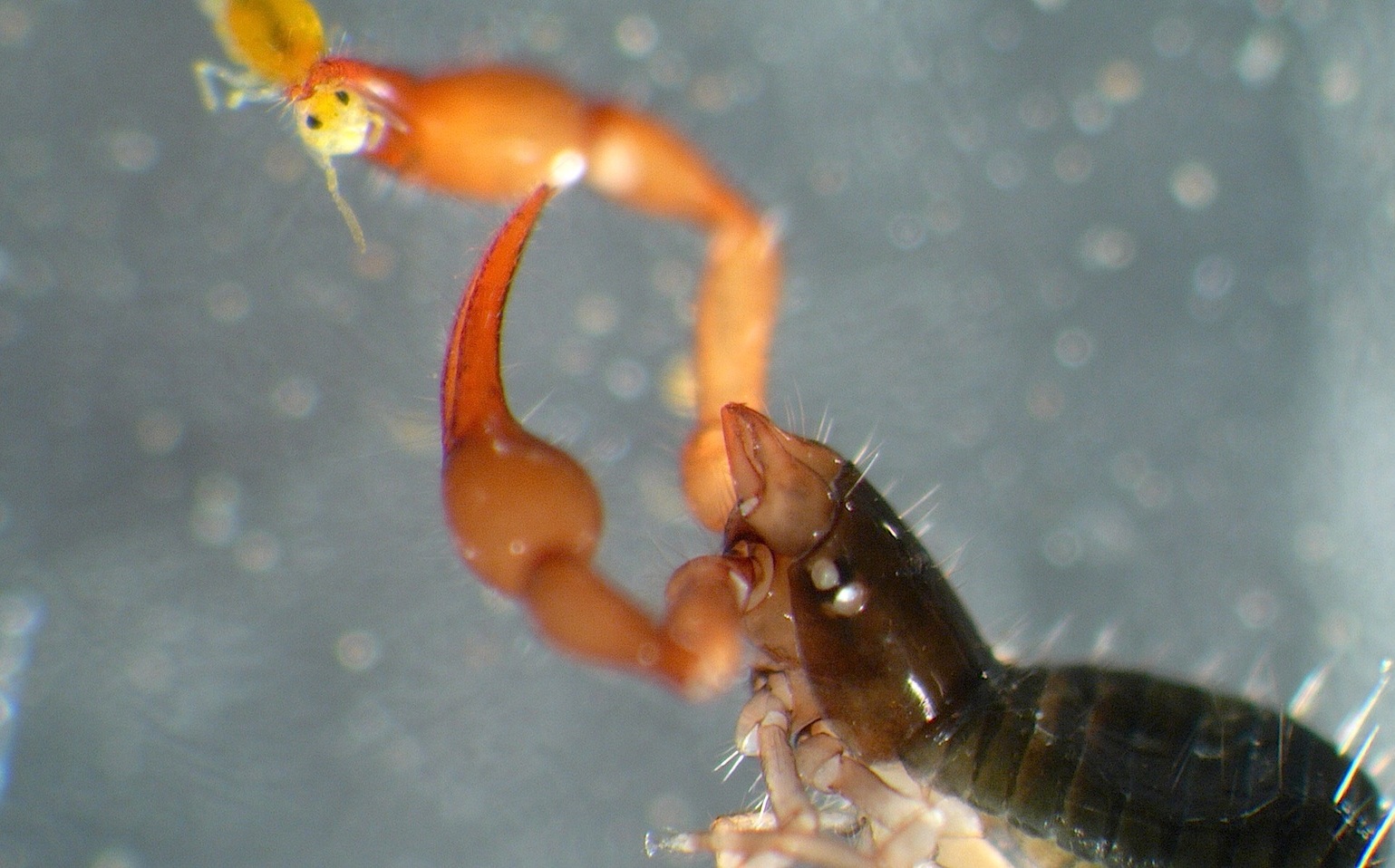

Clockwise from top left:
1) This scanning electron microscope (SEM) image, shows the hypopi (non-feeding / dispersal) stage of an astigmatid mite. Clearly visible on its notogaster (back) are fungal spores, adhering to it. As this is the dispersal stage of the astigmatid mites’ development, the fungal spores are likely to be dispersed with it, to a greater distance than if they had adhered to a different mite.
2) At times photographs can be used to illustrate unusual situations, for example from a pitfall trap, a sminthurid collembolan was found caught in the pincers of a pseudoscorpion, although we know that springtails are prey for these top predators, it is rarely seen.
3) A photograph can be a very good teaching tool, particularly if similar looking specimens are actually different suborders. On the left is an astigmatid mite, whilst on the right is an oribatid mite. The hairiness of the Astig is clearly visible as are the apodemes, in comparison to the Oribatid which has noticeable genital and anal shields, as well as aggenital and adanal shields visible.
4) A photograph illustrating just a tiny portion of the diversity from a soil fauna sample, won first prize in the Agriculture, Food, Diet and Health category in the Biotechnology and Biological Sciences Research Council (BBSRC) science photo competition (February 2010); Featured in Science 327, (2010) p1183 – Random Samples: A World in a Grain.
Unfortunately, due to this immense diversity and opacity, expertise in taxonomy has suffered. There are labs of nematologists, acarologists or microbiologists, but few that try to identify the diversity of taxa to the same level. Teaching soil ecology to students is hampered by these limitations that have already been set.
The ability of visualising interactions at the microscale has increased our understanding of the interactions occurring between the soil fauna. It is thought that soil fauna have a large influence of the microflora community. Ingestion of spores can increase the likelihood of sporulation; faecal pellets can form a large nutrient pulse that can be colonised by bacteria – providing a food source for later; the soil fauna can also be used as a dispersal mechanism, transferring spores to new habitats.
The soil food web has the greatest diversity of species and the greatest number of interactions between species of any food web studied. This is why continuing to investigate these interactions and visualising them is of vital importance to the study of this ecosystem.
Felicity Crotty is also on the editorial board for Beneath Our Feet. Check out her bio on our site here.
The world beneath us

The fungal superhighway: soil fungi colonise different areas in the soil, often depending on the associations they have with plants growing aboveground. Image credit: http://flic.kr/p/dpRSsP.
Soil animals and microbes play important roles in ecosystems: they control the rates of greenhouse gas emissions, mediate the nutrients available for plant growth, and many more functions besides. The more we know about the types of soil communities that inhabit a patch of soil we're interested in, the more we can do to predict how that patch will behave.
The work of Franciska de Vries and colleagues, for example, has shown that soils with more fungi in them could be more resilient to drought. However, the biogeography of soil microbes and animals remains elusive. Mapping what lies beneath has the potential to satisfy much more than our curiosity: knowing which microbial neighbourhood you're in could really help with growing your food.
We know that soil communities tend to be strongly linked to environmental factors, like pH. Because it's much easier to measure pH across large scales, we can use it to help us predict the biogeography of soil communities. Robert Griffiths and co-workers investigated the biogeography of soil bacteria in British soils in 2011, producing a map of the similarities between bacterial communities.
The map reveals broad geographic patterns in soil bacteria, suggesting that land use is a useful way of predicting soil communities: for example, bacteria found in peaty soils in the Scottish Highlands and the English Pennines are similar, despite being many hundred miles apart. Further investigation revealed that much of the variation in soil bacterial communities was explained by pH, plant communities and land use types.

A map of the similarities between bacterial communities in the British Isles, produced by Griffiths et al. (2011).
Above ground, plants have also been shown to help us predict the sorts of soil organisms that exist beneath them. Ruth Mitchell and colleagues have used a statistical technique known as Co-Correspondence Analysis to study how well one community (in this case, the plants) can predict another (the microbes). Ruth and co-workers found that the plant community could indeed be used to predict the soil microbial community. Plants are useful in this respect because they are easier to survey than soil microbes and, because they grow over longer periods, provide a 'summary' of the environmental conditions driving the microbial communities.
In some of my own work, I've identified differences in the microbial communities that occur beneath distinctive landforms in a peat bog, by carrying out an intensive survey of both plant and microbial communities. This approach could be useful because the landforms can be easily identified from aerial photographs, allowing us to potentially map predicted patterns of their associated soil microbial communities over larger areas. Doing this could help us to improve our predictions of how different elements of the ecosystem might be functioning, using computer models.

A map of peatland landforms from Whitfield's PhD. Each landform, easily identifiable from its plant cover, has a distinct microbial community.
Our knowledge of the what lies beneath is improving all the time, and there is a growing library of resources to get into if you're interested. A great example is the European Atlas of Soil Biodiversity [information found here], which was launched in 2010. The Global Soil Biodiversity Initiative is working to publish a Global Soil Biodiversity Atlas, so watch this space!
Mike Whitfield is also on the editorial board for Beneath Our Feet. Check out his bio on our site here.
Making soil biodiversity accessible
I represented the Global Soil Biodiversity Initiative (GBSI) during the Summer of Soil event in Järna in Sweden 2013, and attended the Living Soil Forum, which took place between the 22nd and 26th of July.
During this week, a number of short (TED-talks) were given by invited speakers (I was one of them) in the mornings, and the participants worked with developing projects and ideas related to soil quality and soil biodiversity in the afternoons. My aim was to introduce important research on soil biology and soil formation in a popular way, accessible to people outside the academia.

The event was absolutely fantastic, and very well organized. I was thrilled to meet so many enthusiastic people that cared about the quality of our soils and the organisms living there. For some reason it had been difficult to get scientists to the meeting, while a mixture of teachers, farmers, entrepreneurs etc. were well represented. I think we as scientists should spend more time popularizing our work and making it accessible to ordinary people.
I was inspired by many of the people I met at the meeting. For instance, one woman grew food and feed in a 2000 square meter garden (picture to the right) and her idea was to live on what she could produce in this area, which is the share each person would have on the globe if equally divided. Based on the fodder she produced she had calculated she could eat meat once a week. School classes come regularly for visits and I can just imagine the discussions coming out of these visits. I asked her to what extent she used her own urine to close the nutrient cycle, and we had a long discussion about this.
During the week I spread flyers about the activities going on in the GSBI and I also distributed my popular scientific book about soil (Jord – funderingar kring grunden för vår tillvaro, in Swedish) to those that were interested. I can assure you that there is a lot of interest in what we are doing.

Researchers' Night: Teaching children, exchanging research, and...eating bugs?

(Left: Dr. Gerlinde De Deyn helping school children look for similarities and differences between springtail species using magnified pictures. Of course the students verified for themselves whether the living animals really looked like this.)
On September 27 the European Commission organized Researchers’ Night in 300 cities across Europe. At the events a wide variety of fun-learning activities were offered to the visiting public. If you missed it, don’t worry; Researchers’ Night is a yearly event! Dr. Gerlinde De Deyn had the opportunity to show off the world of soil biodiversity at the event in Brussels. Here are her thoughts on the event.
I do hope you all found your way to a great event in one of the 300 cities across Europe to hear, see, smell and taste all the excitement science has to offer; I think it was especially fun for the general public!

Gerlinde’s nephews helped out at the Soil Biodiversity stand in Brussels, EU Researchers’ night 2013
As a Marie Curie fellow I was in the fortunate position to be a stand holder in Brussels at the central location (yes in Brussels, there were even multiple locations with activities!) in the Sint-Gorikshallen/Les Halles Saint-Géry, close to the Grote Markt/Grand Place.
It was a bit of a logistical challenge to get all the tools from Wageningen University (The Netherlands) where I work to Brussels city. Luckily I am Belgian and have very nice, strong and interested nephews who were happy to help me out with building up our stand.
How exciting to guide crowds of school children in French and Dutch through the wonderful world of soil organisms and what they do for us! I took along several species of living beasties and magnifying glasses so that visitors could verify for themselves that these tiny animals were alive, jumping around, all small, yet different in appearance.

Outreach in action, not all roots are the same, not all soil organisms either! People could take a closer look on the spot using magnifying tools. Note also the image on the laptop screen showing a springtail on its back, which nicely revealed the springtail’s spring structure (furcula).
The microscope proved to be an even more appealing tool than the magnifying glasses. They acted as a magnet for the youngsters. Good to start the introduction of looking at soil nematodes with a word of how to handle a microscope with care (no worries, all went fine).

The Atlas can be downloaded from the website.
There was way too much to explain of course, given the overwhelming biodiversity in soil. Luckily I had copies of the European Soil Biodiversity Atlas with me to offer to the teachers and interested people from various professions. The Atlas was very well received and I trust it will be used, although some people would have preferred a French rather than English copy.
At the expo there was a great number of other interesting stands, amongst which there were insect tastings (dead or alive from the perspective of the insects), studying fungi and yeasts from the national culture collection, lessons in the sex-life of snails, and so on.
There was everything from nematodes and springtails to crickets, grasshoppers, click beetle larvae and little critters alike. It’s not surprising that it did not take long before Peter de Batist - the man at the expo promoting the eating of insects - and I were exchanging research experiences and promotion material. I have to admit my nephews ate the insects (dead and alive), and as a vegetarian I am still wondering when to try my first insects.
You may wonder, what is my main drive of participating in events like this? My main reasons:

Spot the European Soil Biodiversity Atlas at our colleague’s insect (insect-eating) stand.
I like to give people - of all ages - the opportunity to discover a whole new world, a world hidden because of the small size of the inhabitants, yet so nearby and important to all life on earth! I still remember the feeling when I first discovered this hidden world decades ago. In the meantime I have learned a lot, but many mysteries out/down there remain to be solved. There will be exciting times for many years to come!
You are bound not only to meet an interested public but also many other scientists, passionate about their own research, yet with an open mind for other people’s research too.

Weathering the storms
One of the consequences of current climate warming is that the amount and intensity of extreme weather events is increasing. A rapidly growing number of studies show that these extreme events may have complex and often indirect ecological consequences, however, little is known about the role of soil biodiversity in these processes.
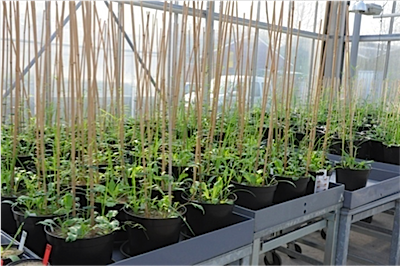
Photo by Annelein Meisner
In a recent paper in PNAS (2013; 110:9835-9838) Annelein Meisner and colleagues show that extreme weather events may tip the balance between native and exotic plant species in vegetation. The researchers dried and wetted soils before planting a mixed vegetation of native and genetically related exotic plant species. Although all soils were re-set to standard moisture conditions before planting, the differences in plant biomass distribution between natives and exotics were striking. In soils that had been dried, exotic plant species became dominant, whereas in control soils, exotics and natives were more in balance. The role of different nutrient availabilities leading to the shifts in plant dominance could be largely ruled out.
In a second experiment, soil samples were inoculated into sterilized soils and planted again with the same plant mixtures as before. Interestingly, most effects could be recalled, suggesting that soil microbes were responsible for the plant responses to the extreme weather events. This study revealed that soil biodiversity might memorize effects of extreme weather events, which may influence plant community composition that was established after the abiotic stress had been taken away.
The study by Meisner and colleagues shows that effects of extreme weather events - due to climate warming - may work out on ecosystems in quite unpredicted ways.
The study also gives rise to some questions.
First, what is the mechanism leading to dominance of the exotic plant species? It is increasingly recognized that feedback interactions between plants and soil properties influence plant community composition. The question now is how these feedback effects are organized. In most studies, plant-soil feedback effects are measured as net effects of all decomposers, pathogens, and symbiotic mutualists. Each of these major groups of soil biota can include hundreds to even thousands of species. The challenge will be to tease apart the contribution of the various groups, as well as the species within these groups in explaining how plant-soil feedback effects may depend on extreme weather events and other environmental conditions. This is a major issue for soil ecologists to study in the near future.
Second, it needs to be analyzed how the effects reported by Meisner and colleagues might work out in the field, where many other influences can affect plant performance, such as aboveground and belowground invertebrates, aboveground vertebrates, resource limitation, as well as other abiotic environmental conditions. Although these issues need more work, a fact is that extreme weather events have been reported to enhance plant invasions. A memorizing effect of the abiotic stress conditions in the soil biodiversity might provide a new explanation for plant invasiveness.
This study on effects of abiotic stress that can be memorized in the soil community is a demonstration of the complex involvement of soil biodiversity in plant community composition and ecosystem functioning.
Still, Pandora´s box does not seem to be fully opened yet. Plant-soil interactions are net effects of myriad interactions of plant roots with the diverse soil community. Some of these interactions can be positive, whereas others are negative. Studies during the past years have elucidated that soil biota can be much more specific in their interactions with plants than has been assumed for long. It is a major challenge in order to further explore soil biodiversity, its specificity, and effects on plant community dynamics.

From Archaeology News Network, credit to Marcel van Oijen