

Blog Archive:
Beneath Our Feet
Soil ecologists define research priorities
Nico Eisenhauer
Professor for Experimental Interaction Ecology
German Centre for Integrative Biodiversity Research
Many, if not most, of the ecosystems on Earth are dependent on, or substantially influenced by, interactions and processes occurring within and among the planet’s soils. The remarkable biodiversity harbored in soil provides essential ecosystem services, and the sustainable management of soils has attracted ever-increasing scientific attention. Although soil ecology emerged as an independent field of research many decades ago, and we have gained important insights into the functioning of soils, there still are fundamental aspects that need to be better understood to ensure that the ecosystem services that soils provide are not lost and that soils can be used in a sustainable way. In a recent Opinion Paper (Eisenhauer et al. 2017; https://doi.org/10.1016/j.pedobi.2017.05.003), we highlight some of the major knowledge gaps that should be prioritized in soil ecological research. These research priorities were compiled based on an online survey of 32 editors of Pedobiologia – Journal of Soil Ecology. The questions were categorized into four themes:
(1) soil biodiversity and biogeography;
(2) interactions and the functioning of ecosystems;
(3) global change and soil management;
(4) new directions.
While some of the identified barriers to progress were technological in nature, many respondents cited a need for substantial leadership and goodwill among members of the soil ecology research community, including the need for multi-institutional partnerships, and had substantial concerns regarding the loss of taxonomic expertise. Global efforts such as the Global Soil Biodiversity Initiative suggest that meaningful collaborative endeavors among researchers could be possible and may represent a starting point from which to build this concerted effort to address the questions presented in our Opinion Paper.

Interaction in the soil caught in the act: a predatory mite from the family Bdellidae feeding on the springtail Sminthurinus elegans. Image by Andy Murray.
Reference:
Eisenhauer N, Antunes PM, Bennett AE, Birkhofer K, Bissett A, Bowker MA, Caruso T, Chen B, Coleman DC, de Boer W, de Ruiter P, DeLuca TH, Frati F, Griffiths BS, Hart MM, Hättenschwiler S, Haimi J, Heethoff M, Kaneko N, Kelly LC, Leinaas HP, Lindo Z, Macdonald C, Rillig MC, Ruess L, Scheu S, Schmidt O, Seastedt TR, van Straalen NM, Tiunov AV, Zimmer M, Powell JR (2017) Priorities for research in soil ecology. Pedobiologia 63: 1-7.
http://www.sciencedirect.com/science/article/pii/S0031405617301063
Ploughshares are swords… if you are an earthworm
Olaf Schmidt
University College Dublin, Ireland
and
Maria J. I. Briones
University of Vigo, Spain
“Let us beat our swords into ploughshares” is an evocative slogan used by peace builders around the world. However, when it comes to earthworms, ploughs are swords that can kill you and destroy your homes.
We have known for a long time that tillage operations impact large soil macrofauna such as earthworms, directly by mechanical injury and indirectly by destroying their channels and burying surface plant residues. For example, a study from Ireland showed that very intensive soil cultivation for potato production (including grubbing, destoning and ridging) can virtually eliminate earthworm populations. Many such individual studies exist around the world. For the first time, scientists have assembled all available primary research results from individual field experiments from the five continents and analysed them together in a meta-analysis, a statistical tool that allows us to look for (and quantify) common effects or trends across many independent studies.
The scientists from the University of Vigo, Spain, and University College Dublin, Ireland, extracted data from 165 publications, from across 40 countries, published between 1950 and 2016. Each of the studies investigated earthworm populations under conventional tillage (inversion tillage such as mouldboard ploughing to 25 cm depth) and other forms of reduced tillage (such as soil loosening up to 25 cm depth and no tillage).
The findings published in the scientific journal Global Change Biology show a systematic decline in earthworm populations in soils that are ploughed every year. The deeper the soil is turned, the more harmful it is for the earthworms.
Results show convincingly that most forms of reduced tillage will increase earthworm numbers and biomass. Among the five forms of reduced tillage analysed separately, the most positive effects were seen in no-tillage (direct drilling) and also superficial tillage or soil loosening <15 cm (non-inversion tillage). Another form known internationally as Conservation Agriculture (which involves retention of at least 30% of organic residues or mulching) also prompted a significant increase in earthworm populations (see figure). These reduced tillage practices are increasingly being adopted world-wide due to their environmental benefits in terms of erosion control and soil protection. They are economically attractive because not having to plough brings savings in cost, labour and fuel.

The effect of the different forms of reduced tillage treatments on earthworm abundance (a) and biomass (b) as a percentage of the control (conventional ploughing). Treatments were No-tillage, Conservation Agriculture (CA), Shallow soil loosening (SSL), Deep soil loosening (DSL), and other forms of Reduced tillage (RT). Mean effect and 95% confidence intervals are shown. Sample sizes are shown on the right of each treatment (number of control–treatment pairs / number of studies). Reprinted with permission of John Wiley & Sons Ltd. from Briones MJI and Schmidt O: Conventional tillage decreases the abundance and biomass of earthworms and alters their community structure in a global meta-analysis. Global Change Biology DOI:10.1111/gcb.13744. Copyright © 2017 John Wiley & Sons Ltd.

Lumbricus terrestris is an ‘anecic’ species, seen here foraging at the soil surface at night. Photo credit: Olaf Schmidt
The study also analysed ecological groups of earthworms (namely epigeics, anecics and endogeic) and the most common species separately. According to the findings, the earthworm species most vulnerable to tillage are the larger ‘anecic’ earthworms that create permanent vertical burrows and feed on soil surface residues. Of all species included in the study, the nightcrawler (Lumbricus terrestris) suffered most under conventional ploughing. The small ‘epigeic’ earthworms that live in the organic litter layers of soil and convert debris to topsoil were also found to be highly susceptible.
These findings can be translated into advice for farmers in different parts of the world. Switching to reduced tillage practices is a win-win situation for farmers because they save costs and, in return, larger earthworm populations help in soil structure maintenance and nutrient cycling. The larger the populations of these beneficial soil organisms, the more of these beneficial functions a farmer will get – for free. Earthworms are also good indicators of soil quality and soil health, it is easy to check for a farmer of his/her soil is in good status by just digging up a bit of soil and checking worm numbers (there are simple guides available that show how many worms you should expect in a spade-full of soil). We know of course that there is much more life in the soil (bacteria, fungi, mites, springtails, nematode worms etc), but to study them is difficult for non-specialists. Earthworms are so useful because everybody can look for them easily.
Coming back to our opening slogan, when we speak about earthworm populations and soil protection, perhaps we should say “Let us beat our swords into ploughshares… but use them less often”. Reduced tillage practices will restore productive earthworm populations and help maintain soil structure, nutrient recycling and other biological soil functions.
Read the original manuscript here:
Briones MJI, Schmidt O (in press) Conventional tillage decreases the abundance and biomass of earthworms and alters their community structure in a global meta-analysis. Global Change Biology DOI:10.1111/gcb.13744
Soil fauna responses to ecosystem disturbances
Dave Coyle
Southern Regional Extension Forestry and UGA – D.B. Warnell School of Forestry and Natural Resources.
Find Dave on Twitter @drdavecoyle, and check out his website.
Mac Callaham
USDA Forest Service – Southern Research Station.
See more about Mac here.

Soil fauna are central to the field of soil ecology. For a generation, scientific giants Drs. Dave Coleman, Dac Crossley, and Paul Hendrix at the University of Georgia - Odum School of Ecology taught a course on soil biology and ecology largely centered on fauna, training numerous ecologists and taxonomists. After these three retired from UGA, however, the class went on a multi-year hiatus. In 2013, Dr. Mac Callaham, a soil ecologist with the USDA Forest Service, and Dr. David Coyle, a forest health specialist with Southern Regional Extension Forestry and the University of Georgia, teamed up to bring the course back. As part of the course, students from the Warnell School of Forestry and Natural Resources, Odum School of Ecology, and departments of Plant Sciences and Crop and Soil Sciences, conducted a literature review on the impacts of various land disturbance factors on soil biota and wrote term papers synthesizing their findings. Student papers were combined and edited into the first-of-its-kind review on the impacts of disturbances on soil fauna, and was published in the journal Soil Biology and Biochemistry (http://www.sciencedirect.com/science/article/pii/S0038071717301530).

Mac is well-known for his work with earthworms, and other macroinvertebrates, and in particular their responses to land-management activities. Dave’s PhD research examined the impacts of a suite of non-native root-feeding weevils in the Upper Peninsula of Michigan. Together, we have often lamented the fact that soil fauna – especially macrofauna – rarely get the attention they deserve (our opinion, obviously). But, in researching this paper, we found that publishing trends confirm this notion (see right). In recent years, there has been a disproportionate increase in papers dealing with soil microbes compared to soil fauna. Anecdotally, with the exception of earthworms, ants, and a select few economically important taxa (think crop pests like corn rootworm, or citrus root weevil), soil fauna are somewhat ignored. And for those of us who work on soil fauna, that isn’t cool. Sure, we know that microbes are important actors in soil ecosystems, but they don’t act alone, and the soil ecology research community has amassed years of scholarship indicating that macrofauna can have big influences on the biomass, composition, and activity of soil microbes.
So, we acted like any good scientists and we wrote about it (and it was peer-reviewed, even!). We synthesized what was known (and unknown) about the impacts of natural and anthropogenic disturbances on soil fauna. For some taxa, there was very little information (published or otherwise) available. For others, information was plentiful. We know there are a LOT of complex interactions between organisms, disturbances, and their environments - especially when dealing with multiple scales (see below). One of our challenges was capturing this heterogeneity and adequately conveying what it meant, in some cases, when information was only available from one scale. Fortunately, there are some really good long-term studies in existence (e.g. Luquillo LTER: http://luq.lternet.edu/) that were great sources of information. We examined natural disturbances like wind damage, flooding and water stress, drought, and fire; invasive plants and invasive invertebrates; and fire. In each case we reviewed the impact of these factors on fauna in different parts of the soil (i.e. epigeic and endogeic/anecic).
In what may hardly be considered groundbreaking to anyone who does research below the soil surface, the take home message was “it depends,” and it depends on a lot of different things. A lot. The impacts of particular disturbances vary depending on the specific fauna in question. It also matters at what scale – you may see fine-level impacts (e.g. in a plot) but at the watershed scale there is no discernable impact on fauna communities. Short time duration versus long time duration also matters, as certain taxa are much better at “rebounding” after a disturbance than others. Additionally, the issue of giving an accurate name to the organism under study (i.e. taxonomy) is important. Most studies of soil fauna do not identify organisms to the species level, which makes interpretation of results incredibly difficult (not to mention complicating the comparison of data across studies).

Types and scale of ecosystem disturbances. Modified from Coyle et al. 2017
Our review reaffirmed some things we already knew: belowground ecology is hard, scale is important, and there isn’t enough taxonomy in the world. It also highlighted some things we didn’t know: the pace of publishing work on soil microbes is much greater than that dealing with soil fauna. As one would expect, there are some significant gaps in the knowledge. But that’s why we’re all here working and reading this blog, in the hopes of filling those gaps.
Soundtrack for Soil Biodiversity
By Elizabeth Bach
Executive Director, Global Soil Biodiversity Initiative
Colorado State University
And
Allison Danish
Colorado State University
Summer is arriving at the Global Soil Biodiversity Initiative secretariat headquarters in Colorado, USA. Like many of you all, we’re gearing up an active field season, some long hours in the lab, and maybe a road trip or two. I always look forward to this shift in work as it usually allows me to jam out to some great music in the background. Inspired by a recent groundwater-themed playlist from the European Geosciences Union, I set out to put together a Soundtrack for Soil Biodiversity!
The playlist captures several musical styles. Each of the songs on the list relates to soil or a soil organism, either literally or metaphorically. Stream the full playlist in the link below this list.
Do you have a favorite song about soil biodiversity? Share with me, and we’ll keep building the list! I’d love to hear what everyone is listening to all around the world!
Another one Bites the Dust by Queen: OK, I know they don’t mean “bite the dust” literally, as say an earthworm might, but this song has pushed me through some long days of sample processing.
The Trees by Rush: Classic rock exploration of forest succession: oaks vs. maples competing for light! No musical exploration of research examining the differences in C and N cycling in arbuscular mycorrhizal fungi dependent maples in contrast to ectomycorrhizal fungi dependent oaks, but you can read up on that here: Phillips et al. 2013. New Phytologist
Nematode by Charlemagne: Nematodes crawling through the soil, decomposition, erosion, this song is about the role soil organisms play in renewing life.
Dirt by Florid Georgia Line: “You came from it, and some day you’ll return to it.” This country-western ballad captures a lifetime lived on the red ultisols (acrisols) of the southeast USA.
I like Dirt by the Red Hot Chili Peppers: The title speaks for itself.
Termite Hop by the Beatnik Termites: Rock & Roll teenage love story song, “everybody’s got to do the termite hop.” Curious about the role of eusocial insects including termites and ants in soil food webs? Check this recent review: King 2016, Soil Biology & Biochemistry
Centipedes by Hot Box Machine: Become one with centipedes on the run, lost in all the fun. Connect with the centipedes and feel at one with the Earth.
Centipede by Knife Party: Centipede vs. Tarantula, scientifically informative electronic dance music. Check out this video of a real centipede taking down a tarantula.
Buggin’ Out by A Tribe Called Quest: A rapper wrestles with the pressures of fame “in between the girt and the dirt.”
Wormship by Illiterate Light: Exploring one’s feelings through the experience of an earthworm in a rainstorm
Earth by Sleeping at Last: Life reflects the processes of the Earth, digging into it tells many stories of disaster and hope.
Cio da Terra (The Earth in heat) by Milton Nascimento: Brazilian ballad praises the "miracle" of soil generating life (in Portuguese).
Bonus tracks (not on Spotify):
All my Friends are Insects by Weezer: Well, one of their friends is an earthworm, which is not an insect, but still a lot of fun!
Dichotomous Key by Billy Kelly & Molly Ledford: This focuses on trees, and it’s a great musical introduction to a dichotomous key:
If you’re working on some writing projects and want music to focus, check out the instrumental version of Aesop Rock’s Music for Earthworms.
The Ground Beneath Us: From the Oldest Cities to the Last Wilderness, What Dirt Tells Us about Who We Are
Paul Bogard
Assisstant Professor
James Madison University
Harrisonburg, Virginia USA

I came to soil from the stars. In my first book, The End of Night: Searching for Natural Darkness in an Age of Artificial Light, I did my best to call attention to the value of darkness and the many costs from light pollution. Most people in modern cities and suburbs—especially the younger among us—have no idea what a real starry sky looks like, and no idea of what they’re missing. The fact that life on earth evolved with bright days and dark nights, and needs both light and darkness for optimal health, is something most of us never think about. When I began to imagine the next book I would write, I quickly realized the same is true of soil.
It’s hard to believe that so few people understand how important soil is for our survival. Hard to believe, perhaps, until you hear the estimate that we in the west spend on average 90-95% of our time inside, cut off from the natural world. My new book, The Ground Beneath Us: From the Oldest Cities to the Last Wilderness, What Dirt Tells Us about Who We Are, began when I heard this stunning number. It wasn’t long before I realized that when we do walk outside, we mostly walk on pavement or asphalt. We have gone from being intimately in touch with the natural ground at our feet to being almost completely separated from it. From there, I began to see how this literal separation was symbolic of our separation from the different grounds that give us our food, our water, our energy, and even our spirit. I decided to explore the many costs of this separation, and the value of knowing the life at our feet.
I certainly could have written an entire book about the wonderful subject of soil. But I decided to place our relationship with soil within the larger subject of our relationship with the ground. I was fascinated by the notion that the oldest spiritual traditions and the newest sciences tell us the same thing about the ground—that it’s alive, and that we would be wise to treat it carefully. I was intrigued as well by the different kinds of “grounds” that give meaning to our lives, such as battlegrounds and burial grounds, hallowed ground and ground we deem sacred. I was—and continue to be—especially interested in the question, Why do we live so separated from and ignorant of that which sustains us?
From the paved ground of New York, London, and Mexico City, to the grounds that would inspire me to ponder the sacred—the Nazi death camp at Treblinka in Poland, the wild tundra of Alaska’s southwest—I went looking for answers. Between these bookends I placed the chapters in which I sought to share the amazing, mysterious, known-more-than-ever and yet still-barely-known world of soil. The similarities to the stars came back to me here. The numbers so large they bend our brains as we try to comprehend. The galaxies upon galaxies beyond anything we now know. And especially, the way that once you know what’s out there, you never look at the sky—or, in this case the ground—the same way again.
Everywhere I go now I find myself looking at the ground with wonder. This is the feeling that stays with me after writing this new book. Wonder that everything growing—even us, if we pause long enough to realize—is anchored in soil, dependent on its life for our life. If I had one wish for the new book, it would be that it help more people to realize this, and bring to soil the attention and respect it deserves. It would be that we would walk outside, look down, and know what we have been missing.

Becoming grounded on the Alaska tundra. Image from P. Bogard
Click here to learn more about Paul and his writing.
30 Questions for Soil Protistology
Stefan Geisen
Department of Terrestrial Ecology & Laboratory of Nematology
Netherlands Institute of Ecology
Wageningen, The Netherlands

Saccamoeba. Image from S. Geisen
With 47 authors of the soil protist initiative, a group closely linked to the GSBI, we have just compiled an important opinion paper to highlight 30 key open study questions dealing with soil protists. We show that protists are a highly-underrepresented group of soil organisms, especially compared with the other microbial bacteria and fungi. However, there are several reasons why protists are important and should be prioritized or at least be included in future soil biodiversity studies!
Protists are incredibly diverse!
Protists are taxonomically highly diverse; they represent the majority of the eukaryotic tree of life where fungi, plants and animals are small monophyletic groups.
We also highlight that protists are morphologically diverse, ranging from bacterial sized taxa of few micrometers to several centimeters.
Furthermore, protists span a huge functional diversity of organisms; in addition to the mainly considered bacterivorous taxa, many protists feed on fungi, nematodes, a huge diversity is parasitic to animals and pathogenic in plants.
Protists are of key importance in soils!
Without protists, bacteria and fungi would have few enemies!
Protists are a key link in soil food webs- without them most soil animals had no food!
Without protists, plants would suffer from nutrient limitation!
This is just a fraction of what we highlight in the paper. For more info, check out the paper published in Soil Biology and Biochemistry. More updates on the soil protist initiative can also be accessed directly here and here.

Fig. 1. Common free-living soil protists as visualized by size (lengths), morphology and phylogenetic affiliation. Modified from Geisen et al. 2017
Don’t hesitate to get in touch with us and be connected- protists are a key part of future research!
Six ways soil biodiversity sustains us!
Elizabeth Bach
Executive Director, Global Soil Biodiversity Initiative
Sustainable Leadership Fellow at the School of Global Environmental Sustainability,
Colorado State University
This blog post first appeared in the HUMANnature blog from the School of Global Environmental Sustainability, Colorado State University
As a 5-year-old, one of my favorite things to do was play in the dirt. My cousins and I would make “soup,” a mixture of soil, leaves, twigs, and some unfortunate bugs, with just enough water to easily stir. The “recipes” were endless; from which part of the yard we got the soil, the ratio of twigs to leaves, the addition of a stray earthworm or insect all contributed to different “soups.” As a kid, this play occupied my imagination for hours at a time. As an adult, the interactions of soil and organisms, dead and alive, continue to fascinate me. Just like a hearty stew, soil provides nutrients and energy to all organisms living aboveground, including people, and sustains ecosystems and humanity now and into the future. How, you ask? Well, here are 6 ways soil biodiversity sustains us!

Clockwise from top left: nematode, psuedoscorpion, burrowing owl, tardigrade. Photo credit: D. Robson, A. Murray, M. Knoth, N. Carrera.
1. It’s Alive! Soil is home to ~25% of all described species on Earth. These range from microscopic nematodes and tardigrades to small psuedoscorpians and even larger animals like burrowing owls. But wait, there’s more! The majority of soil species likely have not even been described by scientists. That means soil holds numerous biological mysteries and likely supports far more than 25% of all species on Earth. Soil is a frontier for exploration and discovery, right beneath our feet.

Left: Legume Gliricidia growing with maize in Zambia, Right: mushrooms. Photo credit: ICRAF, D. Endico
2. It grows our food! Some soil organisms people can eat directly, like mushrooms, truffles, and some insects. Other soil organisms help fruits, vegetables, and grains grow by recycling nutrients from dead plant material. All plants, including crops, need nutrients, such as nitrogen, phosphorous, and potassium, from soil. Most soils have limited reservoirs of these nutrients. But dead plants, perhaps from the previous year’s crop, retain many of these nutrients in their tissue. Soil organisms like insects, earthworms, micro-invertebrates, fungi, and bacteria break down dead plant material, releasing nutrients for new plant growth. Soil organisms are critical to recycling nutrients to grow food and support sustainable farming.

Left: a child receives medication, Right: bacteria colonies can vary in color, shape, and texture. Photo credit: hdptcar, P. Turconi/Fondazione Istituto Insubrico di Ricerca per La Vida
3. It helps us live long and prosper! Soil organisms impact our health and lifestyles in both negative and positive ways. For example, anthrax, tapeworms, histoplasmosis, and brain encephalitis are all caused by soil organisms, including bacteria, pictured above. Valley Fever, or coccidioidomycosis, is a nasty and often deadly disease caused by the soil fungus Coccidioides immitis native in the southwest USA.
Other soil organisms can cure many diseases. In soil, all these organisms live together in a community. Some organisms have evolved defenses, such as antibiotic compounds, that can minimize disease agents. Antibiotics like penicillin, originate from soil organisms, and can combat many illnesses caused by bacteria or fungi, like pneumonia and strep throat. Soils are also a promising frontier in the development of new pharmaceuticals, which may reduce antibiotic resistance. People around the world, like the child receiving a shot in the photo above enjoy healthy lives thanks to soil organisms.

Reindeer grazing. Photo from pixabay.com
4. It supports wildlife! Nutrient cycling from decomposition also supports food for wildlife that we enjoy viewing, hearing, and in some cases, hunting. Without soil biodiversity, wildlife would not have plants, fruit, and nuts to eat. Much like the effects on people, however, soil can also harbor disease organisms that can make wildlife sick, or even result in death. For example, in July 2016, anthrax, a soil bacterium, released from thawing soil in Siberia killed >1500 reindeer. That’s right, Santa’s sleigh may be running slow this year because of a soil organism!

5. It filters water! As water moves through soil, soil organisms use the nutrients and minerals dissolved within it. This effectively removes excess nutrients and some pollutants before water reaches ponds, streams, lakes, rivers, etc. This is important not only for clean drinking water for animals and people (pictured above), but also for healthy fish and other aquatic organisms. In many areas of the US, there is extra nitrogen and phosphorous in surface waters, in part due to run-off of fertilizers from crop fields and lawns. When there is excess nitrogen and phosphorous in water, algae use it grow, consuming large amounts of dissolved oxygen. Reduction in dissolved oxygen can cause fish and other large aquatic organisms to suffocate, generating a “dead zone,” also known as hypoxia. The 2016 “dead zone” in the Gulf of Mexico was estimated to be about the size of Connecticut (5,898 square miles)! Soil organisms can reduce this nutrient load, and the number of algae that grow, keeping our waters oxygenated and healthy.
Soil biodiversity also helps store water in soil. Earthworms, insects, and other animals create tunnels, which allows water to flow into the soil more easily during precipitation events. In addition, soil organisms generate organic matter, made up of the byproducts of biological metabolism (think compost) that gives soils a dark color. Because soil organic matter is charged, it holds water between organic molecules, allowing soil to store more water than clay, slit, and sand particles alone.

Cyanobacteria (top left, right) oxygenated Earth's atmosphere, Soil organisms cycle greenhouse gases like carbon dioxide (bottom). Photo credit: K. Siampouli, Futurilla, Art by MarkAC, EU Joint Research Center; Numbers calculated by US DOE, Biological & Environmental Research Information System.

Left, Mycen chlorophos, a bioluminescent fungus found in Asia, Top right, Fuligo septica is also known as “dog vomit slim mould,” Bottom right, scanning electron image of a tardigrade Photo credits: S. Axford, Stu’s Images, J. Méndez, and M.J.I. Briones
6. It recycles the air! Before plants covered our planet, cyanobacteria (pictured above) used simple carbon molecules and minerals from rocks as energy sources. This released oxygen, which eventually built up in the atmosphere to levels that could support the evolution of more microbes, plants, fungi, and animals, like us. We still rely on plants and soil organisms to maintain enough oxygen in the atmosphere for us to live. Soil organisms also cycle greenhouse gasses, which trap heat near the surface of Earth (pictured above, bottom panel).
Soil organisms can both pull greenhouse gases, like carbon dioxide, out of the atmosphere and respire carbon dioxide back into the atmosphere. When soil organisms decompose dead material, they use carbon from the tissue as an energy source. Some of that carbon is used for growth and reproduction. That carbon can stick around in soil for weeks, years, decades, or even longer. Some of the carbon is used for respiration, just like when we breath, soil organisms produce carbon dioxide. This adds up to a lot of carbon! As shown above, soils contain 2,300 gigatonnes of carbon. By comparison, respiration by soil organisms contributes only 60 gigatonnes of carbon back to the atmosphere. We can help soil organisms potentially reduce greenhouse gasses in the atmosphere through land management choices like ecosystem restoration, conservation farming practices, and increased urban green space.
Soil organisms are truly the unsung heroes of sustainability. We need them. Wildlife needs them. Fish need them. Ecosystems need them. Soil biodiversity not only sustains life on earth, it is intrinsically fascinating. From bioluminescent fungi (pictured far left) to dog vomit slime mold (pictured top right) and adorable tardigrades (pictured bottom right) soil is home to some awesome living things. It is organisms like these that captured my adult imagination long after my “soup” making days as a kid. The best part is, it is not imaginary at all. The real world beneath our feet is astounding and essential. We all need living soil, so future generations can play and thrive in the dirt.
All images, except the reindeer, are from the Global Soil Biodiversity Atlas and available for free download (pdf) and use
The Marvel of Soil Biodiversity

By Leo M. Condron, Professor of Biogeochemistry, Lincoln University, Canterbury, New Zealand
This article appears in the Autumn 2017 issue of New Zealand Turf Management Journal
We have been granted permission to share this article in full.
Click the image on the left to view the full article.
Little Houses in Big Trees
David Walter
mite researcher
University of the Sunshine Coast and Queensland Museum

This article appears in Wildlife Australia magazine from the Wildlife Preservation Society of Queensland. The full publication is available digitally and in print.
We have been granted permission to share this article in full.
Click the image on the left to read the the article.
Illustrating Soil Life
By Katelyn Weel, artist, Gransherad, Norway
I first discovered the beauty and elegance of microscopic creatures as a student of Environmental Sustainability at Lakehead University in Orillia, Ontario. During my studies, I worked as a research assistant analyzing protozoa and diatoms in natural freshwater biofilms.

Vorticella. By Katelyn Weel
In 2013 I left Canada and started working at VitalAnalyse in Norway, where I observed soil in the microscope and started learning about soil life as it applies to agriculture. Despite having studied environmental sustainability for four years, until I started this work I really had no idea about what was going on in the soil. Once I started to learn just how complex and intricate below ground ecosystems are and how little we really know about them, I developed a much greater appreciation for soil, and I started to see the need for a very different approach to agriculture.
In my role at VitalAnalyse, I occasionally help lead public workshops, seminars, and demonstrations about life in the soil. During these events, I have noticed that the smallest things most people can easily relate to are usually mites or springtails that can be seen with the naked eye. If it requires a microscope, it starts to feel abstract. Even solid and detailed images taken from scanning electron microscopes are clinical looking, alien, out of context, or simply too “sciency” for most non-academics to connect with. If only we could take pictures of rotifers, protozoa, and bacteria in their natural habitat with regular cameras, to simply observe them as we would any other animal with our own eyes.
I decided to try using my imagination and my experience with the microscope to illustrate what it might look like if we could simply shrink down and observe rotifers, flagellates, ciliates, and other soil organisms face to face in their natural habitat.
In each drawing, I aim to demonstrate some of the complexity and diversity of soil ecosystems, including small details you might not notice at first glance, such as tiny flagellates, bacteria, or threads of fungi in the background. I want to illustrate the organisms in a way that they are both realistic and beautiful, and to draw the viewer into the mysterious world beneath us.
The drawings have been well received here in Norway. I’ve realized that there is a lack of illustrations like this in our field, so I am reaching out to let more people know that these drawings exist, and I’d love to do more.
My gallery of soil life illustrations can be found here. There are more drawings in progress, and the site will be updated as I continue adding to the collection. I hope that my artwork can help more people connect with soil biology, and bring them a little closer to the invisible and underappreciated world of microbiology that is so important to our everyday lives.

Rotifer. By Katelyn Weel

Testate amoeba. By Katelyn Weel
Chasing rabbits: How do soil communities respond to herbivore mammals? Part II
Walter Andriuzzi
Postdoctoral Fellow
Colorado State University
In the previous post I described how herbivore mammals, from rabbits to cattle, can affect the soil food web, and how difficult it is to find general patterns across different places. Here I summarize what we found in a meta-analysis of field studies that had compared soil communities inside and outside exclosures (plots of land that were fenced to keep herbivores out).

Rene van der Wal, ecologist at University of Aberdeen, surveys the plant community on Isle of May. Photo by: Walter Andriuzzi
First, the effects of herbivores depend on climate. For example, soil respiration rate is lower with herbivores than without in subarctic ecosystems, whereas in temperate ecosystems it is higher with herbivores than without. Second, the effects of herbivores vary between trophic groups in the soil food web, and between soil biological functions. For example, unlike respiration, soil microbial biomass and nitrogen mineralization rate do not respond consistently to herbivores in either climate type, whereas they both tend to decline when herbivores are present under arid climates. In subarctic sites, root-feeding nematodes are negatively affected by herbivores, whereas predatory nematodes appear to do just as fine.
Third, the effects of herbivores vary also within trophic groups in the soil food web. Take for example two of the most widespread and abundant groups of soil animal decomposers, oribatid mites and springtails: the former decrease in abundance when herbivores are present, whereas the latter do not show a consistent response. Fourth, the effects of herbivores depend on the herbivore species, in a way that can be at least partly predicted based on their body size: the smaller the herbivore, the more likely its effects on the soil organisms to be neutral, or even positive (that is, increasing biological activity or abundance of soil organisms); the larger the herbivore, the more negative its effects tend to be.
How do our results compare with previous theory? An established framework predicts that herbivore presence has positive effects in the highly productive systems, and negative effects in poorly productive systems. However, the results of our meta-analysis support these predictions only in part. Herbivores have negative effects in low productivity biomes, for example in tundra, but most highly productive systems also exhibited negative effects of herbivory on belowground communities. The big exception was soil respiration in temperate grassland. Moreover, we found that climate is more important than vegetation type; and that herbivore identity and body size are also important.
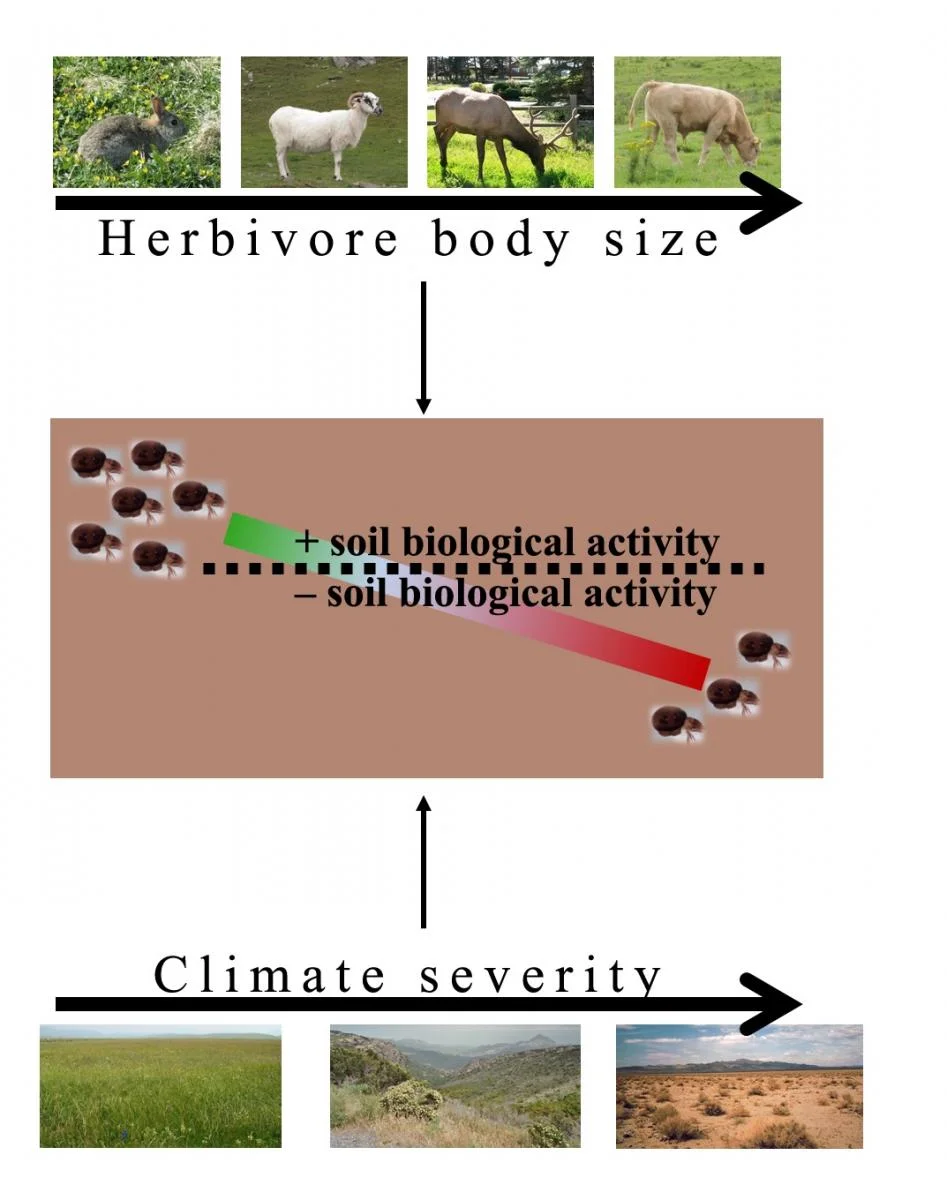
Conceptual model of how herbivore size and climate determine the effect of herbivores on the soil community. Modified from Andriuzzi & Wall 2017
In our meta-analysis, we did observe that responses tend to shift to negative with increasing body size, and an explanation may well be physical disturbance. A more recent framework of belowground responses to herbivory focused on the role of large herbivores on soil compaction. In fine-textured soils, trampling by cows reduces soil pore size and limits oxygen and/or water availability, leading to declines in mineralization rates. We could not test the importance of soil texture in our meta-analysis, because too few of the available studies quantified it rigorously.
Based on our results we developed a conceptual diagram which partly integrates those previous frameworks, by envisioning gradients of herbivore body size and/or climate limitations. Small herbivores, for example the rabbits on the Isle of May, may have limited effects on soil biological activity, or even enhance it by fuelling the soil food web with their excreta and/or more palatable plant resources. Large herbivores, for example cattle (especially if at high density), may lead to physical disturbance such as compaction (because of trampling) and exposure of soil to erosion and atmospheric agents (because of great reduction of plant cover) so the net response belowground is negative. Likewise, with a temperate climate herbivore presence could promote soil biological activity, though not to a great extent if the system is productive enough (as likely was the case on the Isle of May). In ecosystems more limited by aridity, cold, etc., herbivore presence begets the opposite response due to its physical effects on soil. All this is a simplification - different groups of soil organisms may not respond in the same way – but it offers a mechanistic framework to make sense of our findings, and to generate new hypotheses to test.
There are several areas with limited data that challenge the applicability of our general frame work. There were very few studies from the tropics that we could include in the meta-analysis. As a result, while we know a good deal on the effects of reindeer on soil organisms in subarctic tundra, we know next to nothing on those of elephants and impalas in African savannah. Another major surprise was how little some major groups of soil organisms have featured in herbivore exclusion experiments. Protists, which are essential in the soil food web, are lacking altogether from the meta-analysis; earthworms, which have huge effects on soil and plants, were also poorly represented. I hope that our meta-analysis will spur new research to understand how herbivores change their ecosystems not only aboveground, but also belowground.
Chasing rabbits: How do soil communities respond to herbivores? Part I
Walter Andriuzzi
Postdoctoral Fellow
Colorado State University
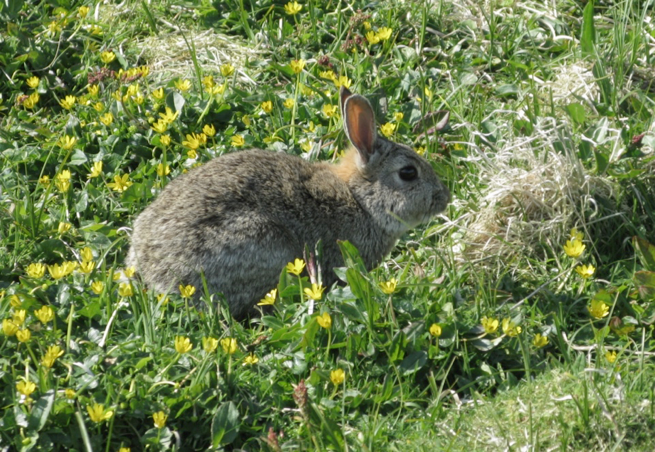
Terror of the undergrowth: A young rabbit on the Isle of May.
Photo by Water Andriuzzi
June 2011. I am standing near the edge of a vertical cliff above the Atlantic Ocean. Two puffins glide and land gracefully on the rocks despite their almost comically short wings. I am on the Isle of May, a wind-swept Scottish island with some of the biggest colonies of marine birds in Europe. Not far from the guano-streaked cliff there is a small plot of land enclosed by a fence. This is an exclosure, and its task is to keep out the rabbits that graze the vegetation on the island with the efficiency of a lawnmower. The grass outside, punctuated by cushions of forbs like Silene uniflora and Armeria maritina, is ankle-high; inside, the grass brushes my knees. And this is not the only difference. Outside the exclosures, the ground is littered with rabbit faeces, which fertilizes the soil. The plants grazed by the rabbits undergo changes in their chemical make-up, and tend to release more carbon into soil as root exudates. The rabbits also change the environment physically: with a reduced plant cover, the ground is more exposed to atmospheric fluctuations; and of course, rabbits make burrows. Unsurprisingly, excluding rabbits is a big deal for the plants. But what happens belowground?
This is a question that ecologists Richard Bardgett and Rene van der Wal have investigated since the early 2000s. They set up these exclosures on the Isle of May to test the idea that the effects of herbivores on a soil biological community depend on the fertility of the system. The Isle of May is an ideal natural laboratory to test this framework, because it has two levels of soil fertility: near the seabird colonies the soil is enriched in nitrogen of marine origin (courtesy of the birds’ guano and ammonia), whereas in the middle of the island it is not. And yet, three years after the exclosures had been established, rabbits had the same (weak) effects on the soil food web regardless of whether the plots were close to the coast or not.
In 2011, as a master’s student of van der Wal, I seek to find out if things have changed eight years since the experiment started. As a proxy for the soil food web, I study the nematodes, microscopic roundworms that live in the water films between soil particles. They occupy almost all trophic levels belowground: there are nematodes that feed on bacteria, nematodes that feed on fungi, nematodes that feed on microalgae, nematodes that feed on plant roots, and nematodes that feed on nematodes. Because they are so diverse and extremely abundant, they have a big impact on ecosystem functioning; in turn, of course, they are affected by what happens to the plants and the soil where they live. And yet, once again we find only small differences in the soil food web inside and outside the exclosures, despite obvious differences in plant biomass and plant diversity.

One of the exclosures on the Isle of May. Photo by: Walter Andriuzzi
The difference between what happens above and below ground is in no way peculiar to this experiment. Many other studies found surprisingly weak effects of herbivore mammals on soil fauna and microbes. Other studies found big effects, but not in a consistent direction: in some herbivores increased the abundance of soil organisms or the rate of soil biological processes, while in others the opposite was observed. In an attempt to better understand general patterns in belowground responses to herbivory, I recently performed a meta-analysis, an analysis of results from numerous previous studies, on herbivore-plants-soil interactions to find global commonalities in how soil organisms and the biological processes they regulate respond to herbivores. Stay tuned for the next post to discover what I found out!