

Blog Archive:
Beneath Our Feet
Arbuscular Mycorrhizal Fungal networks in the spotlight
By Corentin Bisot, Vrije Universiteit Amsterdam

Arbuscular mycorrhizal fungi use plant-derived carbon to build extensive underground networks of filaments, called hyphae, that can stretch for meters through the soil. These networks are ubiquitous in underground ecosystems, measuring over meters per cubic centimeter of soil. Their detailed structure has however never been fully resolved.
In our work, we built a custom microscope capable of capturing month-long timelapses of growing fungal colonies in controlled conditions. To analyze this large amount of data (100s of Terabytes), we developed an image-processing pipeline that tracks the movement of millions of hyphal tips, the growing part of fungal hyphae.
We find that these tips collectively behave as a travelling wave, forming a propagating front that leaves behind a well-structured network that coats space surprisingly evenly. This network is crucial for nutrient acquisition, as many plants rely on this symbiosis for a significant portion of their mineral intake. Striking a balance between dense coverage and outward expansion appears to be a carbon-efficient strategy to supply nutrients while also exploring for new host plants.
However, carbon and nutrients must flow in opposite directions—carbon from the plant to the fungi, and nutrients (nitrogen, phosphorous, etc) back to the plant. By zooming in on individual hyphae, we observed bidirectional flows, with resources moving both ways inside single tubes. These flows varied over time and space, suggesting a finely tuned system aligned with the needs of each organism.
This research opens new questions: How do these fungi balance network growth and resource exchange? And what physical mechanisms drive such coordinated bidirectional flows? We are just beginning to uncover the hidden dynamics of this fascinating underground world.
Because the soil is opaque, organisms that live there are by nature invisible. By bringing them to the light of the microscope, we hope that their beauty can also help protect them.
Highlighting soil biodiversity and bringing its stunning intricacies to public awareness is a central mission of our team. Toby Kiers founded the Society for the Protection of Underground Networks (SPUN), spearheading global expeditions to document and protect soil biodiversity. Additionally, thanks to captivating artwork by Loreto Oyarte Galvez, our work reached a broader audience through a feature in The New York Times. Corentin Bisot further enhances public engagement by developing the Living Soils Workshop, designed to share the wonders of soil ecosystems with communities worldwide.
Unveiling the Global Richness of Arbuscular Mycorrhizal Fungi
By Stefanie Lutz & Marcel van der Heijden, University of Zurich and Agroscope
The symbiotic relationship between plant roots and mycorrhizal fungi is an ancient and vital cornerstone of life on land. Originating over 450 million years ago, this partnership has enabled plants to colonise terrestrial environments and shape ecosystems across grasslands, forests and deserts. Among these fungi, arbuscular mycorrhizal fungi (AMF) are particularly well known for their role in plant nutrient acquisition, drought tolerance and disease resistance, all while receiving essential carbon compounds from their plant hosts.
Traditionally, AMF research has focused on the Glomeromycota (G-AMF), a group of fungi extensively studied for their association with most land plants. However, recent discoveries have shown that fungi of the Mucoromycota phylum, in particular the enigmatic Endogonomycetes (E-AMF), also form arbuscule-like structures, broadening our understanding of mycorrhizal diversity. While the evolutionary and ecological nuances of these fungi remain a subject of debate, the broader view underscores their importance in plant-fungal mutualisms.
A Hidden Wealth of Diversity

Figure 1: Diverse AMF structures, from left to right: arbuscules (credits: Ryan Geil), vesicles and hyphae (credits: Marcel van der Heijden), and spore assemblage (credits: Fritz Oehl) (credits soil profile: Gabriela Brändle, Agroscope).
In our recent study published in Fungal Ecology, we aimed to increase knowledge of the global molecular diversity of AMF by analysing existing long-read sequencing data from a combination of global field surveys covering 4,733 sampling sites across all terrestrial biomes and continents. Our study provides the first combined estimate of global G-AMF and putative E-AMF richness, far exceeding previously reported numbers and taxa. Specifically, we detected 8,517 OTUs (Operational Taxonomic Units, roughly corresponding to species) of G-AMF, exceeding previous AMF richness estimates by a factor of five to fifteen. In addition, we identified 600 OTUs for putative E-AMF with many unknown species, providing the first global estimate for this group.
Advances in sequencing technologies, such as the use of long-read sequencing, are paving the way for more accurate assessments of fungal diversity. These tools allow researchers to uncover rare and cryptic species, filling gaps in our understanding and providing a basis for global biodiversity assessments.
Towards a Comprehensive Understanding
Understanding the diversity of AMF is more than an academic pursuit. These fungi are an integral part of ecosystem resilience, particularly in the face of climate change and habitat degradation. Rich and diverse mycorrhizal communities improve soil health, enhance plant productivity and stabilise ecosystems under changing environmental conditions. Grasslands, for example, host the highest AMF richness, highlighting their role as hotspots for conservation efforts.
The ongoing study of AMF is a reminder of the intricate, often invisible networks that sustain life on Earth. As we expand our knowledge of these ancient symbionts, we not only unravel the complexities of their evolution and ecology, but also equip ourselves to better protect the ecosystems they support. By embracing the full spectrum of AMF diversity, from G-AMF to E-AMF, we can foster a more resilient and sustainable future for both natural and managed landscapes.
Caatinga Microbiome Initiative: an effort of Brazilian researchers to explore the soil microbiome to measure and facilitate ecosystem recovery
By ademir araujo, Federal University of Piauí (BRAZil)

From left to right: Ademir Araujo, Vania Melo, Lucas Mendes, Erika Valente, Arthur Prudencio, Mauricio Cherubim.
The Brazilian Caatinga is the most biodiverse semiarid ecosystem worldwide and is the only biome entirely unique to Brazil. Like most drylands the Brazilian Caatinga experiences frequent droughts, high temperatures, and concentrated rainfall which paired with fragile soils accelerates soil degradation. This causes soil microorganisms, which play an essential role in soil quality and health, to be severely affected by drought, high temperatures and soil degradation. To monitor the effect of degradation and potential benefit of restoration on soil biodiversity, strategies for restoration have been implemented for decades and focused on soil management practices, such as grazing exclusion, terracing, and agroforestry. However, several studies have shown that it takes several years to restore the soil microbiome. In addition, several gaps remain unexplored yet. To start, researchers need to assess the core microbiome, including viruses, and protists. Native and resilient microbiome may allow researchers to create efficient SynComs to aid in restoration of these fragile communities. To address these knowledge gaps, Brazilian researchers created the Caatinga Microbiome Initiative (CMI) with the mission of understanding how soil microbial communities change during desertification and restoration, and how manipulating these communities could accelerate ecosystem recovery. CMI works on two key approaches: (1) using microbiomes as diagnostic tools to assess the success of restoration strategies and (2) manipulating microbial communities to facilitate ecosystem recovery. This initiative employs molecular-based techniques, such as metagenomics and metatranscriptomics, to study the functional potential of soil microbiomes in degraded and restored areas. This approach will allow researchers to better understand the microbiome’s role in carbon sequestration, nutrient cycling, and soil stability, thus helping to refine restoration practices. Specifically, CMI will explore these under-studied microbial groups and their functions to gain a deeper understanding of how soil microbiomes support ecosystem resilience. It also aims to establish a comprehensive, interdisciplinary network to investigate how soil microbiomes function in response to different restoration strategies. The initiative's findings will contribute to the development of sustainable land management practices in Brazil and serve as a model for combating desertification in other parts of the world, benefiting over 250 million people globally.
Read the paper here:
Araujo, A.S.F., de Medeiros, E.V., Costa, D.P., et al. (2024). Caatinga Microbiome Initiative: disentangling the soil microbiome across areas under desertification and restoration in the Brazilian drylands. Restoration Ecology, e14298. https://doi.org/10.1111/rec.14298
Don't toss your worms, forward them!
By George Brown, Embrapa Forestry/Federal University of Paraná (BRAZil)
Approximately one quarter of the world's animals live in the soil (Anthony et al. 2023), and yet samples taken in even well studied regions can yield new species, particularly in the tropics and subtropics. This is true even for well-known taxa such as earthworms for which around 5,750 species have been discovered, although it estimated that there are over 30 thousand species of earthworms. This can lead to a deficit in biological information that is worsened by inadequate preservation of soil fauna specimens collected worldwide.

Periscolex brachycystis, a native earthworm of Mexico, with a tissue sample taken from the posterior part of the body and placed in the Eppendorf vial, for posterior DNA extraction and molecular analysis (Photo: Carlos Fragoso).
In a paper co-authored by earthworm taxonomists Marie Bartz, Samuel James, Csaba Csuzdi, Daniel Marchán, Carlos Fragoso, Thembeka Nxele, and Chih-Han Chang, recently published in the journal Biodiversity, we make an appeal to researchers who work with or collect soil fauna to adequately preserve and forward their samples to institutions that can store this material over the long-term. The article includes a list of specialists and institutions worldwide that can receive earthworm specimens, aiming to preserve them for future research, thus avoiding the loss of global genetic heritage. It also provides step-by-step instructions on how to sacrifice, preserve and forward the specimens.

A new species of earthworm in the genus Glossoscolex, in the Natural History Museum of the Federal University of Paraná in Curitiba, Brazil (Photo: George Brown).
Importantly, after carrying out the often-arduous field work needed to collect soil fauna specimens, one must also undertake the equally arduous subsequent work of cleaning, sorting, cataloging, and finally, preserving and maintaining these samples for future studies. Unfortunately, we have seen many situations where this latter process, a routine in museums and zoological collections, was not adequately conducted. This occurs especially in institutions with limited infrastructure or support for preserving fauna samples. Consequently, many samples often collected in biologically rich locations can dry out or rot, and are subsequently discarded and/or lost, as there is no infrastructure or space available to accommodate the material and maintain it with due curatorial care.

One of the moving cabinets of the earthworm collection (Fritz Müller Oligochaete Collection - COFM) at Embrapa Forestry in Colombo, Brazil. (Photo: George Brown).
Although focused on earthworms, this appeal can be equally applied to many other taxa of soil or epigeic invertebrates collected using Pitfall traps, Winkler, Berlese, or Tulgren extractors, or by hand sorting of monoliths with the Tropical Soil Biology and Fertility (TSBF) method. However, for non-Annelid taxa different sample preparation techniques may be required, so if you have specimens of other taxa that you wish to forward, please contact regional or state zoological museums, to get advice on the fixing, processing and shipping of your specimens (contact information for some countries can be found in the manuscript). If you have specimens collected using any of these methods, and you believe that you cannot adequately preserve and maintain them over the long-term, please forward them as a donation to appropriate institutions. Besides guaranteeing their conservation, this additionally provides specimens for future studies (especially of taxonomic, genetic and biogeographic nature) and helps avoid the loss of important biological information!
Finally, please remember to adhere to the Nagoya protocol for signatory countries, which includes obligations on the protection, use and sharing of benefits derived from biodiversity. Furthermore, remember to follow the laws and regulations concerning the shipment of biological specimens within-country or to other countries. If specimens are to be shipped or donated to other countries/institutions, various other official scientific or bureaucratic documentation may be necessary. Please certify that all the necessary permits and documents are in order before mailing your specimens.
We thank you in advance for your efforts and contributions towards the long-term preservation of our world’s rich soil biological heritage!
Natural selection in mycorrhizal symbioses
By: Dr. César Marín, Full Professor, Universidad Santo Tomás, Chile | Editor-in-Chief, International Mycorrhiza Society Newsletter
Many biologists hold a strong gene-centric view of evolution: they define evolution as a change in the frequency of alleles. However, many widespread processes, particularly in plants and their microbiomes, complicate this definition: epistasis – where the effect of a gene on the phenotype depends on a complex network of interactions; epigenetic inheritance (heritable changes that do not alter DNA sequences), and horizontal gene transfer between hosts microbes complicate a gene-centric view of evolution, where there is a simple correspondence between genotype and phenotype (one or few non-interacting genes explain one trait). In addition, conceptual and empirical developments over the last century, show that natural selection occurs across multiple levels of the biological hierarchy. In particular, Multilevel Selection (MLS) theory argues that natural selection operates simultaneously in multiple levels of the biological hierarchy (from molecules to communities). This is because at the individual level, selfish individuals outcompete cooperative individuals, but cooperative groups outcompete selfish groups. For example, Darwin argued that within a tribe, individuals who behave more selfishly will have advantages and out-compete the more cooperative individuals, but tribes with individuals “always ready to give aid to each other and sacrifice themselves for the common good, would be victorious over most other tribes; and this would be natural selection” (Darwin, 1871; The Descent of Man, p. 166). Other common examples of MLS theory include the evolution of eusocial insects such as bees and ants -it would not make sense to think that natural selection operates solely at each individual insect level, cancer (where natural selection operates at the organismal and cellular levels), and holobiont (an animal or plant host and its fitness-aligned microbiome) evolution. MLS has long been used in poultry science, where artificially selecting entire cages of less hostile hens produces more eggs than selecting the individual hens that produce more eggs. Please find here a simple explanation of this theory. During the 12th International Conference on Mycorrhiza, which took place in Manchester, UK, in August of 2024, Nancy Collins Johnson and I chaired a workshop dedicated to understand how MLS theory can be used to understand the mycorrhizal symbiosis, across multiple scales.
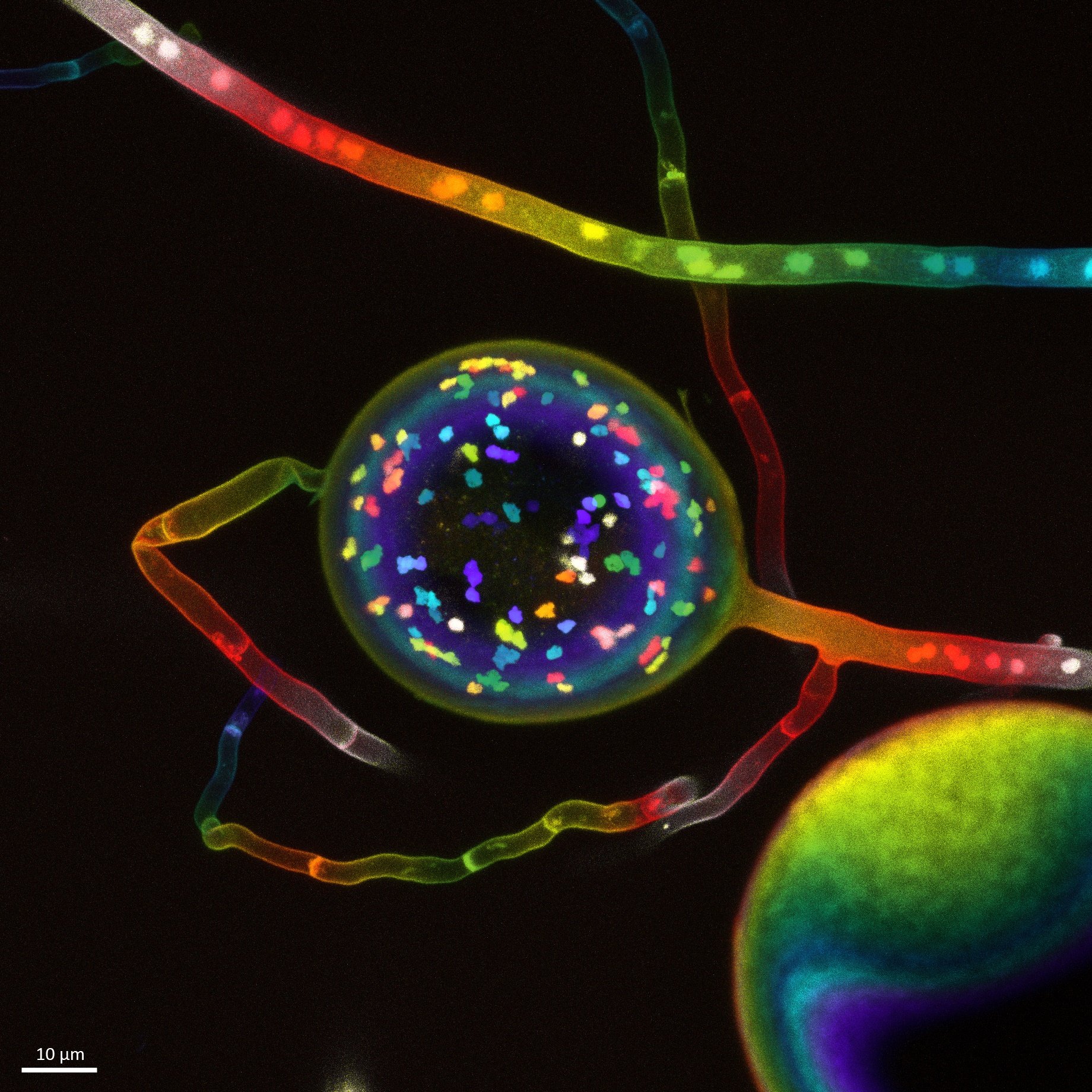
Fig. 1. Spore of an arbuscular mycorrhizal fungus containing multiple nuclei within (represented in different colors). Photo by: Vasilis Kokkoris, Franck Stefani, and Nicolas Corradi.
Hundreds of studies have recognized MLS in natural and laboratory populations, and it may be a useful model, particularly for understanding the evolution of arbuscular mycorrhizal (AM) symbioses. Historically, there has been a conflation of the units involved in natural selection (“units of selection” debate) and uncoupling them may be enlightening. We argue that recognizing three distinct units of natural selection may facilitate a MLS paradigm for the evolution of AM symbioses. One unit interacts with the environment and leads to differential fitness (interactors), the second unit generates inheritance (replicators/reproducers/reconstitutors), and the third unit manifests accumulated or optimized adaptations (manifestors of adaptations). A detailed explanation of these units of selection can be found here. These three different evolutionary functions do not need to occur at the same level of the biological hierarchy. For example, genes would typically constitute replicators, holobionts can be considered as reconstitutors (as their microbiome reconstitutes each generation), while individual organisms (but also groups of organisms, and holobionts and communities) can constitute an interactor. Typically, individual organisms are classical examples of manifestors of accumulated adaptations – as Darwin finches’ beaks, where the change is gradual and accumulates over time. Accumulated adaptations contrast with “product-of-selection” adaptations, like the industrial melanism in moths, where due to the industrial Revolution in the XIX century, it was noted that dark moths became more common. In such case, is the frequency of dark/white moths what changes, but not their biology. We suggest that an understanding of the types of adaptations through this tripartite framework of units of selection could help explain phenomena such as the unusual nuclear dynamics of AM fungi (as a single AM fungal spore can have hundreds of nuclei; Fig. 1), and the presence of a core, P-mineralizing microbiome in the AM fungal hyphosphere (ie. in the microbiome inhabiting the hyphae). This workshop explored how natural selection operates across the biological hierarchy in AM systems, from nuclei to groups of plant holobionts and ecosystems. It included five talks by: César Marín (Chile; introduction to this framework); Sander van Otterdijk (The Netherlands; selection at the nuclei level); Letian Wang (China; on a core functional microbiome in the AM fungal hyphosphere); James D. Bever (US; on plant-soil-feedbacks and the relationship of this concept with MLS theory); and Nancy Collins Johnson (US; on “Functional Team Selection” as a framework to understand how plants assemble their belowground microbiome) (Fig. 2).
We hope that this workshop will illuminate debates regarding individuality and holobionts in AM systems and help advance the development of theories and experimental systems to elucidate mechanisms of mycorrhizal evolution. This knowledge is necessary before AM symbioses can be effectively managed in agriculture and ecosystem restoration.
YouTube link of the workshop: https://youtu.be/vKDwfqW6Ask?si=2mpvwh0NWEDBslom
Website: https://cesar-marin.com/

Fig. 2. From left to right: Letian Wang, Sander van Otterdijk, César Marín, Nancy Collins Johnson, James D. Bever. Photo by: Patricia Silva-Flores.
Celebrating the Launch of the First Local Soil Biodiversity Network: The Irish Soil Biodiversity Research Network (ISBRN)
By Dr Tara Dirilgen, Founder ISBRN | Assistant Professor of Environmental Biology & Sustainability, Maynooth University

ISBRN members at network launch meeting 26 June 2024
The Irish Soil Biodiversity Research Network (ISBRN) was officially launched on 26th June 2024. It was a great success, thanks to the attendees presence and active participation throughout the day. Fifteen people from across 8 Institutions (AFBI, DCU, MU, UCC, UCD, UG, Teagasc and TUD) participated in showcasing their research and contributing to discussion topics (network mission and scope; project capture; funding landscape and opportunities; future direction of ISBRN). The main take home was the enthusiasm and agreement in the timely nature, and need for such a network in Ireland.
In the hope that it will encourage others to establish their own local network, I share below some background to how the network came about and learnings from the organisation of the first meeting.
Inspiration
It was when I joined the Irish Pollinator Research Network (IPRN) that I realised, first hand, the value of having and being a part of such a network. IPRN exemplified how openness, transparency, collegiality and collaboration can be at the forefront of the science we do. A reality often hindered by competition, especially if in the same research field/area (and in such a small country!).
Motivation
This was twofold and a couple of years in the making; the personal motivation and the scientific motivation. The personal piece is that I was, at the time, transitioning into an independent researcher, and as a postdoctoral fellow felt that I was out of the loop re: (i) knowing who was who and what they did (yes, even in a country the size of Ireland), and on the flip side (ii) realising that I was not included in some relevant communications (this likely a result of not being a PI/Research Group Leader at the time). The scientific motivation was purely aspirational: by bringing all researchers together we could collaborate but more importantly, we could collectively, make better progress and strides in furthering our knowledge of soil biodiversity.
The final push (so perhaps three-fold) came during the 3rd GSB conference in Dublin, where Dr. Monica Farfan (past GSBI Executive Director) pitched to us the idea of local networks by country and GSBI’s support for such an initiative.
Realization
This took a bit of work and benefited from having an organising team for the first meeting (thank you to Dr. Grace Hoysted and Dr. Fiona Walsh for jumping on board). As the main aim was to capture all researchers across the island of Ireland, we made sure to advertise and circulate as widely as possible. The workshop style discussion of pre-set topics enabled us to capture all opinions and ideas.
What worked:
· Meeting agenda and format (elevator pitches + workshop style brainstorming)
· Promotion of event and network using many channels within and beyond Ireland. This had a two-fold effect of promoting the network and ensuring a wide reach. We had more member sign ups and PIs than anticipated - positively reinforcing the need for such a network
· Having some funding to support the meeting e.g. catering, workshop supplies, etc
What could be improved:
· Having an external expert facilitator/mediator of the discussion topics (although, I like to think I did as good a job as possible having to put on many hats!)
· Allocating sufficient time shortly after the meeting to collate the discussions. While still fresh in everyone’s minds.
Immediate Outputs
· The next meeting will be hosted by University of Galway (UG), date to be set for 2025. This and all subsequent annual meetings will bring together PIs and research group members
· Shared excel file with ISBRN members containing collated discussion topics and summary action table. This allows input by all and opportunity to add initials to actions they would like to lead or contribute to.
· Summary doc of meeting and list of PIs, research area and contact info, for circulation.
With thanks to; colleagues who supported the idea from the very beginning (OS, TC, TB, FB), GSBI for their encouragement and support in realization, lab members for their assistance with post-meeting collation, Soil Science Society of Ireland for their support, and Maynooth University for providing funding to host the first meeting (under the Network and Collaboration Support fund).
ISBRN is for all researchers based in the Island of Ireland and carrying out research in the area of soil biodiversity. To become a network member fill out this form here.
Send an email to the GSBI (info@globalsoilbiodiversity.org) if you would like a copy of templates from the ISBRN as a starting point for creating your own local network.


Declines in soil biodiversity as a result of global changes
By Dr. Helen Phillips
Assistant Professor, Ecological Data Science, University of Helsinki

It has been well established that humans have an impact on global biodiversity, through human-caused global changes (GCs) such as climate change, land use intensity, and pollution. Additionally, the consequences of these GCs (stressors) (e.g., drought, harvesting of aboveground biomass, and pesticide use) have an impact on biodiversity. However, there is still debate on the magnitude and direction of that impact. Although experiments can inform scientists on how GCs affect biodiversity on a small-scale, the results may not be applicable for other taxa or globally. To assess patterns at a global scale, scientists often use meta-analyses, which use existing published research to collect and analyze data from across the globe to uncover broad-scale patterns. Although meta-analyses have previously been conducted on GC impacts on biodiversity they have typically been limited in scope, either by excluding soil biodiversity (soil fauna communities), or by limiting the range of GCs studied. Soil biodiversity fills a critical role in ecosystems, but have been largely understudied even though they harbor 59% of Earth’s species (Anthony et al. 2023). To fill these knowledge gaps, we undertook a meta-analysis focused on six GCs (climate change, land-use intensification, pollution, nutrient enrichment, invasive species and habitat fragmentation) and their stressors on soil fauna communities specifically. Following a comprehensive literature search, we extracted data from 624 papers, resulting in 3161 comparisons between soil fauna in un-impacted sites and impacted sites.
Through our meta-analysis, we found that pollution had the strongest negative impact on soil fauna communities. These results are particularly alarming, since most meta-analyses do not include pollution as a GC and the rate of pollution is increasing faster than other GCs. We were only able to collect data from two pollution stressors (metals and pesticides) and found that metal pollution had the strongest negative impact, although the impact of pesticides was still significantly negative.
Our study found that climate change had a negative impact on soil fauna communities, which was predominantly driven by drought, land use intensification, and is in line with the findings of similar studies. And whilst there was no overall effect of nutrient enrichment, when we looked at individual stressors, we found that many of the organic-based additions, such as the addition of manure, or mulch, resulted in an increase of abundance of soil fauna communities. We had expected there to be some context-dependency to the impact of each of the GCs, but rarely found this to be the case. For example, there was no difference in GC impact based on soil faunal body size, except for land use intensification impacts where micro-fauna tended to be less negatively impacted than larger fauna groups.
Overall, we found that many GCs and their stressors reduced soil fauna biodiversity, and that these responses differed from previous analyses measuring above-ground biodiversity. Once again this highlighted the need to explicitly include soil biodiversity (particularly soil fauna) into large-scale global change research, whilst also ensuring that we adequately study a range of different global change impacts.


How diverse is the soil life across Europe? A first continent-wide DNA analysis sheds light on the biodiversity below our feet
by julia Köninger, universidade de vigo, Spain

Much more than just a brown mass - soils are full of life. However, we still don't fully understand how this life is distributed. Large-scale studies are especially rare. This is where DNA analysis comes in handy because it allows us to quickly identify many different groups of organisms fairly easily. In our Europe-wide study, we analyzed soil DNA through the LUCAS framework of the European Commission. We used metabarcoding to screen the 18S gene providing information on soil eukaryotes (which include fungi, animals, and protists) to understand who lives where and why. We looked at 787 sites and examined how soil properties and climate affect the diversity of these organisms. The ecosystems we studied included croplands (both annual and permanent), managed and unmanaged grasslands, and broadleaved and coniferous woodlands.
We found 97 different groups (phyla) of eukaryotes belonging to three main categories: protists (57%), fungi (33%), and animals (10%). Among the animals, 52% were nematodes, 33% were arthropods, 11% were rotifers, 3% were tardigrades, and 0.8% were annelids.

The results showed that the type of ecosystem is the most important factor influencing soil eukaryotic diversity. Soil properties have a greater impact than climatic, although long-term climate and land-use also play significant roles. Specifically, soil pH affects the richness of fungi, rotifers, and annelids, while plant-available phosphorus influenced the richness of protists, tardigrades, and nematodes.
Surprisingly, croplands had the highest diversity of fungi, protists, nematodes, arthropods, and annelids among the ecosystems considered. However, those sites were also more homogeneous in species composition compared to other ecosystems. Taxa between croplands, grasslands, and woodlands often overlapped, with croplands hosting the most specialized taxa for many groups. The high diversity in croplands might be due to previous land uses, with DNA from dormant or dead organisms adding to the diversity we observed. While the study showed factors that should be considered in future monitoring and conservation efforts, it also points to some limitations in often applied DNA analysis methods. These methods do not distinguish between DNA from living organisms and dead material (necromass), which can skew biodiversity assessments. Moreover, the soil samples we used were too small to capture the diversity of larger soil animals, like arthropods and earthworms.

Our study on soil eukaryotes is complemented by a parallel study on bacteria (16S gene) and fungi (ITS gene), helping us get a better grasp of the overall soil biodiversity. Our results are just a few of many to come as more funding has been allocated to soil biodiversity research reflecting a growing awareness of its importance. The new knowledge should be translated into soil biodiversity indicators for different ecosystems and climatic zones. Including target values and baselines in legislations is crucial, as it allows to detect alarming changes and to respond appropriately.

Secret sounds beneath our feet can help restore soil health
By Dr. Jake Robinson, Flinders University, australia

Soils are the foundation of terrestrial life. They are conglomerates of both abiotic (non-living) and biotic (living) entities that form dynamic ecosystems. An estimated 59% of planet Earth’s species live in soil and invertebrates have major roles in keeping soils healthy. However, 75% of the world’s soils are affected by degradation––a figure that could rise to 90% by 2050 if deforestation, overgrazing, urbanisation and other harmful practices persist. This poses a major problem for biodiversity and the ecosystem services that sustain human populations. Indeed, 98% of our calories come from soil, and earthworms alone underpin 6.5% of the world’s grain production. However, detecting, measuring and monitoring soil biota is challenging––it’s too costly and intrusive to do at scale. Therefore, improved cost-effective and non-destructive soil biota assessments to guide soil management and restoration are needed.
Cue ecoacoustics. Ecoacoustic tools are used to detect acoustic waves emitted by organisms (e.g., bats, cetaceans, birds, frogs, insects, trees). For instance, ecoacoustics is widely employed to monitor above-ground and aquatic soundscapes, revealing changes in biodiversity and ecosystem dynamics. By detecting variations in species' acoustic signatures, ecoacoustics provides valuable insights into the status and trends of ecosystems.

Early trials testing microphones in soil-filled buckets
All living things make sounds. After all, sound is a form of energy––a set of vibrations that are propagated as acoustic waves through a particular medium, be it, air, liquid or solid. Some organisms are known as ‘soniferous’, meaning ‘sound-producing’. This term is typically reserved for those life forms that deliberately generate sound, for things like communicating (think of bird song) and navigating (think of echolocating bats). Other organisms simply produce sounds as a by-product of their activity, for instance, moving around a given environment (such as soil) causes vibrations.
We apply ecoacoustics in our research to detect the sounds of soil. We use specialised microphones attached to probes which we place into the ground to record the organisms. The recorded acoustic data can be analysed to make inferences about the abundance and diversity of soil communities. For this, we use acoustic indices – quantitative measures of soundscapes based on their frequency, amplitude, and temporal patterns. In healthy soils, soil biota are abundant and active, which is reflected in their acoustic profiles, as we have recently shown in UK and Australian forests.

Recording soil ecoacoustics data in the field
Soil ecoacoustics can help us monitor soil health. For instance, it can help us track the effectiveness of soil restoration interventions, and farmers may use it to gain insights into areas where earthworm populations are deficient. My colleague at Flinders University (Australia) has likened it to going to the doctor. When a person has an ailment, their doctor often asks them lifestyle questions, takes a blood test, and listens to the sounds of their lungs and heart. Our ecoacoustics research aims to do the same for soil. We ask questions about restoration status, take soil tests, and listen to the soil’s metaphorical beating heart––the acoustic waves emitted by resident soil biota. This aids in assessing soil degradation levels and gauging the effectiveness of our efforts in restoring soil biota.
It's still in its early days, but we think ecoacoustics has great potential to improve soil biodiversity monitoring. Indeed, a ‘horizon scan of global biological conservation issues for 2024’ identified soil ecoacoustics as an emerging priority.
The next time you're walking over soil, tread lightly. You don’t want to interrupt nature’s secret symphony!
References:
Anthony, M.A., Bender, S.F. and van der Heijden, M.G. (2023). Enumerating soil biodiversity. Proceedings of the National Academy of Sciences, 120(33), p.e2304663120.
Kraamwinkel, C.T., Beaulieu, A., Dias, T. and Howison, R.A. (2021). Planetary limits to soil degradation. Communications Earth & Environment, 2(1), p.249.
Kopittke, P.M., Menzies, N.W., Wang, P., McKenna, B.A. and Lombi, E. (2019). Soil and the intensification of agriculture for global food security. Environment international, 132, p.105078.
Fonte, S.J., Hsieh, M. and Mueller, N.D. (2023). Earthworms contribute significantly to global food production. Nature Communications, 14(1), p.5713.
Shamon, H., Paraskevopoulou, Z., Kitzes, J., Card, E., Deichmann, J.L., Boyce, A.J. and McShea, W.J. (2021). Using ecoacoustics metrices to track grassland bird richness across landscape gradients. Ecological Indicators, 120, p.106928.
Linke, S., Gifford, T., Desjonquères, C., Tonolla, D., Aubin, T., Barclay, L., Karaconstantis, C., Kennard, M.J., Rybak, F. and Sueur, J. (2018). Freshwater ecoacoustics as a tool for continuous ecosystem monitoring. Frontiers in Ecology and the Environment, 16(4), pp.231-238.
Robinson, J.M., Breed, M.F. and Abrahams, C. (2023). The sound of restored soil: using ecoacoustics to measure soil biodiversity in a temperate forest restoration context. Restoration Ecology, 31(5), p.e13934.
Robinson, J.M., Taylor, A., Fickling, N., Sun, X. and Breed, M.F. (2024). Sounds of the underground reflect soil biodiversity dynamics across a grassy woodland restoration chronosequence. bioRxiv, pp.2024-01.
Sutherland, W.J., Bennett, C., Brotherton, P.N., Butchart, S.H., Butterworth, H.M., Clarke, S.J., Esmail, N., Fleishman, E., Gaston, K.J., Herbert-Read, J.E. and Hughes, A.C. (2023). A horizon scan of global biological conservation issues for 2024. Trends in Ecology & Evolution.
A global indicator of soil macroinvertebrate communities
by Dr. Patrick lavelle, Institute for Ecological and Environmental Sciences, Paris Sorbonne University, France
Production of soil based ecosystem services can be assessed using the abundance and diversity of soil macroinvertebrate communities as proxies.

A major challenge for environmental policy is to encourage the production or preservation of soil ecosystem services through appropriate management methods. For example, 133 GT of carbon (C), equivalent to 15 years of anthropogenic emissions at current day rates, were emitted during the industrial era due to inadequate management methods (deep tillage, exclusive use of chemical fertilizers, bare soils during intercropping periods and erosion). Reintegration of this C lost to the soil would be a critical input for climate change mitigation.
Measuring the provision of ecosystem services is, in the current state of knowledge, an arduous task which requires a costly scientific investment, due to the chemical, molecular or physical techniques used.
Our recent work proposes the use of a synthetic indicator of soil macroinvertebrate communities as a simple and cheap proxy to these measurements.
Soil macroinvertebrates, which can be seen by the naked eye, belong to 16 main orders, present around the world (ants, earthworms, centipedes, etc). Their populations are very sensitive to the soil environment, its humidity, temperature, plant cover, texture or its organic matter content and can therefore be precise and reliable indicators of the quality of the soil environment.

This pattern has been confirmed throughout time in diverse environments across the planet. Moreover, when our studies tested for this relationship, we found a very close link between macroinvertebrate communities and the various chemical, physical or biological characteristics of the soils.
About forty years ago a simple method of sampling macrofauna was proposed in the Tropical Soil Biology and Fertility program. This method has become so standard that today data from more than 8000 sampled sites with this method have been collected in a database. The sOilFauna research project led by Nico Eisenhauer and Jerome Mathieu funded by sDiv brings together 25 researchers from 9 countries in an effort to explore and synthesize this data set.
The first analysis published from this data in 2022 showed the extreme sensitivity of these communities to all the major factors of the soil environment (plant cover, climate, latitudinal and altitudinal variations, soil/soil texture, nutrient/organic matter content). On a global planetary scale, communities described by the abundance of the 16 broad taxonomical units responded identically to changes in soil quality. Communities are ranked first according to the abundance of the different groups and the number of different faunal groups present in the sampling. An additional attribute is the relative proportion of social insects (ants and termites) in the community.
This similarity in the response of all communities is remarkable since each of the large groups is locally composed of different families, genera and species whose distributions are much more local.

Hurtado et al. 2024 recently published an indicator that is a simple addition of the densities of each of the groups, of macroinvertebrates estimated using the ISO/TSBF method transformed into logarithmic units and multiplied by a different coefficient depending on the groups. A final arithmetic transformation makes it possible to adjust these indicators in a rank from 0.1 to 1.0 and thus to compare them with all possible sites, locally, regionally and globally.
This macrofauna indicator is significantly correlated with all other proxy indicators of soil services, physically linked to hydraulic services, chemically linked to productive capacity and carbon storage, biologically expressing the biodiversity of smaller organisms. This correlation, verified on local and regional scales, is however not verified on a global scale and future research will be needed to delimit the areas in which this correlation is operative.
Our research has produced an indicator of soil macrofauna that can be used as indicator of overall soil quality. Land managers, farmers, technicians or scientists can use it to evaluate the overall capacity of their land to provide the services sought by the community. This indicator can be used within the framework of public policies intended to link the offer of services from conservation efforts to societal demand. These public policies must be based on detailed knowledge of the links between the different metrics proposed to the indicator, e.g. how much C stored in the soil corresponds to an increase from e.g., 0.5 to 0.7 in the value of the indicator. These relationships remain to be established on a local level, but a significant number of local and regional studies show their feasibility and propose methodologies adapted to calibrate these relationships.
References
Hurtado, E., Lavelle, P., Velasquez, E. 2024. A global indicator of soil macroinvertebrates communities to assess soil-based ecosystem services. Applied Soil Ecology, 193, 105138..
Lavelle, P., Mathieu, J., Spain, A., Brown, G., Fragoso, C., Lapied, E., De Aquino, A., Barois, I., Barrios, E., Barros, M.E., Bedano, J.C, Blanchart, E., Caulfield, M., , Chagueza, Y., Dai, J., Decaëns, T., Dominguez, A., Dominguez, Y., Feijoo, A., Folgarait, P., Fonte, S.J., Gorosito, N., Huerta, E., Jimenez, J.J., Kelly, C., Loranger, G., Marchão, R., Marichal, R., Praxedes, C., Rodriguez, L., Rousseau, G., Rousseau, L., Sanabria, C., Suarez, J.C., Tondoh, J.E., De Valença, A., Vanek, S.J., Vasquez, J., Velasquez, E., Webster, E., Zhang, C. 2022. Soi lmacroinvertebrate communities: a worldwide assessment. Global Ecology and Biogeography 31.1261-1276.
Lavelle, P., Rodríguez, N., Arguello, O., Bernal, J., Botero, C., Chaparro, P., Gómez, Y., Gutiérrez, A., Hurtado, M., Loaiza, S., Xiomara Pullido, S., Rodríguez, E., Sanabria, C., Velásquez, E., Fonte, S.J., 2014. Soil ecosystem services and land use in the rapidly changing Orinoco River Basin of Colombia. Agric. Ecosyst. Environ. 185, 106-117.
Velasquez, E. , Lavelle, P. 2019. Soil macrofauna as an indicator for evaluating soil-based ecosystem services in agricultural landscapes. Acta Oecol. 100, 1034446.
Soil Biodiversity and California Agriculture: A Landmark study for California and the USA
By Dr. Daniel rath, USA- Natural resources defense council, and Dr. kate Scow, USA - University of california davis

Satellite image of the Central Valley of California
The capacity of global agricultural systems to help provide solutions to climate change and biodiversity loss hinges on soil biodiversity. The vast, interconnected network of soil organisms beneath our feet is estimated to hold more than half of the world’s remaining biodiversity. This living network winds through the soil like golden threads in a tapestry, and is (simultaneously!) responsible for regulating greenhouse gasses, providing nutrients and energy to our crops, helping store water and reduce flooding, suppressing pathogens, and much more. This multifunctional nature of soil biodiversity emerges from their numerous connections and interactions – between symbionts, between parasites and hosts, and between predators and prey. Given this complexity and soil’s extraordinary diversity, a recent report commissioned by the California Department of Food and Agriculture provides guidance for how protecting soil functions requires us to consider soil biodiversity from a whole-system perspective.
And protecting soil biodiversity is necessary! Soil biodiversity faces major threats from human activities and global change, including land use change, increased human disturbance, climate change, pollution, invasive species, overexploitation, and loss of habitat connectivity. These threats disrupt soil biological networks, impair ecosystem functions, degrade soil structure and fertility and reduce ecosystem resilience. In the next few decades, soil biodiversity faces the immediate threat of extreme weather events, further land use conversion, and increased disturbance and pollution. If these more immediate threats are not addressed, these soils will be unable to handle the more gradual threats of longer and more active fire seasons, changing rainfall and increased temperatures due to climate change.
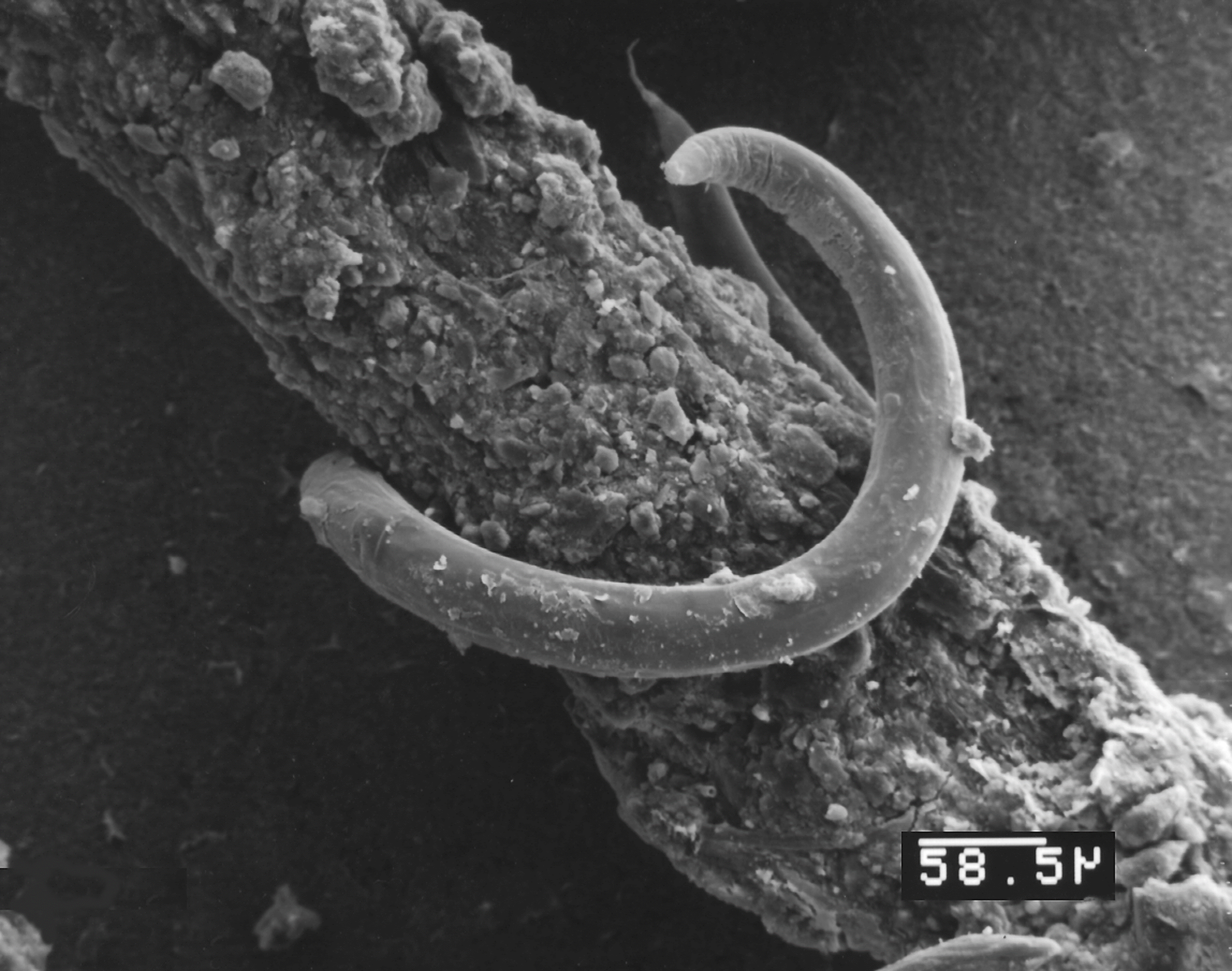
A nematode wrapped around a plant root. Photo Credit: Mara Johnson, Scow Lab
Historically sidelined in broader biodiversity conservation efforts, soil biodiversity is now gaining recognition. Restoring, maintaining and enhancing soil health and biodiversity is a target in the new Kunming-Montreal Global Biodiversity Framework, while protecting soil biodiversity is a key deliverable of the EU biodiversity strategy for 2030 and a major focus of the proposed EU Soil Health Law. In the USA, a recent report out of California’s Department of Food and Agriculture –: Soil Biodiversity in California Agriculture: Framework and Indicators for Soil Health Assessment –builds on the momentum around healthy soils by being the first US report to outline a strategy for how to measure and monitor soil biodiversity in agroecosystems. The report also outlines recommendations for how to integrate soil biodiversity into existing and future state programs.
The report, a collaborative effort among California soil scientists and microbiologists, addresses the challenge of selecting appropriate soil biodiversity indicators and methods, and proposes a versatile framework attuned to stakeholder input and expert insights. Inclusion of four example “use-cases” in the report demonstrates the adaptability of the framework, with recommendations for how to integrate soil biodiversity monitoring into established soil health and conservation initiatives. The report concludes by recommending that monitoring of soil be included in the California’s Healthy Soil programs, and expanded to other state and federal initiatives such as the 30x30 Biodiversity Initiative - a global initiative to conserve 30 percent of the globe’s lands and coastal waters by 2030.
Confronting simultaneous crises in biodiversity loss, climate change, and public health by building on the synergy between human health and soil health can lead to creative solutions. By promoting sustainable land management, embracing the principles of agroecology, and elevating belowground biodiversity to its deserved prominence, we can ensure the preservation and regeneration of our soils. For soil to continue to play roles in providing essential ecosystem services, it is crucial that we recognize and preserve life belowground and ensure that our healthy, living soils get the protection they deserve.

Summary of the proposed Indicator Selection Framework (ISF) to select soil biodiversity indicators for a wide range of purposes
Earthworms as drivers of global food production
By Steven Fonte, Colorado State University

Earthworms serve an important role in processing and restructuring of soils and are considered as important indicators of soil health. They are also known to benefit plant growth by feeding on decaying plant material and incorporating surface residues (plant material left on the field after harvest) in the soil. In this way, earthworms help to release nutrients (mainly nitrogen) making them available for uptake by growing plants. Earthworms also form extensive networks of tunnels belowground and their castings (excrement) turn into highly stable soil aggregates, making them key soil ecosystem engineers. These engineering activities can drastically improve water infiltration, thus helping soils to capture and store rainfall for use by plants and protecting soils against erosion. Along with their effects on plant growth and soil structure, earthworms interact with other soil organisms in complex ways, and in many cases can help plants defend against pathogens. Despite the range of ways that earthworms impact soils and plant growth, the contribution of earthworms to agricultural production remains poorly understood. In our recent study, we aimed to fill this knowledge gap by quantifying the global impact earthworms have on agricultural production.

To gauge their impact, we leveraged findings from a previous meta-analysis quantifying the effects of earthworms on plant growth across a range of experiments conducted in varying soil types, management regimes, crop types, and with a gradient of densities of earthworms. We then combined global data layers (i.e., maps) of soils, fertilizer management, and crop yields, along with a recent map of earthworm abundance and diversity to estimate the impact of earthworms on global agricultural production. We focused on common grains (corn, rice, wheat, barely) and legumes (e.g., dry beans, garbanzos), as these were the crops most commonly considered in the meta-analysis.
Our study estimated that earthworms contribute to roughly 6.5% of global grain production and 2.3% of global legume production. This is equivalent to 140 million metric tons of food each year, which puts earthworms on par with Russia or Brazil in terms of their contribution to the global grain supply! Earthworm contributions were especially notable in places that have reported large earthworm populations, such as Europe and East Asia, indicating that more worms translate into a greater impact on crop yield. Additionally, we found their contributions to be quite important in regions with more acidic soils and lower fertilizer inputs rate, such as Sub-Saharan Africa, where earthworms were estimated to contribute as much as 10% of annual grain production. And we suspect these numbers might be an underestimate since the maps of earthworm abundance for much of the Global South were based on limited data and may not accurately reflect earthworm populations in these regions. This is the first study to our knowledge that has sought to estimate the contribution of a beneficial soil organism to global agricultural production. In summary, our research highlights the need to better understand the role of soil biodiversity in agricultural systems and then apply this knowledge toward the improved management of soils for achieving multiple sustainability goals.

In highlighting the potential value of soil organisms to global agricultural production, we hope that our findings motivate farmers and policy makers to further invest in soils and gain a true appreciation for the biodiversity beneath our feet. And the next time you are working in your garden or on your farm and come across an earthworm, you might think twice about rototilling your soils, and perhaps leave some mulch or manure for them to feed on.